
Description:
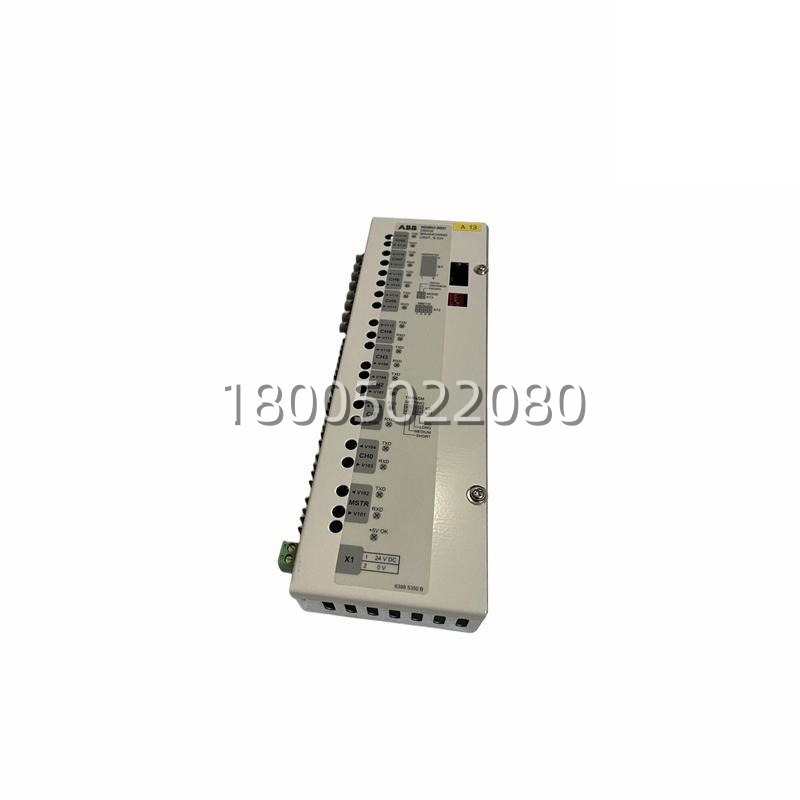
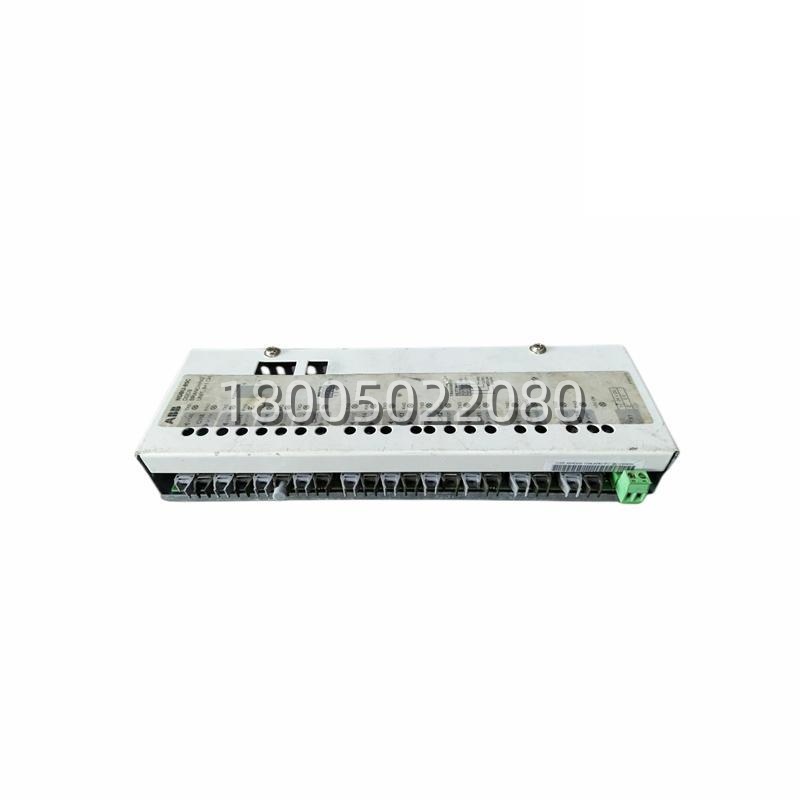
The ABB NDBU-85C (Order Number: 3BSE018426R1) is a DDCS (Distributed Drive Communication System) Fiber-Optic Branching Unit / Star Coupler manufactured by ABB for use in ABB ACS600, ACS800, ACS1000, and DCS800 drive systems, as well as Advant OCS / 800xA interconnected drive networks. It receives one incoming DDCS fiber-optic signal from the master controller or parent unit and passively distributes identical copies to up to eight downstream slave nodes (drive control boards, I/O stations, or subordinate branching units) via 5 Mbps POF (plastic optical fiber) or 10 Mbps HCS (hard-clad silica) ports, plus one auxiliary 10 Mbps channel—enabling star-topology expansion of the DDCS network with complete electrical isolation and zero signal latency.
Application Scenarios:
Consider a 5 MW steel-rolling main drive line where a single ABB ACS800 master drive communicates via DDCS fiber with three subordinate inverter sections, two excitation boards, and a local I/O node—all originally daisy-chained in a vulnerable point-to-point topology. After a fiber-crimp incident caused a cascade communication loss across the entire line, the plant retrofits the DDCS network to a star topology using the ABB NDBU-85C (3BSE018426R1). The master APBU / RDCO fiber plugs into the NDBU-85C’s INPUT port; eight slave fibers radiate from the CH1–CH8 outputs to each drive’s AMCx card. The branching unit’s DIP switches are set to match the fiber length class (SHORT / MEDIUM / LONG), and the front-panel LEDs confirm optical link integrity on each branch. The result: a single fiber fault now affects only its own branch without bringing down the rest of the drive network, and the passive design introduces no new points of failure or jitter. The maintenance team values the immediate visual confirmation of link health during start-up—turning invisible fiber problems into clearly identifiable channel states.
Parameter:
| Main Parameters | Value/Description |
|---|---|
| Product Model | NDBU-85C (Order No. 3BSE018426R1 / Art. No. 64001507) |
| Manufacturer | ABB (ABB Drives / Motion Control Division) |
| Product Category | DDCS Fiber-Optic Branching Unit / Star Coupler (Passive Optical Distributor) |
| System Compatibility | ABB ACS600, ACS800, ACS1000, ACS6000, DCS800, Advant OCS with DDCS links |
| Channel Configuration | 1 × DDCS Input (Master), 8 × 5 Mbps DDCS Outputs (CH1–CH8), 1 × 10 Mbps Aux/Monitor port |
| Fiber Media Supported | POF (Plastic Optical Fiber, ≤30 m @ 5 Mbps), HCS (Hard-Clad Silica, ≤200 m @ 10 Mbps) |
| Connector Type | SMA 905 (standard for ABB DDCS POF/HCS fibers) |
| Address / Config | DIP switches S1 for unit addressing (in cascaded topologies), S2 for per-channel optical power setting (SHORT / MEDIUM / LONG) |
| Power Requirement | Typically none — passive optical splitting; some C-variant versions accept 24 V DC for LED diagnostics only |
| Diagnostics | Per-channel green LED (lights when valid optical signal present on corresponding branch) |
| Electrical Isolation | Complete galvanic isolation via fiber optics — immune to ground loops & EMI from thyristor switching |
| Mounting Method | 35 mm DIN rail (EN 60715) or panel-mount in drive control cabinet |
| Operating Temperature | 0 °C to +50 °C (some refs cite –20 °C to +60 °C for industrial variants) |
| Dimensions (approx.) | 263 × 95 × 55 mm (L × H × W), Weight ≈ 0.70–0.95 kg |
| Certifications | CE, cULus, IEC 61131-2 (cabinet-install only, IP20) |
Technical Principles and Innovative Values:
- Innovation Point 1: Passive Optical Signal Replication with Zero Latency. The ABB NDBU-85C uses optical coupling elements to split the incoming DDCS light signal into up to eight identical copies—no regeneration, no buffering, no added jitter. This preserves the deterministic < 1 ms DDCS cycle time essential for multi-drive coordinated control and regenerative load sharing.
- Innovation Point 2: Star Topology That Eliminates Cascade Failure Risk. Traditional DDCS point-to-point or daisy chains mean one broken fiber kills the downstream nodes. By deploying the NDBU-85C, each drive or I/O node gets its own home-run fiber from the star center. A damaged fiber to one inverter does not interrupt communication with the others—dramatically improving drive-array availability in process-critical lines.
- Innovation Point 3: DIP-Switch-Selectable Optical Power Classes & Per-Channel LEDs. The C-version adds configurable transmit-power levels (Short / Medium / Long) to optimize link margin for different fiber types and distances, plus individual channel LEDs that confirm optical presence. Technicians can instantly spot which branch has lost its signal—without a fiber scope or laptop—cutting mean time to repair (MTTR) during unplanned outages.


