Product Overview
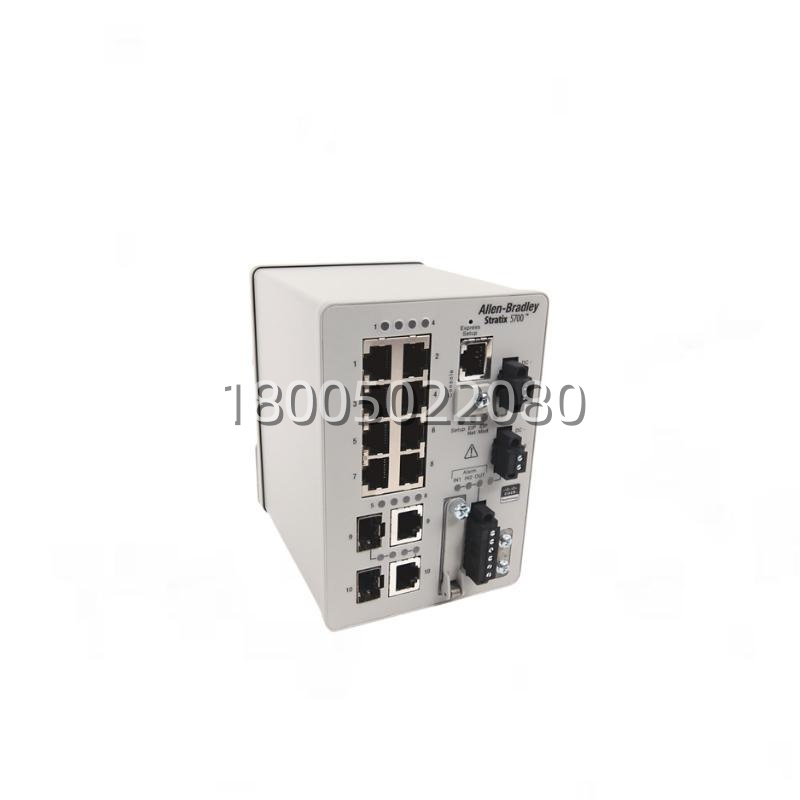
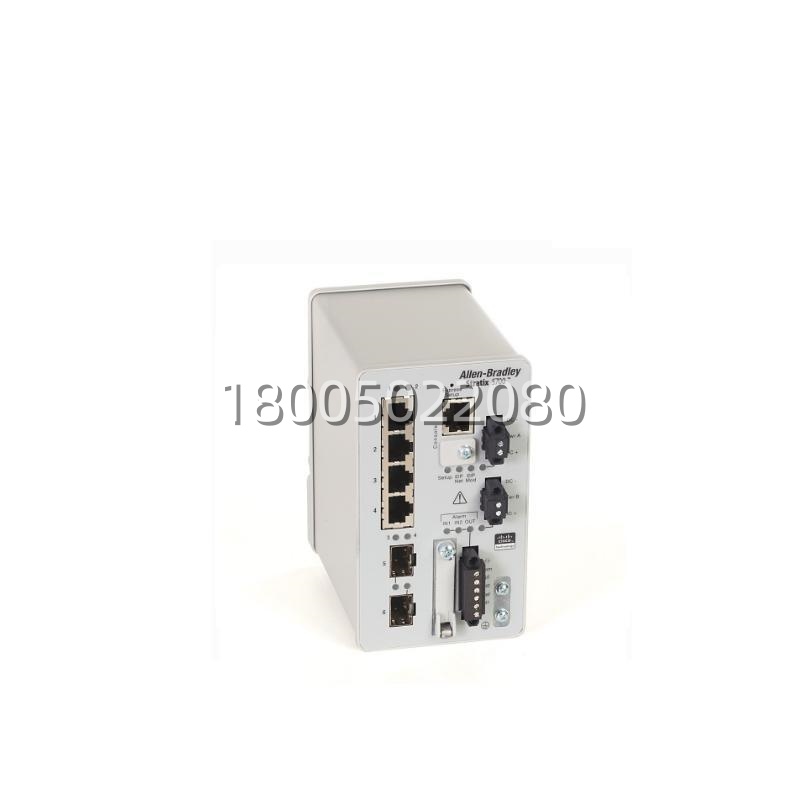
The Allen-Bradley 1783-BMS06SA is an entry-configuration member of Rockwell Automation’s Stratix 5700 industrial Ethernet switch family—a Cisco IOS-based, Layer 2 managed 6-port switch purpose-built for machine-level and cell-level EtherNet/IP networks inside CompactLogix and ControlLogix architectures. OEM-branded from the Cisco Catalyst IE 2000 platform, the 1783-BMS06SA brings enterprise-grade switching intelligence (Cisco IOS command-line plus Rockwell’s graphical Device Manager web UI) into a fanless, DIN-rail-mountable, -40 to +60 °C industrial package that shrugs off vibration, shock, and electrical noise on the plant floor. Port-wise, the switch delivers four 10/100 Base-TX Fast Ethernet copper RJ-45 ports for device-level connections—typically VFDs, point I/O, HMIs, cameras, and barcode readers—plus two 10/100/1000 Base-T/Base-X combo ports (RJ-45 or SFP) that serve as uplinks to the cell supervisor, a Stratix 8000/8300 core, or a distribution ring. The “SA” suffix places this SKU in the non-PoE, standard-hardware tier of the 5700 lineup: no Power-over-Ethernet budget, no expansion module bay, but full Layer 2 managed feature set including VLANs (up to 256), IGMP snooping, Rapid Spanning Tree, port mirroring, LLDP, CIP Sync (IEEE 1588 PTP) readiness, and Rockwell’s CIP-diagnostics integration that surfaces port-level health into Studio 5000 / FactoryTalk Linx without SSH-ing into the switch.Physically, the 1783-BMS06SA measures 78 × 132 × 117 mm (H × W × D), weighs ~620 g, and draws 6.4 W typical from a 24 V DC nominal supply (18–32 V DC input range, 2 A max inrush), with redundant DC input terminals for resilience. The housing is IP30-rated when installed (vented top/bottom, side panels sealed), and the switch carries CE, cULus, ATEX/IECEx Class I Division 2 Groups A-D, IEC 61800-3 (drive-bay immunity), IEEE 1613 (substation), and NEMA TS2 (traffic-control) agency marks—meaning the same 1783-BMS06SA that lives in a conveyor-cell panel can also be specified for water-treatment substations, solar-inverter yards, and rail-side cabinets without re-certifying the enclosure. From a system role perspective, the 1783-BMS06SA is the “machine-cell switch” of choice: put one on every packaging machine, palletizer, or process skid, land 4 FE devices on the downlinks, uplink the two Gig combos (one active, one standby or ring) to the area distribution, and the cell stays deterministic, diagnosable, and Cisco-familiar without jumping to the larger 1783-BMS10CA (10-port) or the modular Stratix 5700/8000 tiers.
Technical Specifications
| Parameter Name | Parameter Value |
|---|---|
| Product Model | 1783-BMS06SA |
| Manufacturer | Rockwell Automation (Allen-Bradley), Cisco OEM (IE 2000 based) |
| Product Type | Managed Industrial Ethernet Switch, Layer 2 |
| Total Ports | 6: 4×10/100 Base-TX RJ-45 + 2×10/100/1000 Combo (RJ-45 or SFP) |
| Switching Capacity | 5.6 Gbps (non-blocking) |
| Forwarding Rate | 4.2 Mpps |
| VLAN Support | Up to 256 VLANs (802.1Q) |
| Management | Cisco IOS CLI + Web GUI (Stratix Device Manager) + SNMP v1/v2c/v3 |
| Time Sync | CIP Sync / IEEE 1588 PTP supported |
| Input Voltage | 18–32 V DC (24 V DC nominal), redundant DC-in terminals |
| Power Consumption | 6.4 W typical / 13 W max |
| Operating Temp | -40 … +60 °C (-40 … +140 °F) |
| Dimensions (H × W × D) | 78 × 132 × 117 mm (3.07 × 5.20 × 4.61 in) |
| Mounting | 35 mm DIN rail (top-hat) or panel mount |
| Ingress Protection | IP30 (when installed in cabinet) |
| Certifications | CE, cULus, ATEX/IECEx Cl I Div 2 A-D, IEC 61800-3, IEEE 1613, NEMA TS2 |
Main Features and Advantages
Cisco IOS under the hood with Rockwell-facing UX on top. The 1783-BMS06SA runs genuine Cisco IOS—the same CLI that network admins know from enterprise Catalyst—but Rockwell layers a Stratix Device Manager web UI on top that maps port status, MAC tables, and errors into EtherNet/IP-native terminology. For the controls engineer who doesn’t live in show interface counters, the web UI displays “Port 1: Connected to VFD-101, 100 Mbps FDX, CRC errors: 0” without requiring a CCNA. For the IT-side network team, the 1783-BMS06SA is just another Cisco neighbor in CDP/LLDP, so the plant-network documentation stays consistent. This dual-audience design is the Stratix 5700 family’s core win, and the 1783-BMS06SA carries it at the lowest port-count entry point.4×FE downlinks + 2×Gig combos in a fanless DIN package. Most industrial “5-port unmanaged” switches give you 5×FE and stop there—no uplink headroom, no management, no diagnostics. The 1783-BMS06SA gives four FE ports for the machine devices (VFDs, Point I/O, HMI, safety devices) and two Gigabit combo ports for uplink. The combo means each Gig port can be RJ-45 copper (cheap, fine for same-cabinet) or SFP fiber (LC, for reaching the MCC-room distribution across the yard). In a ring topology, one combo is the active uplink, the other is the ring-return—pair two 1783-BMS06SA units across a small cell and you get a 2-switch ring with Rapid STP or REP (Resilient Ethernet Protocol, Cisco proprietary) converging sub-second.CIP Sync (IEEE 1588 PTP) and EtherNet/IP QoS. Motion and high-speed coordinated drive applications on EtherNet/IP benefit from sub-microsecond clock alignment across the network; the 1783-BMS06SA hardware timestamps PTP frames and works with a Stratix 8000/8300 or an IE-3000/4000 grandmaster to distribute CIP Sync through the cell. Even without a grandmaster, the switch honors 802.1p CoS and DSCP markings that Rockwell controllers and drives emit, so motion traffic gets priority over HMI polling and camera video on the same FE link. For machine builders who’ve fought “my VFD jitters when the camera uploads” battles, the 1783-BMS06SA solves it at the port level without deep Cisco knowledge.Rockwell Studio/FactoryTalk integration. The 1783-BMS06SA advertises itself via CIP over EtherNet/IP, meaning Studio 5000 and FactoryTalk Linx can discover the switch, read port-status tags into the PLC data table, and drive HMI alarms on “port 3 link down” or “CRC error threshold exceeded”—no SNMP OID mapping required. For plants standardizing on Rockwell, this is the differentiator versus a third-party Hirschmann or Moxa switch that needs an AOI to interrogate. The 1783-BMS06SA becomes a first-class node in the Asset Centre inventory too, pulling firmware revision and serial-number fields automatically.Ruggedized for panel-floor reality. Fanless means no fan to seize in dusty air; the 1783-BMS06SA convection-cools through the top/bottom vents and side fins. The 18–32 V DC input range tolerates the 24 V rail sag that happens when a cabinet’s main 24 V PSU is near load limit, and the redundant DC-in terminals let you land two feeds (e.g., primary 24 V + UPS-backed 24 V) so a single feeder trip doesn’t dark the switch. At 78 mm tall it tucks onto a 35 mm DIN rail between a CompactLogix and a 1769-IF8 analog card. The -40 °C cold-start rating means freezer-warehouse and outdoor-substation skids don’t need a heated enclosure for the switch itself, though the cabinet still needs spec’d accordingly.