
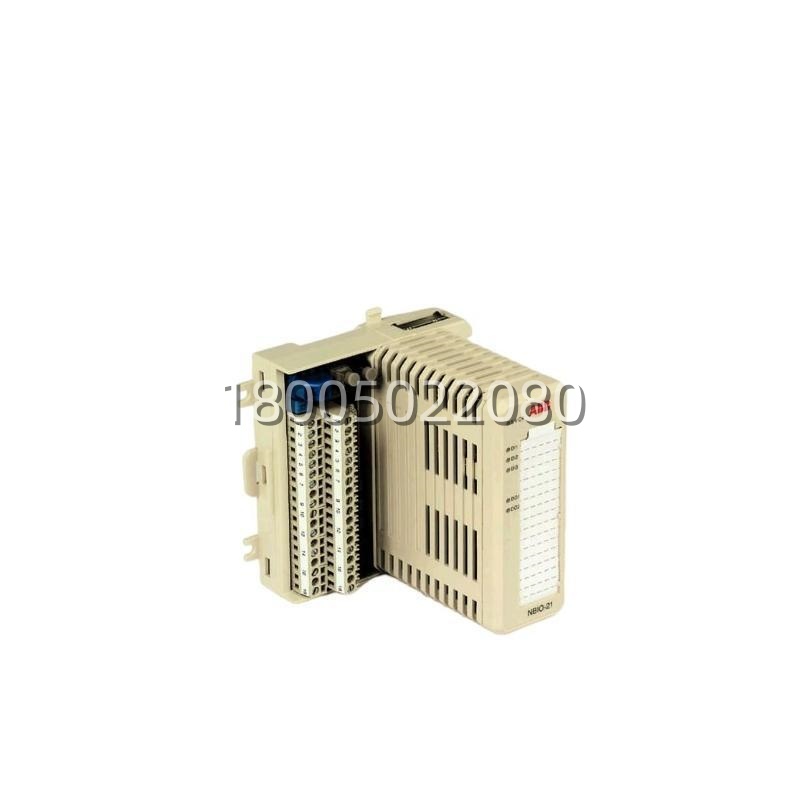
Description:
The ABB NBIO-21CU (also written NBIO21CU) is an Analog Input/Output Unit within ABB’s S800 I/O family, designed for use with Symphony Plus, Freelance 800F (AC 800F), and Advant OCS systems via appropriate interface modules (CI854A, CI867, etc.). It provides eight independent analog input channels (typically 4–20 mA, 0–20 mA, ±10 V DC — jumper or software selectable per revision) and four analog output channels (4–20 mA or 0–10 V DC), all with 12/16-bit resolution and galvanic isolation between field-side and system backplane. The module is housed in the standard S800 I/O terminal base (TU8xx series) and draws 24 V DC auxiliary power from the terminal base, making it a compact, hot-swappable analog interface for continuous-process measurement and control — temperature, pressure, flow, level, and position feedback loops.
Application Scenarios:
Picture a petrochemical distillation column where the original analog input card feeding column-top temperature (7 × RTD-transmitter 4–20 mA signals) and reflux-flow setpoint (1 × AO to the control valve positioner) begins showing frozen values on two AI channels — traced to a failed A/D multiplexer after 14 years. The DCS engineer selects the ABB NBIO-21CU as the direct replacement. After a LOTO check, the old module is unlatched from its TU805 terminal base (field wiring stays on the base — no re-termination), and a new NBIO-21CU is clicked into place. The system automatically recognizes the module type via the backplane PROM, the green PWR and RUN LEDs illuminate, and within the next scan cycle all eight temperature and flow values return live to the operator graphics. The single analog output driving the reflux valve is re-verified via a manual output test from the DCS. Total swap time: under 3 minutes, zero impact on the running process. The key pain point solved: a hot-swappable, form-fit analog I/O module that preserves all field wiring and DCS addressing, restoring measurement fidelity and loop control instantly in continuous-process applications.
Parameter:
| Main Parameters | Value/Description |
|---|---|
| Product Model | NBIO-21CU (NBIO21CU) |
| Manufacturer | ABB (Sweden / Switzerland) |
| Product Category | Analog Input / Output Module (S800 I/O Family) |
| System Compatibility | ABB Symphony Plus (S800 I/O), Freelance 800F (AC 800F), Advant OCS via CI854A / CI867 / IMDSI / IMCISxx interfaces |
| Analog Inputs (AI) | 8 × channels, individually configurable: 4–20 mA, 0–20 mA, ±10 V DC, 0–10 V DC (resolution 12–16 bit; accuracy ±0.1–0.2 % FS) |
| Analog Outputs (AO) | 4 × channels: 4–20 mA (default) or 0–10 V DC (jumper selectable on many revisions); 12-bit D/A, drive capacity ≥ 500 Ω @ 20 mA |
| Input Impedance (AI) | ≈ 250 Ω (current mode) / > 100 kΩ (voltage mode) |
| Isolation | ≥ 1.5 kV AC channel-group-to-backplane & channel-to-channel (group-wise) galvanic isolation |
| Supply Voltage | 24 V DC (from S800 terminal base TU8xx; typ. 70–120 mA @ 24 V DC) |
| Indicators | PWR (green), RUN/Comm (green), per-channel Status LED (yellow — reflects input > 2 mA or output active) |
| Process Alarms | Low / High / Low-Low / High-High configurable per AI channel; broken-sensor (open-loop) detection on 4–20 mA inputs |
| Mounting | Plugs into S800 terminal base (e.g., TU805, TU810, TU813) on 35 mm DIN rail; hot-swappable |
| Operating Temp. | -20 °C to +60 °C (storage: -40 °C to +85 °C); 5–95 % RH non-condensing |
| Certifications | CE, UL / cULus, FM (Div. 2 optional), ATEX / IECEx (selected versions), RoHS, IEC 61131-2 |
Technical Principles and Innovative Values:
The NBIO-21CU is a process-grade analog interface — not a generic data-acquisition card — qualified for continuous-operation in classified process areas.
- Innovation Point 1: Live-Zero Broken-Sensor Detection on 4–20 mA Inputs. The NBIO-21CU can be configured to flag a “Sensor Break / Wire Break” alarm if the measured current falls below ~3.6 mA (configurable threshold), and a “Low Signal” or “High Signal” if process values exceed limits. This lets the control system distinguish between a true low-flow condition (e.g., 3.8 mA = 0 %) and a failed transmitter or open circuit — a critical distinction for safety and asset availability in SIL-rated or EPA-regulated processes.
- Innovation Point 2: Backplane-Powered with No External Aux Wiring on the I/O Side. The NBIO-21CU draws its operating power and the AO loop excitation (where loop-powered) from the 24 V DC supplied through the S800 terminal base. Field wiring is confined to the removable terminal block on the TU base — the module itself has no separate power terminals. This reduces panel wiring, eliminates polarity errors on the module, and makes hot-swap replacement truly tool-minimal.
- Innovation Point 3: Per-Channel Software Selectability Reducing Spare-SKU Count. Although the NBIO-21CU has fixed hardware (8 AI + 4 AO), each AI channel can be independently assigned as current or voltage in the engineering tool without changing jumpers on the module. Plants can standardize on a single analog I/O spare (the NBIO-21CU) for mixed voltage/current analog-input needs — only the configuration download differs — simplifying obsolescence planning and spare-holding cost.
Application Cases and Industry Value:
- Case 1 – Oil Refinery Crude-Unit Reboiler Temperature Loop Restoration (Middle East): A crude distillation unit’s bottom-reboiler temperature loop (4–20 mA from a thermowell transmitter) went stale — traced to a failed AI channel on an aging S500 analog card. The I/O was migrated to an S800 rack with a NBIO-21CU. The module was installed in an existing TU810 base, the original field wires transferred to the base’s screw terminals, and the DCS configuration mapped the 8 AI + 4 AO points. Loop check passed first time; the plant standardized the NBIO-21CU for all future analog-point additions across three process units, retiring five different legacy analog-card spares.
- Case 2 – Pharmaceutical Water-For-Injection (WFI) Skid Local I/O (Western Europe): A GMP WFI generation skid used a compact S800 I/O station with a NBIO-21CU reading conductivity (AI), temperature (AI), and driving the divert-valve positioner (AO). The module’s 16-bit resolution allowed the skid’s PLC to resolve conductivity changes down to 0.01 µS/cm — well within the pharmacopeia requirement. After 7 years of continuous steam-sanitization cycles in the warm MCC room, the NBIO-21CU showed no drift; the site’s validation team cited the module’s stable performance as a positive finding in the periodic re-qualification audit.


