
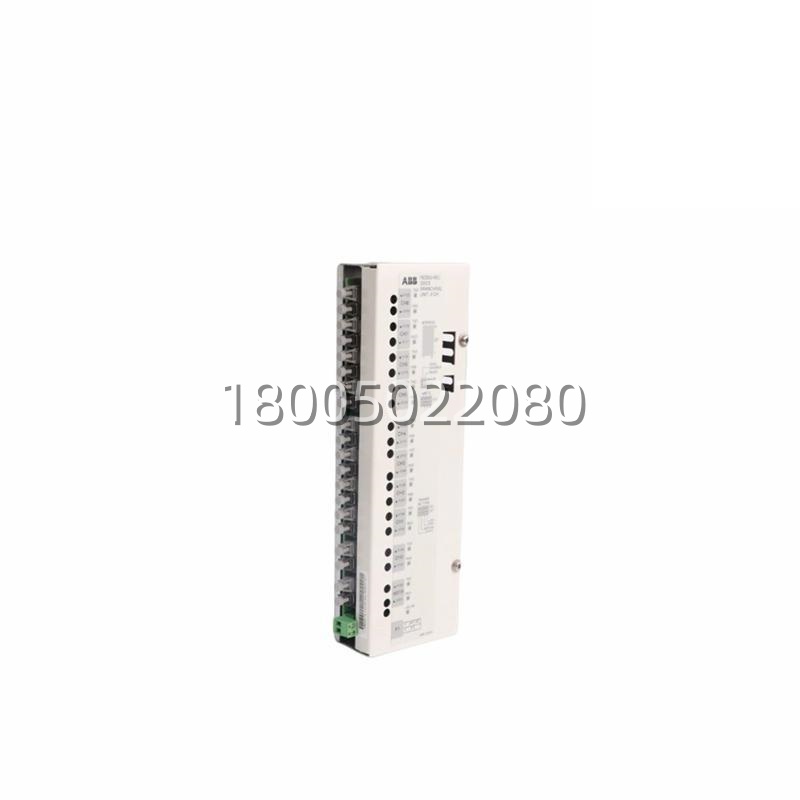
Description
The ABB NDBU-95C (3AFE64008366) is a Drive Bus Branching Unit / Optical Fiber Hub used in ABB’s Large Drives and Multidrive systems (ACS600, ACS800, ACS880, ACSM1 families) to distribute the DDCS (Distributed Drive Communication System) fiber-optic protocol signals from a master control board (typically the AINT-12 / RDCO / AMCx option board) to up to five slave inverter modules, I/O stations, or tap units. It receives one fiber-optic input and actively regenerates and fans it out to five fiber-optic outputs, allowing star-type topology expansion of the drive internal communication bus beyond the limit of a single direct fiber daisy-chain.
Application Scenarios
A 6 MW cement-mill main drive consisted of an ABB ACS800-104 multidrive with one rectifier and four inverter modules driving twin synchronous motors via a gearbox. The original configuration used direct fiber daisy-chaining from the AINT-12 board through all four inverters — which worked but made fault isolation difficult and exceeded the recommended fiber attenuation budget when a fifth monitoring node was added for a regenerative load-sharing card. The drive specialist inserted a ABB NDBU-95C 3AFE64008366 between the AINT-12 transmit port and the inverter receive ports: one input from the master, five outputs — four to the inverters and one spare for future expansion or a local DDCS monitor. The NDBU-95C actively repeated the DDCS telegrams, restoring signal integrity and providing individual fiber-run length independence. Post-installation, the drive’s built-in fiber-link diagnostic showed all nodes “Link OK” with improved margin. The commissioning engineer noted: “The NDBU-95C solved our fiber-budget problem and gave us a clean star topology. Now each inverter’s fiber can be unplugged individually for testing without breaking the rest of the chain — huge for troubleshooting on a live line during a slowdown.”
Parameter
| Main Parameters | Value/Description |
|---|---|
| Product Model | NDBU-95C (successor to NDBU-95 / NDBU-95B) |
| ABB Order / Article | 3AFE64008366 |
| Manufacturer | ABB (Large Drives & Systems — DDCS Accessory) |
| Product Category | DDCS Drive Bus Optical Branching Unit / Fiber-Optic Repeater-Hub |
| Input Ports | 1 × DDCS Fiber-Optic Input (typically 62.5/125 µm multi-mode, 650 nm / 850 nm wavelength) |
| Output Ports | 5 × DDCS Fiber-Optic Outputs (same specification as input — electrically regenerated) |
| Function | Receives serial DDCS telegrams, amplifies & retransmits to all 5 outputs (fan-out / star split) |
| Power Supply | 24 V DC (±10 %, typ. 100–200 mA), via 3-pin screw terminal or D-sub (version-dependent) |
| Indicators | PWR (green = 24 V present), Link / Activity LEDs per port (some versions: Input Activity + 5× Output Activity) |
| Fiber Connector Type | ABB DDCS standard round keyed connector (proprietary — mates with AINT / RDCO / RDCU / NDCO fiber pigtails) |
| Wavelength / Type | Compatible with ABB DDCS multi-mode fiber (62.5/125 µm or 50/125 µm GRIN), 650 nm (visible red) or 850 nm (IR) — auto-senses |
| Maximum Fiber Length (per leg) | Per DDCS spec — typically ≤ 50 m (multi-mode) for 650 nm; ≤ 100 m for 850 nm (follow drive manual Chap. 7) |
| Operating Temp. | 0 °C to +55 °C (32 °F to 131 °F); storage -40 °C to +85 °C |
| Mounting | 35 mm DIN rail (EN 50022) or panel-screw mount (flange holes on housing) |
| Dimensions (approx.) | 110 × 45 × 120 mm (H × W × D) |
| Standards | IEC 60950-1 (Safety), CE, RoHS |
| Compatibility | ACS600, ACS800-01/04/07/11/17/104, ACS880 (with DDCS fiber option), ACSM1 with RDCO-02/03 |
| Notes | NDBU-95C is backward-compatible with NDBU-95 / NDBU-95B — replaces them in spares planning |
Technical Principles and Innovative Values
The ABB NDBU-95C (3AFE64008366) is a purpose-built active hub for ABB’s proprietary DDCS drive communication protocol:
- Innovation Point 1 — Active Signal Regeneration (Not Passive Splitting): Unlike a passive optical splitter that attenuates signal strength by 3–10 dB per branch, the NDBU-95C receives the incoming optical pulse train, converts it to an electrical signal, reclocks it, and drives five independent optical transmitters. This restores full optical power to each output branch, extending allowable fiber length and permitting true star-topology expansion beyond the daisy-chain limit.
- Innovation Point 2 — DDCS Protocol Transparency: The unit is protocol-transparent — it repeats any DDCS telegram (drive parameter requests, process data cycles, diagnostic messages) without interpreting or modifying content. This means no firmware dependency and no configuration — plug it in, apply 24 V DC, and it works with any DDCS-capable master (AINT-12, RDCO-02/03, AMCx cards).
- Innovation Point 3 — Per-Port Activity LEDs for Rapid Fault Isolation: Input-activity and (on most versions) individual output-activity LEDs let technicians see at a glance whether the upstream DDCS source is transmitting and which branches are correctly reflecting the signal. Unplugging one suspect fiber no longer breaks the remainder of the ring/star — a major advantage over direct daisy-chaining through inverter modules.
- Innovation Point 4 — Industrial DIN-Rail Form Factor with 24 V DC Supply: The compact metal/plastic housing clips onto standard DIN rail next to the drive control cabinet’s fiber termination area. The 24 V DC supply can be sourced from the drive’s auxiliary supply or a separate UPS-backed PSU — a loss of 24 V extinguishes the PWR LED and the unit ceases repeating, which is detectable as a DDCS link loss by the master.


