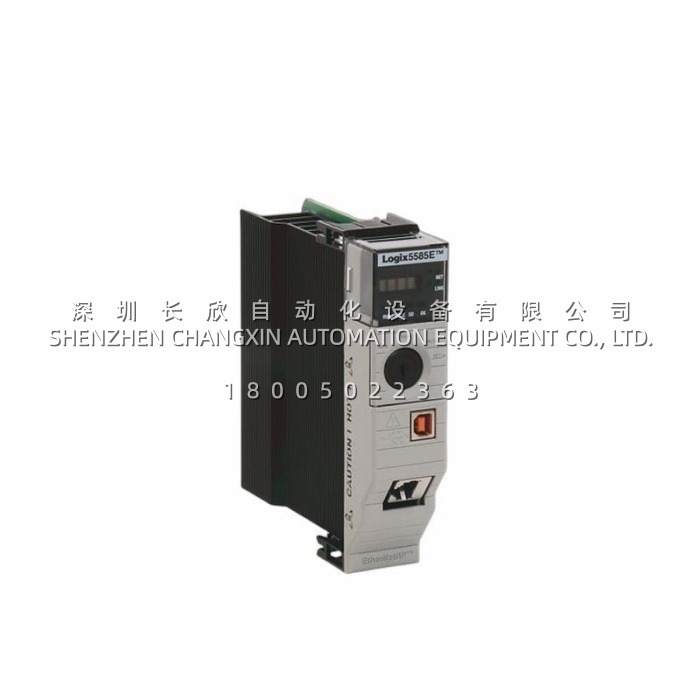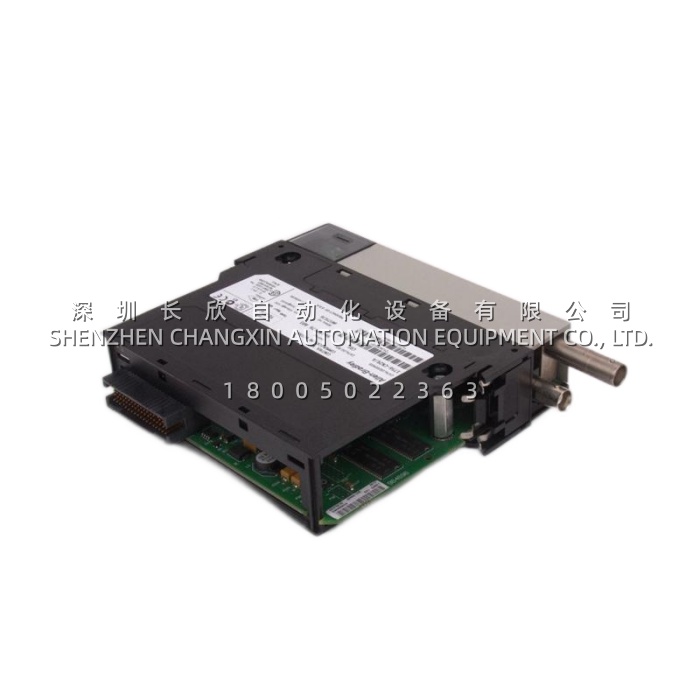
Application Scenarios
A food and beverage packaging facility experienced an unexpected processor fault on a ControlLogix system that had operated continuously for more than a decade. The line controlled multiple conveyor zones, filling valves, reject mechanisms, check weighers, and production data exchange with the plant MES. Because the application included extensive I/O configuration, produced-consumer tags, and validated safety interlocks, a full migration to a newer platform would have required program conversion, HMI changes, and additional production validation.The maintenance team installed a verified replacement 1756-L55M23 into the original chassis position. After confirming the controller revision, nonvolatile image, and I/O configuration, they restored the approved project and returned the line to production with the original control logic and device addressing intact. The 1756-L55M23 allowed the plant to avoid a disruptive platform migration while restoring system availability and preserving the validated automation program.
Parameter
| Main Parameters | Value/Description |
|---|---|
| Product Model | 1756-L55M23 |
| Manufacturer | Allen-Bradley / Rockwell Automation |
| Product Category | ControlLogix Logix5555 Processor / PAC |
| User / Logic Memory | 1.5 MB RAM |
| Integrated Nonvolatile Memory | 1.5 MB |
| I/O Memory | 208 KB |
| Maximum Digital I/O | 128,000 points |
| Maximum Analog I/O | 4,000 inputs / 2,000 outputs |
| Onboard Communication | One RS-232 port supporting DF1, DH-485, and ASCII |
| Programming Software | RSLogix 5000; legacy Studio 5000 compatibility depends on revision |
| Programming Languages | Ladder Logic, Structured Text, Function Block Diagram, Sequential Function Chart |
| Chassis Compatibility | 1756-A4, A7, A10, A13, and A17 chassis |
| Slot Requirement | One slot; normally installed in the leftmost controller position |
| Backplane Current | 1.23 A at 5.1 V DC |
| Additional Supply Current | 14 mA at 24 V DC |
| Power Dissipation | 5.6 W |
| Heat Dissipation | 19.1 BTU/hr |
| Enclosure Rating | Open style, IP20 |
| Operating Temperature | 0 °C to +60 °C |
| Isolation Voltage | 30 V continuous; RS-232 port tested at 707 V DC for 60 seconds |
| Replacement Battery | 1756-BA1 lithium battery |
| Serial Programming Cable | 1756-CP3 or 1747-CP3 |
| Conducted RF Immunity | IEC 61000-4-6: 10 V rms, 150 kHz to 80 MHz |
Technical Principles and Innovative Values
Innovation Point 1 – Integrated Memory ArchitectureThe 1756-L55M23 combines controller logic and integrated nonvolatile memory in one module. Compared with early 1756-L55 processors that required a separate memory board, this configuration reduces handling steps and simplifies controller service.Innovation Point 2 – Dual-Processor Control ArchitectureThe controller separates application execution from backplane management. While the main processor executes user logic, a dedicated backplane processor handles chassis communication, helping maintain system responsiveness even when the I/O tree expands.Innovation Point 3 – Logix Tag-Based Application ModelThe 1756-L55M23 supports the Logix5000 tag architecture, which organizes data using named variables rather than fixed register tables. This enables clearer program structure, reusable routines, and more maintainable legacy applications.Innovation Point 4 – Flexible MultitaskingThe processor supports continuous, periodic, and event tasks. This allows time-critical control logic, sequenced operations, and background calculations to be scheduled according to process priorities rather than executed in a single undifferentiated scan.Innovation Point 5 – Redundancy CompatibilityWhen paired with a matched 1756-L55M23, redundant ControlNet bridges, and a 1757-SRM redundancy module, the controller supports redundant ControlLogix configurations. This architecture improves availability in continuous-process and critical-infrastructure applications.Innovation Point 6 – Network Expansion Through Communication ModulesAlthough the 1756-L55M23 does not include onboard Ethernet, it supports EtherNet/IP, ControlNet, and DeviceNet through 1756 communication modules. This modular approach lets the system use only the networks required by the application.