roduct Overview
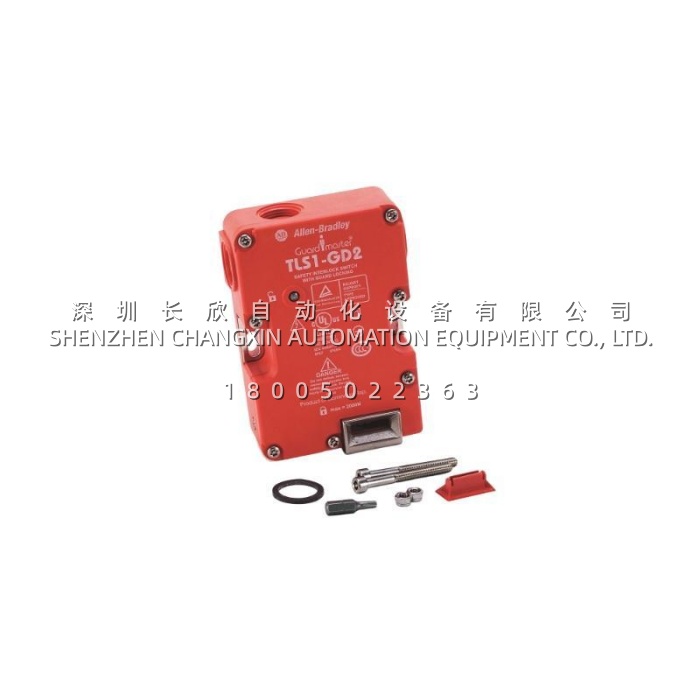
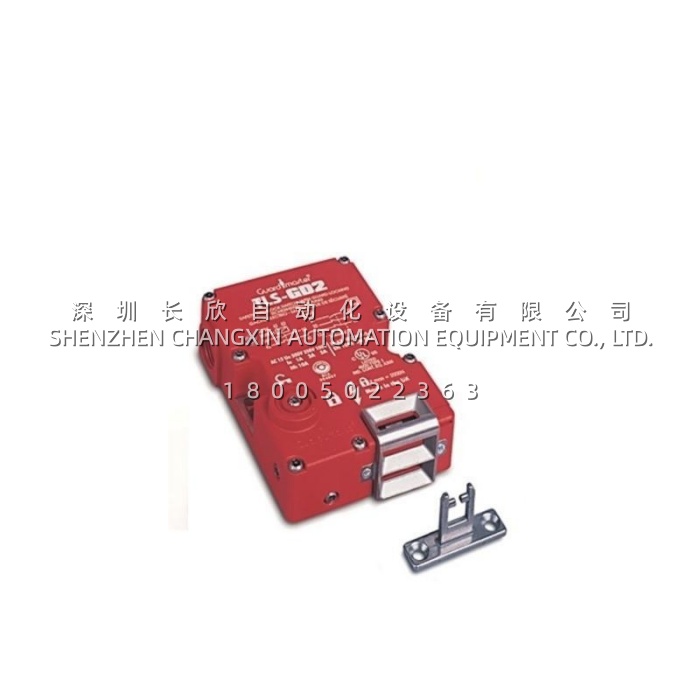
The Allen-Bradley 440G-T27181 is a solenoid-operated guard locking switch from the Rockwell Automation Guardmaster TLS-GD2 family, and it exists to answer one specific question on any hazardous machine: how do I prove that the guard cannot be opened until the danger is gone? Unlike a simple interlock switch, which only tells the control system that a door has been moved, the 440G-T27181 physically restrains the guard in the closed position with a locking bolt and only allows it to retract when the safety circuit removes power from the solenoid. This is the power-to-release, or quiescent current, principle, and it means that a wire break, a blown supply or a coil failure all produce the same outcome: the lock releases and the safety outputs report the guard as unsafe.Mechanically, the 440G-T27181 is a positive-mode, tongue-operated device. A stainless-steel actuator tongue mounted on the moving guard enters the switch head, and the internal bolt engages it with a holding force of 2000 N, roughly 450 lbf, so a determined operator cannot force the door open while the machine is still running. The head is rotatable and offers four possible key entry positions, which lets the same catalog number be fitted to left-hinged, right-hinged, sliding or lift-off guards without ordering a different switch.Electrically, the Allen-Bradley 440G-T27181 provides a redundant contact set: two positively guided normally closed safety contacts for the guard monitoring channel, one normally open auxiliary contact for status feedback to the PLC or HMI, and two normally closed solenoid monitoring contacts that verify the actual position of the lock bolt rather than merely the presence of a command. Housed in glass-filled plastic with an M20 conduit entry and a 1/2 in NPT adapter, rated IP66, IP67 and IP69K, and listed to ISO 14119 and IEC 60947-5-1, the 440G-T27181 is built for machine guarding duties in everything from dry assembly cells to high-pressure washdown food and pharmaceutical plants.
Technical Specifications
| Parameter Name | Parameter Value |
|---|---|
| Product Model | 440G-T27181 (Guardmaster TLS-GD2, TLS-3 GD2) |
| Manufacturer | Allen-Bradley (Rockwell Automation) |
| Product Type | Solenoid guard locking interlock switch, positive-mode tongue operated |
| Locking Principle | Power to release (quiescent current principle); lock bolt retracts when solenoid is de-energized |
| Solenoid Voltage | 24 V AC/DC, 50/60 Hz; solenoid power approx. 7 W |
| Holding Force (Fzh) | 2000 N (450 lbf) per EN/ISO 14119 |
| Safety Contacts | 2 normally closed, positively guided, break-before-make action |
| Auxiliary Contacts | 1 normally open for guard/lock status feedback |
| Solenoid Monitoring Contacts | 2 normally closed for lock bolt position verification |
| Contact Ratings | AC-15: 6 A at 125 V, 3 A at 230 V; DC-13: 2 A at 24 V; A600; thermal current 10 A |
| Actuator | Standard GD2 stainless-steel tongue; rotatable head with 4 key entry positions |
| Connection | M20 conduit entry with 1/2 in NPT adapter; screw terminals |
| Housing Material | Glass-filled plastic housing (PBT), red |
| Enclosure Rating | IP66, IP67, IP69K |
| Operating Temperature | -20 °C to +60 °C (-4 °F to +140 °F) |
| Mechanical Life | 1,000,000 operations minimum; B10d > 2 x 10⁶ operations at minimum load |
| Safety Classification | Type 2 interlocking device with guard locking and low coding per ISO 14119; suitable for PLd/PLe per ISO 13849-1 and SIL 2/SIL 3 per IEC 62061 depending on architecture |
| Certifications | CE for all applicable directives, cULus listed, TÜV certified, CCC, KC, EAC; conforms to EN 1088, EN ISO 14119, IEC 60947-5-1 |
| Physical Dimensions | Approx. 91 mm W x 126 mm H x 33 mm D; weight approx. 0.5 kg; mounting M5 at 1.4 N·m, lid screws 1.2 N·m, terminal screws 1.0 N·m |
Main Features and Advantages
Fail-safe power-to-release locking: The core design decision behind the Allen-Bradley 440G-T27181 is that the solenoid must be energized to unlock, so every credible single fault drives the system toward a safe state. Loss of the 24 V supply, a broken conductor, a failed coil or a tripped safety relay all allow the spring-loaded bolt to retract, and because the lock monitoring contacts report bolt position independently of the command, the control system sees the difference between “asked to lock” and “actually locked.”Locking force that resists real-world forcing: With 2000 N of holding force, the 440G-T27181 holds a guard closed against the kind of leverage an adult can apply to a door handle. This is what separates a guard locking switch from a plain interlock: the guard is not merely monitored, it is restrained, which matters on machines with long run-down times where opening the door three seconds after the stop command would still expose rotating parts.Redundant contacts for diagnoseable safety circuits: The 440G-T27181 gives the designer two positively guided NC safety contacts for the dual-channel guard monitoring circuit, an NO auxiliary for PLC feedback and status indication, and two NC solenoid contacts for verifying the bolt. That combination lets a safety PLC distinguish a door left open, a bolt that failed to engage and a genuine emergency stop request, which shortens fault finding considerably.Rotatable head and flexible mounting: Four possible key entry positions on a rotatable head mean the same Allen-Bradley 440G-T27181 can be fitted to a left-hand or right-hinged door, a sliding panel or a lift-off cover, reducing the number of variants a plant needs to stock and simplifying the mechanical design of new guards.Built for washdown and harsh duty: The IP69K rating and glass-filled plastic housing let the 440G-T27181 survive high-pressure, high-temperature cleaning with caustic agents, which is why it is routinely specified on food, beverage and pharmaceutical equipment. The rotatable head also tolerates the door misalignment and sag that develop over years of service.