Description:
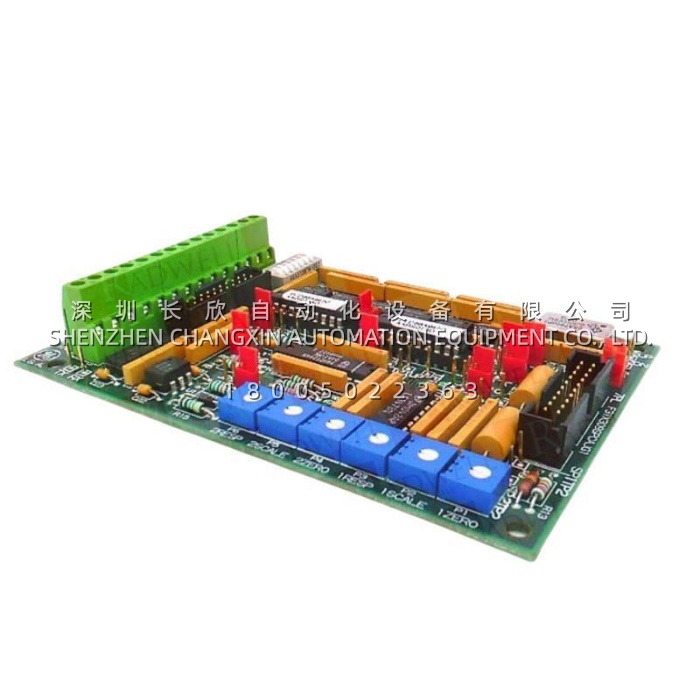
The 531X309SPCAJG1 is a Signal Processor Card (SPC / SPCA) manufactured by General Electric (GE Industrial Control Systems, now GE Vernova) as part of the 531X family of plug-in boards for legacy GE drive and exciter cabinets. It is the signal front-end of the drive control chain, sitting between field devices — encoders, tachometers, current and voltage transducers, LVDT valve position sensors — and the drive’s main control card.In plain terms, the 531X309SPCAJG1 takes raw, noisy plant signals and turns them into clean, standardised references the control card can act on. It handles three jobs: speed feedback interfacing (quadrature encoder and DC tachometer signals), reference conversion (three current reference signals plus one voltage level converted into a voltage reference), and RS-422 serial signal processing for communication with the motor control processor. Everything is configured physically — jumpers, DIP switches and trimming potentiometers — so the 531X309SPCAJG1 carries no firmware to manage and no software licence to renew.One point buyers should know before ordering: this board is documented across several GE platforms. Channel and manual references place it in the DC2000 digital adjustable speed drive (paired with the SDCC drive control card), in EX2000 excitation cabinets, in AC2000 drives, and in the Speedtronic Mark V servo subsystem alongside the 531X301DCCAFG2 (DCCA) servo main control. The role is consistent in every case — signal conditioning and feedback pre-processing — but the terminal assignment and calibration constants differ by rack. Match the board silkscreen (often marked F31X309SPCAJG1) and the JG1 revision suffix against your cabinet before purchase.
Application Scenarios:
Picture a steel mill’s ageing DC2000 drive on a roller table. The line has run for twenty-five years, and one morning the speed loop starts hunting — motor speed drifts, the drive throws intermittent encoder faults, and product spacing goes inconsistent. The mechanical side checks out, the motor is fine, and the SDCC control card is receiving data it cannot trust. In the majority of these events the culprit is the signal front-end: a drifted gain stage, a noisy tachometer input, or contaminated encoder cabling feeding the 531X309SPCAJG1. Because this board owns every feedback signal entering the control loop, it is the first place experienced technicians look when speed becomes unstable rather than simply lost.The second scenario is a combined-cycle plant running Speedtronic Mark V. The servo subsystem that positions gas and steam control valves depends on LVDT feedback, speed pulses, current/voltage sampling and a 4–20 mA command from the plant DCS. The 531X309SPCAJG1 filters, amplifies and digitises all of it before the DCCA main control performs closed-loop calculation. When a valve oscillates or “hunts” around its setpoint, the cause is frequently not the servo valve or the hydraulics — it is noise and drift in the conditioning stage, and the 531X309SPCAJG1 is where that noise is either rejected or allowed through.These scenarios define the pain point the 531X309SPCAJG1 addresses: it is a low-cost board that stands between a healthy mechanical asset and a control system that no longer trusts its own measurements. GE has discontinued production, so plants that depend on these drives face a choice — hold verified spares, or contemplate replacing an entire drive or servo cabinet because of a single obsolete card.
Parameter:
| Main Parameters | Value / Description |
|---|---|
| Product Model | 531X309SPCAJG1 (silkscreen often F31X309SPCAJG1; SPCA = Signal Processor Card) |
| Manufacturer | General Electric — GE Industrial Control Systems / GE Vernova |
| Product Category | Signal processor card / digital signal conditioning board, plug-in for 531X drive and exciter racks |
| Compatible Systems | GE DC2000 digital adjustable speed drive; EX2000 excitation; AC2000; Speedtronic Mark V servo and DC300 drive racks — confirm against cabinet documentation |
| Companion Control Card | SDCC Drive Control Card (e.g., DS200SDCCG1AGD); in Mark V servo racks, 531X301DCCAFG2 (DCCA) main control |
| Speed Feedback Inputs | Differential quadrature encoder channels (A/B/Z) and DC tachometer generator input; encoder supply 5 V or 15 V selectable by jumper — provides speed and direction to the control loop |
| Analogue Channels | Two configurable channels for current and voltage signal processing; LVDT, 4–20 mA command and transducer inputs conditioned in Mark V servo builds |
| Reference Conversion | Three current reference signals plus one voltage level converted to a unified voltage reference — removes the need for external signal conditioners |
| Serial Communication | One RS-422 port, isolated, balanced differential signalling; supports data exchange with the motor control processor and, in documented builds, Modbus RTU |
| Network Capability | LAN control board interface for integration into distributed drive architectures |
| Configuration Method | Hardware only — on-board DIP switches, jumpers and precision trimming potentiometers set filtering, gain, offset, input type and channel enable; no firmware or software configuration |
| Power Supply | From rack backplane; regulated rails including +5 V and ±15 V (24 V DC input on some builds); typical consumption around 5 W |
| Field Connections | Screw terminal strips for encoder, tachometer and I/O wiring, with retention-friendly design; ribbon interface to the companion control card |
| Environmental | Operating roughly −20 °C to +70 °C (build-dependent; some variants −40 °C to +85 °C, AC2000 builds 0 °C to +55 °C); storage −40 °C to +85 °C; 5 %–95 % humidity non-condensing; IP20, cabinet installation required; conformal-coated PCB on industrial builds |
| Documentation / Status | Series manual GEH-6005; Mark V servo reference GEI-100024A. Obsolete — original production discontinued, supplied as new surplus, tested pull-out or refurbished units |
Technical Principles and Innovative Values:
- Innovation Point 1 — Differential signalling where it matters most: The 531X309SPCAJG1 accepts encoder feedback as differential quadrature A/B/Z rather than single-ended pulses, and carries RS-422 as a balanced differential pair. In a cabinet sharing space with thyristor bridges, contactors and excitation equipment, common-mode noise is the dominant failure source; differential reception rejects it at the physical layer instead of trying to filter it out later in software.
- Innovation Point 2 — Reference conversion that removes hardware from the loop: By converting three current references plus one voltage level into a single standardised voltage reference on-board, the 531X309SPCAJG1 eliminates the external signal conditioners, scaling cards and isolation amplifiers that would otherwise sit between the command source and the control card. Fewer devices in the chain means fewer calibration points, fewer failure modes and a shorter fault-trace path.
- Innovation Point 3 — Hardware-configured, therefore immune to software obsolescence: Gain, zero offset, filter time constant, input type and channel enable are set with jumpers, DIP switches and precision potentiometers. The 531X309SPCAJG1 has no firmware version to match, no programming tool to licence and no configuration file to lose. For a plant keeping a thirty-year-old drive alive, that is a decisive advantage: the board can be commissioned by an electrician with a multimeter and the terminal list.
- Innovation Point 4 — On-site calibration without touching the program: In Mark V servo service the board carries multiple precision potentiometers covering signal gain, zero offset, filter bandwidth, LVDT full scale, speed ratio coefficient and current loop offset. Servo zero and span can be trimmed in the field with the drive running, which turns what would be an engineering change into a maintenance task measured in minutes.
- Innovation Point 5 — Multi-stage filtering designed for real cabinets: Multi-stage RC low-pass networks, full-channel RC filtering, TVS transient absorption and optocoupler isolation protect the downstream control card from inductive load surges, excitation rectifier harmonics and high-frequency chopper noise. The 531X309SPCAJG1 is built on the assumption that the cabinet is electrically hostile, because in power generation and heavy industry it always is.
- Innovation Point 6 — Conformal coating for the environments that actually kill boards: Industrial builds use a “three-proof” conformal-coated PCB (G3 class) that resists humidity, dust, and corrosive atmospheres. Combined with industrial-grade operating temperature ratings, this is what allows a 531X309SPCAJG1 to survive decades in a drive cabinet that has no climate control.