
Application Scenarios
On a tissue-converting line in Wisconsin running at 350 m/min, the OEM originally tried capturing the 1024 PPR quadrature encoder on the parent-roll unwind through standard 1769-IQ16 digital inputs on a 1769-L33ER CompactLogix. At line speed that was ~73 kHz per channel—well within the encoder’s rating but far beyond what the 1769-IQ16 (hardware filter + 1 ms debounce) could reliably see. The result: intermittent lost pulses, roll-diameter calculation drift, and web-break trips during splice sequences. The fix was dropping a 1769-HSC into slot 2 of the 1769 rack (within four slots of the 1769-PA4 power supply, respecting the 425 mA @ 5 VDC draw). The module was jumper-configured for two ABZ differential channels—one on the unwind, one on the rewind—with X4 quadrature enabled to squeeze 4096 counts/rev. Four physical sourcing outputs were mapped to preset-compare flags: at 92% diameter the 1769-HSC fired a virtual output that told the tension loop to ramp down; at 98% it triggered a physical output to stage the splice-clamp cylinder. Because counting lives on the module’s own processor, the 1769-L33ER’s 4 ms continuous task never missed a beat, and the line ran 11 months between splice-related breaks versus the previous 3-week average. The pain point—”CPU scan too slow for encoder pulse train”—disappeared in one slot.
Parameter
| Main Parameters | Value/Description |
|---|---|
| Product Model | 1769-HSC |
| Manufacturer | Allen-Bradley / Rockwell Automation |
| Product Category | High-Speed Counter / Encoder Interface Module (Compact I/O) |
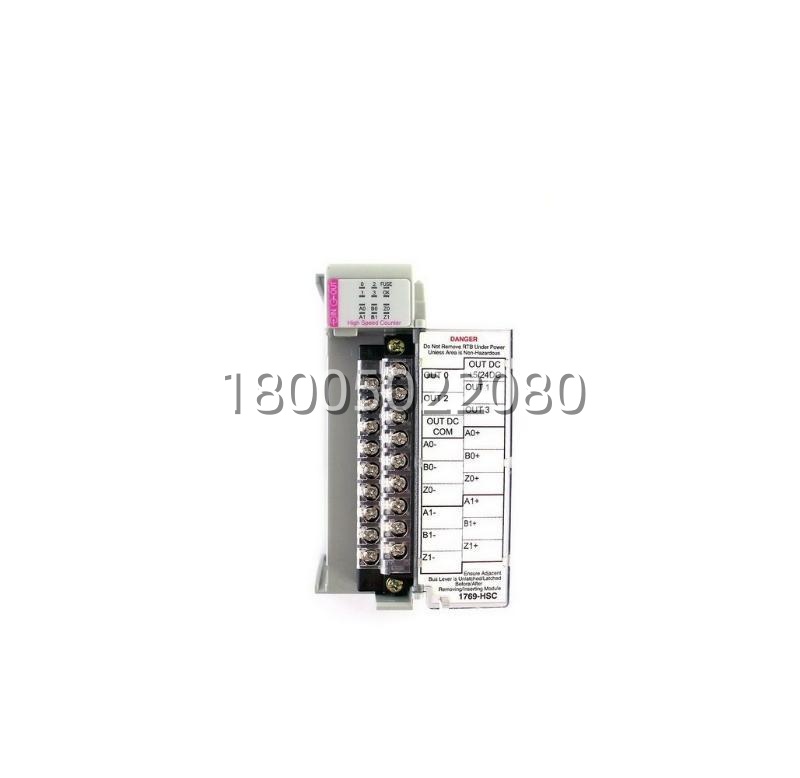
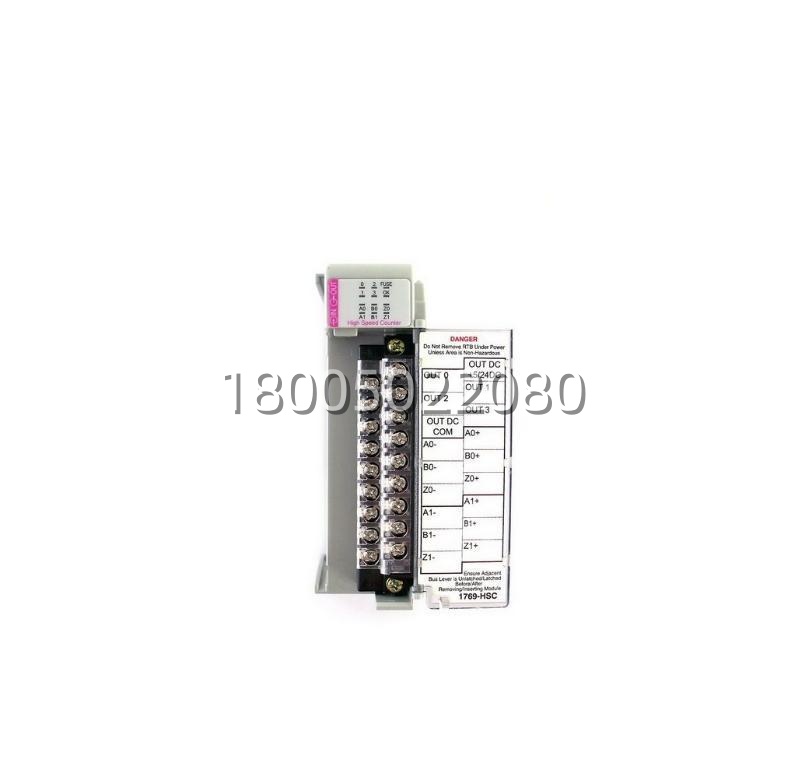
| Input Configuration | 6 × differential DC inputs; configurable as 2 ch ABZ quadrature OR 4 ch unidirectional pulse |
| Max Input Frequency | 1 MHz per channel (min. pulse width 250 ns) |
| Counter Resolution | 32-bit signed DINT, ±2³¹ range, supports Up/Down, Ring, Quadrature (X1/X2/X4) |
| Outputs | 4 × physical sourcing transistor (5–30 V DC, 1 A/point, 4 A/module) + 12 × virtual outputs |
| Backplane Current Draw | 425 mA @ 5 V DC (0 mA @ 24 V DC); peak dissipation ~6.2 W |
| Isolation | 75 V continuous ch-to-backplane, 1200 V AC / 2 s reinforced |
| Mounting Constraint | Must be within 4 modules of 1769 system power supply |
| Engineering Software | RSLogix 5000 / Studio 5000 Logix Designer (Add-On Profile supported) |
| Operating Temp / Rating | 0 to 60 °C, IP20, DIN rail or panel |
Technical Principles and Innovative Values
- Innovation Point 1: Standalone Microprocessor Offloads the CPU Scan. The 1769-HSC doesn’t just “read fast DI”—it has its own intelligence. Pulse counting, direction decode, rollover/ring handling, and rate calculation all execute on-module. The CompactLogix controller only reads the accumulated 32-bit DINT via backplane at whatever RPI (Request Packet Interval) you set (commonly 10–20 ms). This means a 1 MHz encoder stream on a 4 ms-scan controller won’t drop a single count—something no ordinary 1769 digital input could ever promise.
- Innovation Point 2: Flexible Channel Mapping + X4 Quadrature. The six differential inputs on the 1769-HSC can be jumper-routed two ways: (a) two full ABZ channels for dual-encoder axes, or (b) four independent unidirectional pulse counters for flow meters, part-detect wheels, etc. Enable X4 quadrature mode and a 1024 PPR encoder becomes 4096 counts/rev—no extra hardware, just firmware config. That’s a quiet differentiator versus the older 1746-HSCE (SLC 500) which tops out lower and lacks the same virtual-output density.
- Innovation Point 3: 4 Physical + 12 Virtual Compare Outputs. Each counter has configurable preset registers. When the accumulator crosses a preset, the 1769-HSC can fire a physical sourcing output (directly drive a relay coil, solenoid, or VFD enable) ora virtual output that only exists on the backplane—visible to the CompactLogix ladder as a produced tag. Sixteen compare resources across four channels means you can do multi-window positioning (e.g., “decelerate at 80%, coast at 95%, clamp at 100%”) without a single line of CPU logic evaluating the count value—again, hardware-timed response in microseconds, not scan-dependent milliseconds.
Application Cases and Industry Value
Case 1 – Corrugated Box Rotary Die-Cutter (Converting). A Midwest sheet-fed die-cutter running 9,000 sheets/hour used the 1769-HSC to track the vacuum-feed chain encoder (2048 PPR, ABZ, 24 V single-ended). The physical output CH0_OUT0 was mapped to a “knife-home” preset; CH0_OUT1 fired at “knife-approaching” to trigger a registration mark camera. Previously the integrator had tried a soft-counter in the 1769-L36ERM, but at 150 Hz knife cycle the RPI jitter caused registration drift of ±3 mm—reject rates hit 4%. Moving counting to the 1769-HSC with X2 quadrature tightened drift to ±0.4 mm; rejects dropped to 0.3%. The plant engineer noted that the 1769-HSC “paid for itself in two shifts of saved board.”Case 2 – Dairy Bottle Filler / Conveyor Accumulation (Food & Bev). A 12-head rotary filler used the 1769-HSC in 4 × unidirectional mode: three channels on accumulating conveyor star-wheels (pulse pickups from NPN proximity), one channel on the filler turret encoder. The 12 virtual outputs were mapped to “low/med/high” accumulation zones, letting the upstream infeed VFD ramp via Modbus from the CompactLogix without any high-speed output cards. The 1769-HSC sat four slots away from a 1769-PB4 power supply (24 V DC version) with no issues; the integrator later told us the “within 4 slots of power” rule is the one thing to watch—they’d initially put it six slots out on a first revision and saw backplane voltage sag warnings until they reshuffled.
Related Product Combination Solutions
- 1769-L33ER / 1769-L36ERM – CompactLogix 5370 L3 controllers most commonly paired with the 1769-HSC; the L33ER (1 M Ethernet, 2 Mbytes memory) is the sweet spot for single-HSC machine builds.
- 1769-PA4 / 1769-PB4 – 120 VAC / 24 VDC system power supplies for 1769 racks; remember the 1769-HSC draws 425 mA @ 5 V DC, so slot planning matters—keep it ≤4 slots from power.
- 1769-TB3 / 1769-TB3S – Removable screw-terminal blocks for the 1769-HSC (the module ships without them); TB3S adds strain relief.
- 1769-IQ16 / 1769-OG16 – Companion 1769 digital I/O often in the same rack—IQ16 for slow 24 VDC prox, OG16 for relay-style loads supplementing the HSC’s 4 sourcing outputs.
- 1769-HSCE – The “enhanced” sibling: dual-channel, higher feature set, sometimes specified when you need both HSC andmore sophisticated cam/table features—but check lead times; many plants stay on 1769-HSC for simplicity.
- 5069-HSC – The 5069-series successor if migrating to CompactLogix 5380 (5069-L3xx). Pinout and Studio 5000 profile differ; plan for a reconfigure, not a drop-in.
- 1769-ADN – DeviceNet adapter allowing the 1769-HSC to live on a remote 1769 rack off-controller (useful for distributed machine sections).
Installation, Maintenance, and Full-Cycle Support
Physical fit is straightforward—the 1769-HSC occupies one 1769 slot, DIN-rail or panel-mount, and uses a 1769-TB3 removable terminal block (ordered separately) for the encoder and output wiring. The one non-negotiable rule: because the module draws 425 mA from the 5 V backplane rail, Rockwell specifies it must sit within four modules of the 1769 system power supply (PA4/PB4/PO4). Exceed that and you’ll see “Module Not Responding” or backplane undervoltage faults—double-check your rack map before finalizing the BOM. Differential encoder wiring (RS-422, A+/A−, B+/B−, Z+/Z−) should use individually shielded twisted pairs, shield drained to the 1769 chassis ground, not to the signal common, to keep the 1 MHz edges clean in VFD-heavy cabinets.Maintenance on the 1769-HSC is largely configuration-audit rather than hardware-swapping. The front-panel LEDs give per-channel status (A/B/Z presence, direction, output active) at a glance; if a channel “stops counting” in the field, first check the encoder power jumper on the module—1769-HSC can source 5 V DC or pass 24 V DC to the encoder, and mismatches (e.g., 5 V jumper with a 12 V encoder) are the #1 cause of “dead channel” service calls. The module’s self-diagnostics surface in Studio 5000 via the HSC data structure (.CnStatus, .CnFault, etc.), so remote troubleshooting doesn’t require a site visit. Firmware is tied to the Add-On Profile rather than traditional FRN—keep your Studio 5000 AOP pack current if mixing with newer 5380 racks via 1769-UM2.We stock 1769-HSC modules that are fully functionally tested—each unit goes through a loop-back rig: 1 MHz quadrature injected on both channels simultaneously, all four physical outputs load-tested, and virtual-output preset-compare verified against a 1769-L33ER backplane RPI sweep (5/10/20 ms). A 12-month warranty covers DOA and functional drift. For plants eyeing the 5069-HSC migration, we also review BOM impact—the 5069 backplane is 5 V only, the terminal footprint changes, and the Studio 5000 HSC AOI structure differs—so a lift-and-shift isn’t automatic. We’ll flag those delta-points before you cut metal.
Reviews
There are no reviews yet.