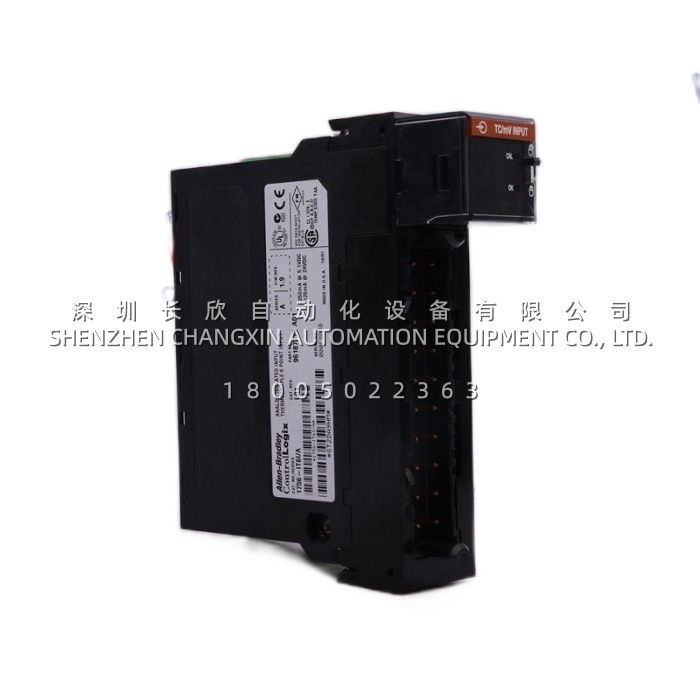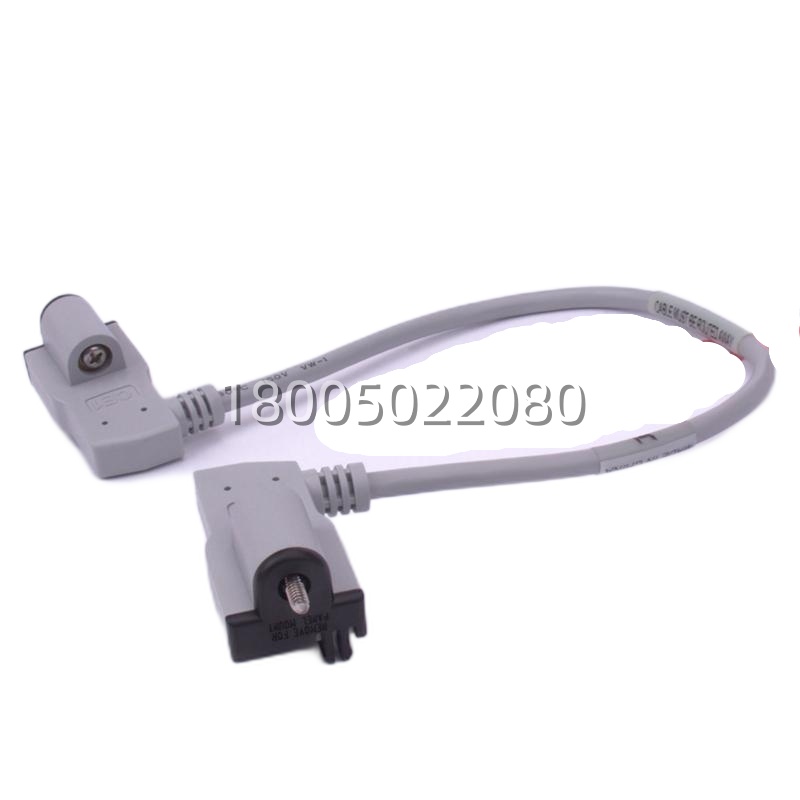
Description:The 1794-CE1/A is a 1-foot (0.3 m) shielded extender cable from Allen-Bradley (Rockwell Automation), designed specifically for the 1794 FLEX I/O system. It serves as a flexible “backbone” link between two FLEX I/O terminal bases (e.g., 1794-TB3, TB3S, TB6), extending the FLEXbus (which carries 5V logic power and data signals) to allow for non-linear or spaced-out physical arrangements of I/O modules within the same logical rack. This is essential for optimizing control cabinet layout when direct side-by-side mounting is constrained by space or wiring access.Application Scenarios:In a太原 (Taiyuan) machinery control cabinet with limited horizontal DIN rail space, an engineer needs to install eight 1794 FLEX I/O modules. However, the cabinet has a vertical support beam blocking the continuous rail. Using the 1794-CE1/A, the engineer splits the I/O rack into two segments: four modules on the left rail and four on the right rail, with the cable bridging the gap over the beam. This maintains a single logical I/O group without requiring a separate network adapter or IP address.
Parameter:
| Main Parameters | Value/Description |
|---|---|
| Product Model | 1794-CE1 / 1794-CE1/A (Revision A) |
| Manufacturer | Rockwell Automation (Allen-Bradley) |
| Product Category | FLEXbus Extension/Interconnect Cable |
| Cable Length | 1 ft (0.3 m) |
| Connector Type | 15-pin D-Sub (Male) with locking screws & shield |
| Signal Transmission | FLEXbus (5V DC Logic, Data, Ground) |
| Compatible Base | 1794-TB3, 1794-TB3S, 1794-TB6, etc. |
| Key Restriction | Only 1 extender cable per I/O group (do not串联/daisy-chain) |
| Operating Temp | 0°C to 60°C (32°F to 140°F) |
| Certifications | cULus, CE |
Technical Principles and Innovative Values:
- Innovation Point 1: Decoupling Physical Layout from Logical Scan. The core innovation of the 1794-CE1/A is its ability to decouple the physical arrangement of I/O modules from the logical addressing scheme. In standard setups, modules must be contiguous. This cable allows engineers to create “L-shaped” or “split-level” racks, providing crucial flexibility in dense control panels where space is at a premium, without fragmenting the I/O system into multiple expensive network drops.
- Innovation Point 2: Signal Integrity Preservation. Despite being a passive component, the cable is engineered with shielded, twisted-pair construction and a locking D-Sub connector to maintain the integrity of the FLEXbus signals over an extended physical path. This prevents electrical noise and signal degradation that could occur if standard unshielded ribbon cables were used, ensuring reliable 5V logic transmission between bases.
- Innovation Point 3: RIUP (Removal Under Power) Support. The design of the FLEX I/O system and this cable allows for modules to be removed or inserted while the system is powered (RIUP). This means the 1794-CE1/A can be used to create a segment that is serviceable without shutting down the entire rack, enhancing maintenance flexibility.
Application Cases and Industry Value:
- Case 1: Compact OEM Machine Panel. An OEM building stamping presses uses the 1794-CE1/A to route the I/O rack around a large circuit breaker in the center of the panel. This avoids the cost of a second Ethernet/IP adapter and keeps the entire I/O configuration under one IP address, simplifying the electrical bill of materials (BOM) and programming.
- Case 2: Legacy Panel Retrofit. During an upgrade of a water treatment plant’s controls, existing conduit entry points force the I/O rack to be split. The 1794-CE1/A is used to connect the two sections, allowing the new FLEX I/O system to fit into the old cabinet footprint without major structural modifications, saving on installation time and cabinet fabrication costs.