
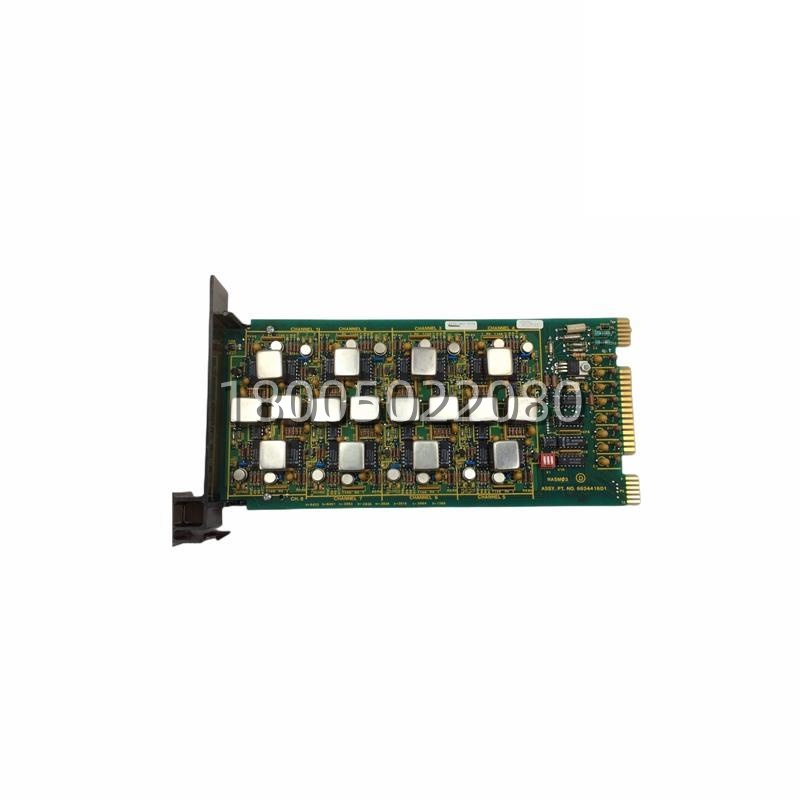
Description
The ABB NASM03 (NASM-03) is an analog input slave module designed for use within ABB Procontrol P13 distributed I/O stations and compatible Symphony Harmony vintage installations. It functions as a remote analog acquisition submodule that connects to a master analog multiplexer (typically NAMP03 or NAMM03) via the station’s internal analog bus, providing eight differential analog input channels (configurable for 4–20 mA, 0–10 V, thermocouple, or mV signals depending on master configuration). The NASM03 contains the input buffering, cold-junction compensation reference (where applicable), and channel-select logic but delegates A/D conversion to the master — making it a cost-effective way to expand analog-point count in a Procontrol P13 rack.h2 Application ScenariosConsider a petrochemical blending unit still running an ABB Procontrol P13 DCS where the reactor section monitors ten temperature zones and six pressure loops via a NAMP03 analog master in the field I/O rack. The original configuration used one NASM03 (8 channels) plus direct master inputs — but a recent process upgrade added three new RTD-temperature transmitters requiring three spare analog channels. Rather than installing a completely new I/O rack with power supply, communication interface, and bus cabling, the instrumentation team simply adds a second ABB NASM03 to the empty slave slot in the existing P13 rack, lands the new 4–20 mA loops on its screw terminals, and updates the master’s channel-scan list in the Procontrol engineering software. The additional eight channels are immediately available — no new fieldbus node, no additional power supply, no re-wiring of the existing loops. This scenario shows the NASM03‘s practical value: it is the modular, low-cost analog expansion building block that preserves the integrity of a proven Procontrol P13 installation while accommodating incremental process changes.h2
Parameter
| Main Parameters | Value/Description |
|---|---|
| Product Model | NASM03 (NASM-03, ABB P13 Analog Slave Module) |
| Manufacturer / Series | ABB / Procontrol P13 (Symphony Harmony legacy compatible) |
| Product Category | Analog Input Slave Module (Sub-Multiplexer Card for NAMP03 / NAMM03 Master) |
| Number of Channels | 8 differential analog input channels |
| Input Signal Types (via Master Config) | 4–20 mA, 0–20 mA, 0–10 V, ±10 V, Thermocouple (Type J/K/T/E/S — via master CJC), mV (±50 mV) |
| Input Impedance | > 1 MΩ (voltage mode); ≤ 250 Ω (current mode with int. shunt) |
| Resolution (System) | Determined by master A/D — typically 12–14 bit effective (0.025 % FS) |
| Accuracy | ±0.1 % FS (typical, with calibrated master & proper CJC on TC types) |
| Isolation | Galvanic isolation between analog inputs, module logic, and Procontrol station bus (≥ 500 V AC test) |
| Bus Interface | Procontrol P13 analog slave bus (ribbon to NAMP03 / NAMM03 master in same rack) |
| Connectors | Screw terminals for field analog signals + pin-header / ribbon to master backplane |
| Operating Temperature | 0 °C to +60 °C |
| Mounting Method | Plugs into dedicated slave slot in Procontrol P13 I/O rack (guided rails + ejector / fixing screw) |
| Dimensions (approx.) | 263 × 20 × 198 mm (P13 card format) |
| Weight | ≈ 0.35 kg |
*Note: The NASM03 does NOT contain its own A/D converter — it buffers and routes the selected channel to the master multiplexer (NAMP03/NAMM03) which performs the conversion. Channel configuration (signal type, range, alarm limits) is done in the master module’s parameter set, not on the NASM03 itself.h2 Technical Principles and Innovative ValuesThe NASM03 implements a classic slave-multiplexer architecture optimized for high-channel-count, cost-sensitive analog acquisition in process DCS.
- Innovation Point 1 – Master-Slave Analog Bus Architecture Minimizes Cost per Point: By offloading A/D conversion, cold-junction compensation, and digital communication to the NAMP03 / NAMM03 master, each NASM03 adds eight analog channels for a fraction of the cost of a standalone intelligent AI module. This design was ahead of its time in recognizing that many process applications need lots of slow-changing analog data (temp, press, level) but not high-speed simultaneous sampling — the sequential scan via the master is perfectly adequate and far more economical.
- Innovation Point 2 – Differential Inputs with High Common-Mode Rejection: All eight channels on the NASM03 are differential (positive and negative lead per input), providing excellent rejection of ground loops and induced noise — a common issue when thermocouple or low-level mV signals are routed through electrically noisy plant cable trays. This ensures measurement integrity even when field grounds differ from the DCS ground reference.
- Innovation Point 3 – Hot-Swap Capable Within Rack Power Budget: The NASM03 draws its operating power from the P13 rack backplane (+5 V / ±15 V DC) and can be inserted/removed with the rack powered (subject to site safety policy and ESD precautions). Because configuration lives on the master, a replacement NASM03 is automatically recognized on the next scan cycle — no download, no re-addressing — which is invaluable during off-hour troubleshooting when a channel group fails.


