Product Overview
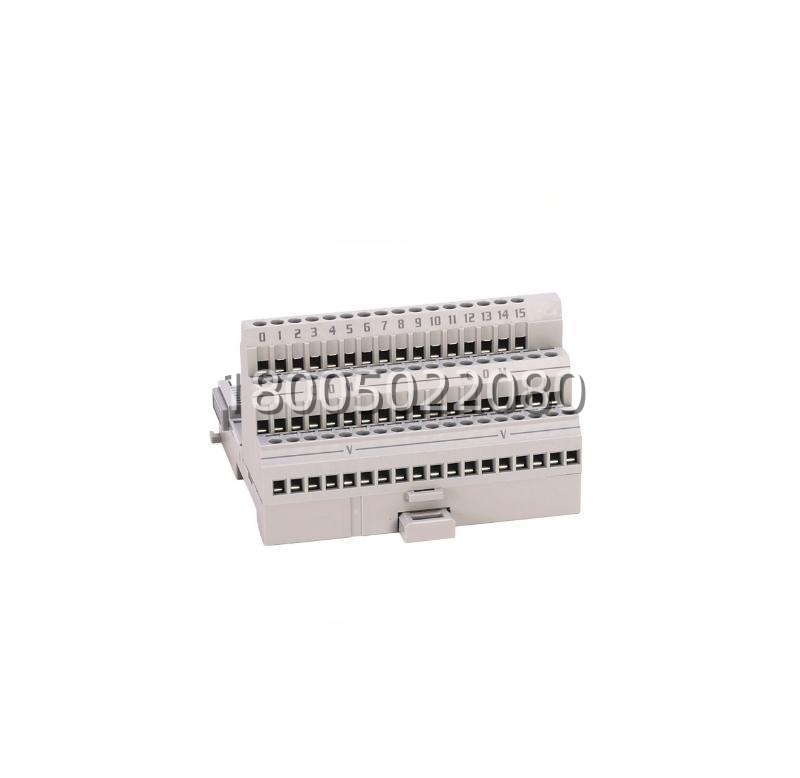
The Allen-Bradley 1794-TB3 is a 3-wire terminal base unit (TBU) within Rockwell Automation’s 1794 FLEX I/O platform, serving as the foundational wiring and backplane interface beneath any 1794-series I/O module (digital, analog, RTD/thermocouple, or specialty) and the companion 1794 communication adapter (1794-AENT for EtherNet/IP, 1794-ACN/R for ControlNet, 1794-ASB for Remote I/O). The 1794-TB3 itself is not a functional I/O device—purchased alone it does nothing; it becomes active only when a 1794 module snaps onto its top face and a 1794 adapter (or a 1794-ADN DeviceNet adapter) closes the FLEXBUS backplane chain. What the 1794-TB3 provides is the field-wiring interface: 52 total screw-clamp terminals organized into three distinct rows—16 I/O positions (0–15) for signal wiring, 18 common terminals (16–33), and 18 voltage-supply terminals (34–51)—so that each I/O point can have its own dedicated +V feed and COM return, a 3-wire architecture purpose-built for PNP sensors, NPN sinks, relay coils, and isolated analog loops where per-point power independence matters. The terminal clamps are Rockwell’s cage-clamp screw type (tighten screw to close the cage onto the stripped conductor), which delivers better vibration resistance than traditional screw-to-copper pressure terminals and handles 22–12 AWG (0.34–3.3 mm²) solid or stranded copper.Electrically, the 1794-TB3 is rated for 125V AC/DC continuous across the field terminals (basic insulation type, field-to-FLEXBUS isolation 125V), with a 10A physical current ceiling per terminal strip—though the actual per-point current is capped by whatever 1794 module sits on top (typically ≤2A per I/O point for digital, far less for analog). The TBU draws 640 mA from the FLEXBUS 5V DC backplane (fed from the 1794 adapter’s 24V DC input), supplies daisy-chain 24V DC power across adjacent TB3 units via integrated power-bus bars and jumper fingers, and supports Removal and Insertion Under Power (RIUP) of the 1794 module above it—the module’s locking lever seats into the 1794-TB3‘s latch, and the FLEXBUS connector mated through the TBU’s printed-circuit backplane ensures the adapter sees the module without re-scanning the entire rack. Mounting is 35 mm DIN rail (EN 60715) or panel via screws, footprint 94 × 94 × 69 mm (3.7 × 3.7 × 2.7 in), operating 0°C to +55°C (IEC extended -20 to +70°C), 5g vibration / 30g shock, certified UL/cUL/CE/CSA/KC/GOST/maritime. For distributed I/O architectures—remote pump skids, MCC-mounted Flex banks, conveyor zone boxes—where field wiring needs to terminate locally and the 1794 module above may be swapped without disturbing the screw terminations, the 1794-TB3 is the standard TBU; sister variants 1794-TB3S (spring-clamp, tool-free) and 1794-TB3K (conformal-coated for corrosive atmospheres) cover the same footprint with different terminal and environmental specs.
Technical Specifications
| Parameter Name | Parameter Value |
|---|---|
| Product Model | 1794-TB3 |
| Manufacturer | Allen-Bradley (Rockwell Automation) |
| Product Type | FLEX I/O Terminal Base Unit (3-wire, screw-clamp) |
| Series | 1794 FLEX I/O |
| Terminal Strips | 3 rows: 16 I/O + 18 COM + 18 +V = 52 terminals total |
| Terminal Type | Cage-clamp screw (tighten screw to close cage onto conductor) |
| Voltage Rating (field terminals) | 125V AC/DC continuous (132V AC max) |
| Current Rating (per strip, physical) | 10A max @ 50/60 Hz |
| FLEXBUS Backplane Current | 640 mA @ 5V DC (drawn from 1794 adapter) |
| I/O Terminal Current (module-limited) | Typically ≤2A per point (digital), module-dependent |
| Wire Size | 22–12 AWG (0.34–3.3 mm²) solid or stranded copper |
| Screw Torque | 0.56–0.79 N·m (5–7 lb·in) |
| Mounting | 35 mm DIN rail (EN 60715) or panel mount |
| Isolation (field-to-FLEXBUS) | 125V continuous, basic insulation type |
| Dimensions (H × W × D) | 94 × 94 × 69 mm (3.7 × 3.7 × 2.7 in) |
| Operating Temperature | 0°C to +55°C (IEC -20°C to +70°C extended) |
| Vibration / Shock | 5g @ 10–500 Hz / 30g operating shock |
| Certifications | UL, cUL, CE, CSA, KC, GOST, Maritime |
Main Features and Advantages
Three-row partitioned wiring that prevents mis-wiring: The standout differentiator of the 1794-TB3 versus cheaper 2-wire TBU designs (or versus landing Flex I/O on a generic DIN terminal block strip) is the explicit 3-row partition: Row A = 16 I/O signal terminals (0–15), Row B = 18 COM returns (16–33), Row C = 18 +V feeds (34–51). In a PNP sensor loop—sensor brown to +V row, blue to COM row, black (signal) to I/O row—the 1794-TB3 physically segregates power from signal so a harried electrician can’t accidentally land 24V+ onto an I/O point and fry the 1794-IB16 above it. For NPN or isolated analog (e.g., 1794-IE8, 4–20 mA with its own loop supply), the same partition lets each channel have a dedicated +V and COM tap from the daisy-chain bus, rather than gang-paralleling COM under one terminal. This 3-wire architecture is why the 1794-TB3 is the default TBU for mixed-sensor Flex racks—one TBU footprint covers PNP, NPN, relay, and analog without re-planning the terminal block layout.Cage-clamp screw terminals with vibration resilience: Rockwell specifies the 1794-TB3 terminals as cage-clamp screw type—you insert the stripped 22–12 AWG conductor into the cage, then tighten the screw to close the cage jaws onto the copper. This is mechanically superior to “screw-direct-to-wire” terminals (where the screw head bears on the conductor) because the cage distributes clamp force evenly and the screw thread doesn’t directly shear the strand bundle. On high-vibration skids—centrifugal pump packs, compressor sheds, vibrating conveyor drives—the 1794-TB3‘s cage clamps hold torque better over thermal cycles, which is why Rockwell rates the TBU at 5g vibration / 30g shock, matching the 1794 module envelope. Paired with the 0.56–0.79 N·m (5–7 lb·in) torque spec, the 1794-TB3 gives a “torque-once, forget” field experience that traditional spring-clamp (TB3S) also delivers but with a different tooling feel—some panels standardize on TB3 (screw) for maintenance crews who prefer screwdriver familiarity, others on TB3S (spring) for faster wiring.