Product Overview
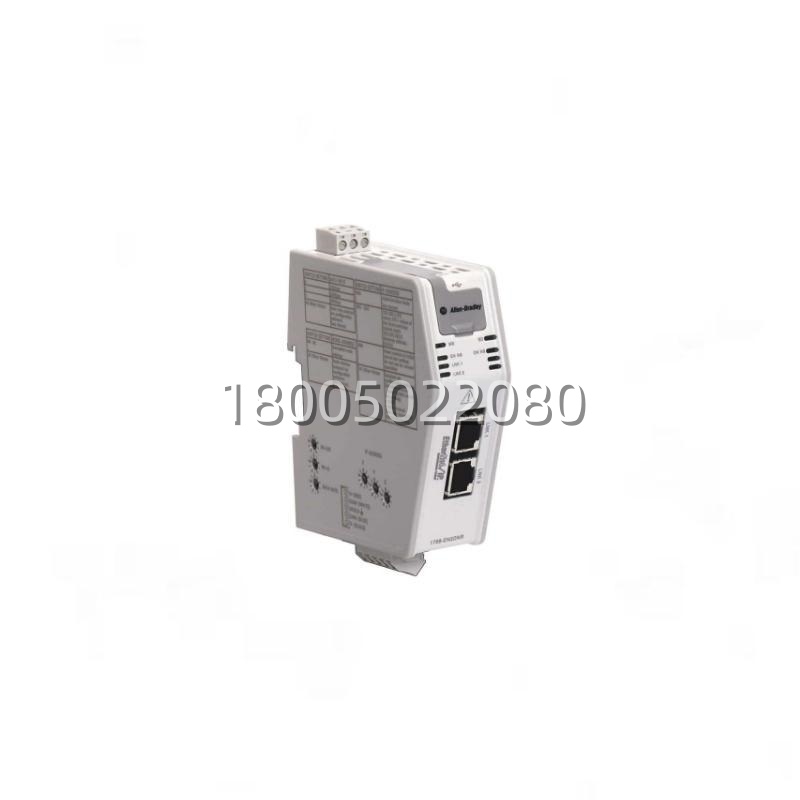
The Allen-Bradley 1788-EN2DN (Revision A) is a standalone EtherNet/IP (EIP) to DeviceNet (DN) Linking Device within Rockwell Automation’s 1788 series, engineered to bridge EIP and DN networks without requiring a rack-mounted DeviceNet scanner module in the EIP controller’s chassis. Occupying minimal 35 mm DIN rail space and powered by a standard 24V DC industrial supply, the 1788-EN2DN operates as an EIP adapter on its 10/100Base-TX RJ45 port, allowing any EIP scanner (ControlLogix 1756-L7x/L8x with 1756-EN2T/EN3T, CompactLogix 1769-L30ER/L36ERM, or third-party EIP masters such as PC-based soft PLCs or vision systems) to exchange cyclic I/O and explicit messages with it. On the DN side, the 1788-EN2DN acts as a DN scanner, polling up to 64 DN slave nodes (including 1794-ADN Flex I/O adapters, PowerFlex VFDs with DN option cards, smart sensors, and legacy 1771-DCM nodes) at configurable baud rates of 125, 250, or 500 kbps, with all data mapping between EIP assemblies and DN poll/response buffers handled automatically by the module’s firmware.Positioned as a flexible alternative to rack-mounted DN bridges (such as the 1756-DNB for ControlLogix or 1769-SDN for CompactLogix 1769 racks), the 1788-EN2DN solves three common pain points in mixed legacy/new automation fleets: first, it saves expensive Logix rack slots and reduces backplane power/EMI load by moving DN scanning duties outside the controller chassis; second, it sustains healthy legacy DN networks during controller migrations (e.g., upgrading from SLC 5/05 + 1747-SDN to CompactLogix 5380 or ControlLogix 5580) without rewiring DN trunks or replacing DN slaves; third, it enables cross-vendor integration, letting non-Rockwell EIP devices communicate with DN-only slaves without custom gateway code. Configuration is handled via standard Rockwell tools: RSLinx Classic for EIP path discovery, Studio 5000 (or RSLogix 5000) for EIP assembly mapping, and RSNetWorx for DeviceNet for DN scanner setup, with an embedded web server providing at-a-glance diagnostics for EIP link status, DN node health, and error logging without requiring specialized software on a service laptop. The 1788-EN2DN is ODVA-conformant for both EIP and DN protocols, carries UL/cUL/CE certifications, and is rated for 0–60°C panel ambient, making it suitable for most industrial MCC and machine-mount enclosures. While Rockwell’s newer 1788-EN3DN offers a Gigabit EIP port for higher-bandwidth applications, the 1788-EN2DN remains the cost-effective 10/100 choice for most legacy DN sustainment and rack-offload use cases.
Technical Specifications
| Parameter Name | Parameter Value |
|---|---|
| Product Model | 1788-EN2DN (Revision A) |
| Manufacturer | Allen-Bradley (Rockwell Automation) |
| Product Type | Standalone EtherNet/IP to DeviceNet Linking Device |
| EtherNet/IP Interface | 1 × 10/100Base-TX RJ45, auto MDI/MDIX, EIP Adapter mode, supports implicit (cyclic) I/O + explicit messaging, up to 128 EIP connections |
| DeviceNet Interface | 1 × 5-pin Phoenix open-style DN port, DN Scanner mode, up to 64 slave nodes, baud rates 125/250/500 kbps |
| I/O Mapping Capacity | Up to 128 input words (EIP → DN), 128 output words (DN → EIP); up to 124 input bytes / 124 output bytes per DN slave |
| Power Input | 18–31.2V DC (nominal 24V DC), typical draw 200 mA @ 24V, inrush 15A @ 24V for 1 ms |
| Mounting | 35 mm DIN rail (EN 60715) |
| Operating Temperature | 0°C to +60°C (32°F to 140°F) |
| Diagnostics | Embedded web server, 5 LEDs (PWR, EIP LINK/ACT, DN LINK/ACT, FAULT), RSNetWorx for DN integration |
| Certifications | UL, cUL, CE, ODVA EtherNet/IP + DeviceNet conformant |
| Configuration Tools | RSLinx Classic, Studio 5000 / RSLogix 5000, RSNetWorx for DeviceNet |
Main Features and Advantages
Rack-offload and EMI isolation: The primary value proposition of the 1788-EN2DN is eliminating the need for a rack-mounted DN scanner in Logix controller chassis. A 1756-DNB (ControlLogix DN bridge) costs ~$1,200 and consumes a 1756 rack slot that could instead hold additional I/O or communication modules, while also drawing ~500 mA from the 1756 5V backplane. The 1788-EN2DN sits outside the rack, draws 200 mA from the panel’s 24V DC supply (already used for sensor and VFD control circuits), and isolates the noisy DN physical layer (24V CAN-based, thick trunk often routed near VFD power cables) from the sensitive 1756/1769 backplane—reducing EMI-induced scan errors on the Logix rack, a common issue in panels with high VFD density. For compact 1769 racks where every slot is precious (e.g., a 1769-L36ERM in an 8-slot 1769 rack already packed with digital I/O and analog modules), swapping a planned 1769-SDN for a 1788-EN2DN frees an entire slot for additional I/O without sacrificing DN connectivity.Zero-code protocol bridging: The 1788-EN2DN handles all EIP-to-DN data translation in firmware, so there is no need to write custom logic to parse DN explicit messages or map DN poll data to controller tags. On the EIP side, the module appears as a standard EIP adapter node—add it to the Studio 5000 I/O tree via its AOP (Allen-Bradley Object Profile) or as a generic EIP adapter, map the input/output assemblies to controller tags, and cyclic I/O exchange begins automatically once the EIP scanner establishes connection. On the DN side, configure the 1788-EN2DN as the DN scanner in RSNetWorx for DeviceNet: upload EDS files for all DN slaves, set the DN baud rate to match the existing trunk, map each slave’s I/O buffers to the 1788-EN2DN‘s internal DN input/output memory, which is already linked to the EIP assemblies. The entire bridge works “out of the box” with no ladder logic modifications to the existing Logix program, which is critical for sustainment projects where validated code cannot be touched.Legacy DN sustainment during controller migration: Thousands of plants still run healthy DeviceNet networks installed 10–20 years ago, with 1794-ADN Flex I/O on remote skids, PowerFlex 70/700 VFDs with DN option cards, and legacy 1771-DCM nodes on older machinery. Rewiring these to EtherNet/IP is often budget-prohibitive, as it requires replacing every DN slave’s interface, pulling new CAT6 cable, and rewriting I/O mapping logic. The 1788-EN2DN lets plants upgrade their controllers to newer Logix platforms (ControlLogix 5580, CompactLogix 5380/5480) without touching the DN trunk: simply land the existing DN trunk on the 1788-EN2DN‘s Phoenix port, add the linking device to the new controller’s EIP network, and the legacy DN slaves continue operating with zero rewiring. This “strangle the DN slowly” approach lets plants phase out DN slaves one-by-one as they fail or as budget allows, rather than a forced full rip-and-replace.Cross-vendor flexibility: Because the 1788-EN2DN adheres strictly to ODVA EIP and DN standards, it works with any EIP scanner, not just Rockwell Logix controllers. This makes it ideal for hybrid lines where a Rockwell CompactLogix controls main logic, but a Cognex or Keyence vision system (with EIP output) needs to send pass/fail data to a Festo or SMC valve bank that only has a DN interface. The 1788-EN2DN bridges the two protocols without requiring a Rockwell rack at the vision system end—just power the linking device with 24V DC, land the vision system’s EIP cable on the RJ45 port, land the valve bank’s DN drop on the Phoenix port, and map the I/O. It also works with PC-based soft PLCs with EIP support, making it useful for lab automation or R&D setups where a full Logix rack is overkill.Compact DIN-mount design with rich diagnostics: The 1788-EN2DN measures ~90 × 70 × 35 mm, so it fits next to DN trunk terminals, VFD control panels, or small machine-mount enclosures without consuming significant panel space. Five front-panel LEDs (PWR, EIP LINK/ACT, DN LINK/ACT, FAULT) give at-a-glance status: solid EIP LINK means the EIP scanner is connected, blinking DN LINK means the DN scanner is up but a slave is dropping, solid FAULT means a critical error (e.g., 24V DC sag, DN baud mismatch). For deeper diagnostics, browse to the 1788-EN2DN‘s static IP via any web browser on the EIP network to view error logs, DN node health tables, EIP connection status, and even update firmware—no need to open RSLogix or RSNetWorx for quick checks, which is a major time-saver for field service technicians.