Product Overview
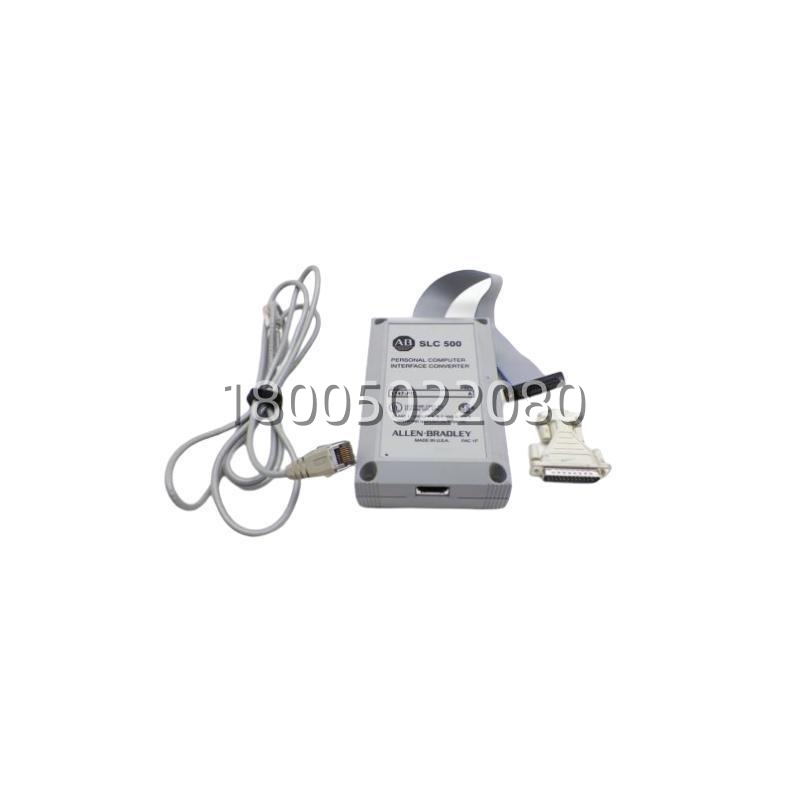
The Allen-Bradley 1747-PIC/A is a specialized protocol interface converter, a critical communication gateway designed to enable connectivity between a personal computer (PC) and Allen-Bradley’s legacy DH-485 industrial network. This module serves as an indispensable tool for programming, configuring, and monitoring SLC 500 series programmable logic controllers, primarily the SLC 5/03 processor, which uses DH-485 as its primary communication port. The core function of the Allen-Bradley 1747-PIC/A is to perform real-time protocol conversion between the asynchronous serial RS-232 data from a computer’s serial (COM) port and the synchronous, token-passing DH-485 network protocol. It acts as an active node on the DH-485 network, managing network access and facilitating the exchange of configuration data, ladder logic programs, and real-time data tables between the programming software (such as RSLogix 500) running on the PC and the controllers on the network.Physically, the 1747-PIC/A is a compact device featuring a 9-pin D-sub female connector for the PC serial cable and an industry-standard 8-pin modular (RJ-45) connector for the DH-485 network cable. It requires an external 24V DC power supply for operation. In a typical setup, the module is connected directly to a PC’s serial port, and then via a shielded, twisted-pair cable to the programming port of an SLC 5/03 or to a DH-485 network trunk connecting multiple devices. The Allen-Bradley 1747-PIC/A is more than a simple cable; it contains the necessary electronics to handle the timing, arbitration, and electrical signaling differences between the two protocols. For maintenance personnel, system integrators, and engineers supporting facilities with a large installed base of SLC 500 controllers, the 1747-PIC/A is an essential piece of test equipment. It is the primary means of uploading, downloading, and troubleshooting control logic on these legacy systems. Its value is historical and practical, as it provides continued access to and support for thousands of SLC 500 systems that remain in reliable service worldwide, ensuring their maintainability and extending their operational lifecycle.
Technical Specifications
| Parameter Name | Parameter Value |
|---|---|
| Product Model | 1747-PIC/A |
| Manufacturer | Allen-Bradley (Rockwell Automation) |
| Product Type | Protocol Interface Converter (DH-485 to RS-232) |
| PC Interface | RS-232 Serial (DB-9 Female Connector) |
| Network Interface | DH-485 (8-pin RJ-45 Modular Connector) |
| Network Protocol | Converts RS-232 to Allen-Bradley DH-485 protocol |
| Baud Rate | DH-485 network speeds up to 19.2 kbps |
| Power Requirement | 24V DC, 50 mA (typically from an external 24V DC power supply) |
| Status Indicators | Two LEDs: Power (green), Communication (green/yellow) |
| Isolation | 500V AC between RS-232, DH-485, and power supply |
| Network Topology | Point-to-point or multi-drop (up to 32 nodes max on DH-485) |
| Cable Requirements | Shielded, twisted-pair cable for DH-485 network |
| Compatible Processors | SLC 5/03 (Channel 0), other DH-485 devices (PanelView, etc.) |
| Operating Temperature | 0 to 60°C (32 to 140°F) |
Main Features and Advantages
The Allen-Bradley 1747-PIC/A provides a reliable and dedicated solution for a very specific communication challenge. Its key feature is the robust protocol conversion that allows a standard PC serial port, a ubiquitous feature on older industrial laptops, to communicate natively with the proprietary DH-485 network. The module handles all the low-level protocol details, such as token passing and message framing, transparently to the user. This allows programming software like RSLogix 500 to communicate with the PLC as if it were connected via a simple serial cable, greatly simplifying the software setup and user experience. The module includes status LEDs that provide immediate visual feedback: a steady green POWER LED indicates proper 24V DC supply, and a flashing green/yellow COMMUNICATIONS LED indicates network traffic, which is invaluable for confirming that the physical connection is active and data is being exchanged.A significant advantage of the 1747-PIC/A is its role in enabling network connectivity. While it can be used for a point-to-point connection to a single SLC 5/03, it also allows the PC to become a node on a multi-drop DH-485 network. This enables an engineer to connect to any device on that network from a single connection point, which is essential for troubleshooting systems with multiple SLC racks, PanelView Standard terminals, or other DH-485 devices. The module provides electrical isolation (500V AC) between the PC, the network, and the power supply, which helps protect the sensitive computer hardware from electrical noise, ground loops, or surges that might be present on the industrial network. Although its data rate (19.2 kbps) is slow by modern standards, it was sufficient for programming and data monitoring tasks for the SLC 500 platform. The Allen-Bradley 1747-PIC/A is a focused, single-purpose tool that performs its job reliably, and its existence is a primary reason why SLC 500 systems remain serviceable decades after their introduction. For support teams, having a working 1747-PIC/A and a laptop with a serial port is often the first step in diagnosing any issue with a legacy SLC system.