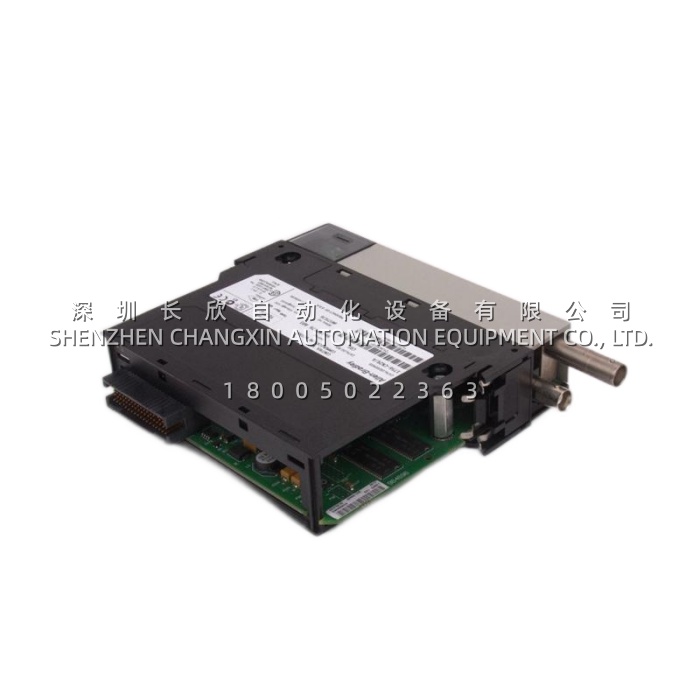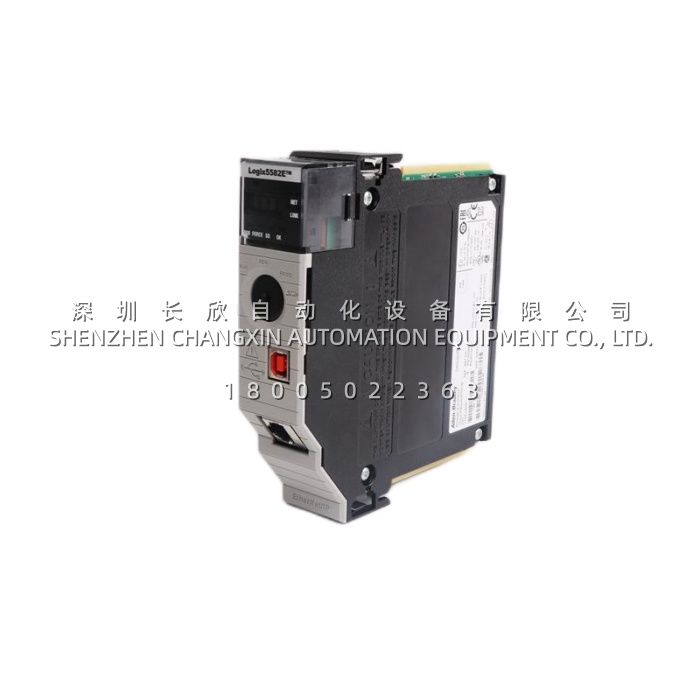
Product Overview
The Allen-Bradley 1756-L83E is a ControlLogix 5580 series processor module from Rockwell Automation, positioned in the middle of the Logix5580 controller lineup with 10 MB of user memory. As a member of the 5580 platform, the Allen-Bradley 1756-L83E delivers substantially higher capacity and performance than the preceding 5570 generation, supporting up to 250 EtherNet/IP devices directly and accommodating integrated motion applications with up to 256 axes over EtherNet/IP . The processor occupies a single slot in any 1756 chassis and communicates with I/O and communication modules across the ControlLogix backplane.
The Allen-Bradley 1756-L83E features an embedded 1 gigabit Ethernet port for high-speed programming, I/O communication, and motion control, alongside a USB 2.0 full-speed port dedicated to local programming and configuration tasks . A four-character alphanumeric display on the front faceplate provides immediate visibility into module status and diagnostic information, reducing reliance on programming terminal connections during commissioning and troubleshooting. Nonvolatile memory is provided through an SD card slot, allowing user programs and tag data to be stored persistently and restored after module replacement .
The Allen-Bradley 1756-L83E supports the full suite of Studio 5000 Logix Designer programming languages, including ladder diagram, structured text, function block diagram, and sequential function chart . With support for 32 controller tasks and up to 1000 programs per task, the processor accommodates complex control strategies that require both continuous and event-driven execution. Its 10 MB memory allocation positions the Allen-Bradley 1756-L83E for applications that exceed the capacity of entry-level 5580 processors but do not require the 20 MB or 40 MB capacities of the L84E and L85E models.
Technical Specifications
| Parameter Name | Parameter Value |
|---|---|
| Product Model | 1756-L83E |
| Manufacturer | Allen-Bradley (Rockwell Automation) |
| Product Type | ControlLogix 5580 Processor |
| User Memory | 10 MB |
| EtherNet/IP Devices Supported | 250 |
| Integrated Motion Axes | 256 (EtherNet/IP) |
| Communication Ports | 1 × USB 2.0 Full Speed (Type B); 1 × 1 Gb Ethernet |
| Controller Tasks | 32 tasks; 1000 programs/task |
| Nonvolatile Memory | SD Card |
| Backplane Power (5.1V) | 1.20 A |
| Backplane Power (1.2V) | 5 mA |
| Power Dissipation (100% load) | 6.2 W |
| Operating Temperature | 0°C to +60°C (Series C chassis); 0°C to +50°C (Series B chassis) |
Main Features and Advantages
High-capacity memory for demanding applications: The Allen-Bradley 1756-L83E provides 10 MB of user memory, placing it above the entry-level L81E (3 MB) and L82E (5 MB) models while remaining below the L84E and L85E for applications with more modest program size requirements . This capacity supports complex control routines, extensive tag databases, and data logging functions without the premature memory constraints of lower-tier processors.
Embedded gigabit Ethernet for high-speed communication: The Allen-Bradley 1756-L83E includes a native 1 Gb Ethernet port, enabling fast program downloads, high-frequency I/O updates, and responsive HMI communication . The port supports up to 250 EtherNet/IP devices directly, reducing the need for additional communication modules in mid-sized network architectures.
Integrated motion control without dedicated hardware: With support for up to 256 motion axes over EtherNet/IP, the Allen-Bradley 1756-L83E handles complex multi-axis motion applications through the same network infrastructure used for I/O and supervisory communication . This integration simplifies system architecture and reduces the component count associated with separate motion control platforms.
SD card nonvolatile storage for program retention: The Allen-Bradley 1756-L83E stores user programs and tag data on a removable SD card, ensuring that configuration and logic persist through power cycles and module replacement . This approach eliminates battery dependency for memory retention and simplifies spare-parts management, as a failed processor can be replaced and reprogrammed from the stored card.
Diagnostic display and status indicators: The four-character alphanumeric display on the Allen-Bradley 1756-L83E provides immediate visibility into module state, fault codes, and network status . Combined with LED indicators, this interface accelerates commissioning and reduces troubleshooting time without requiring a connected programming terminal.