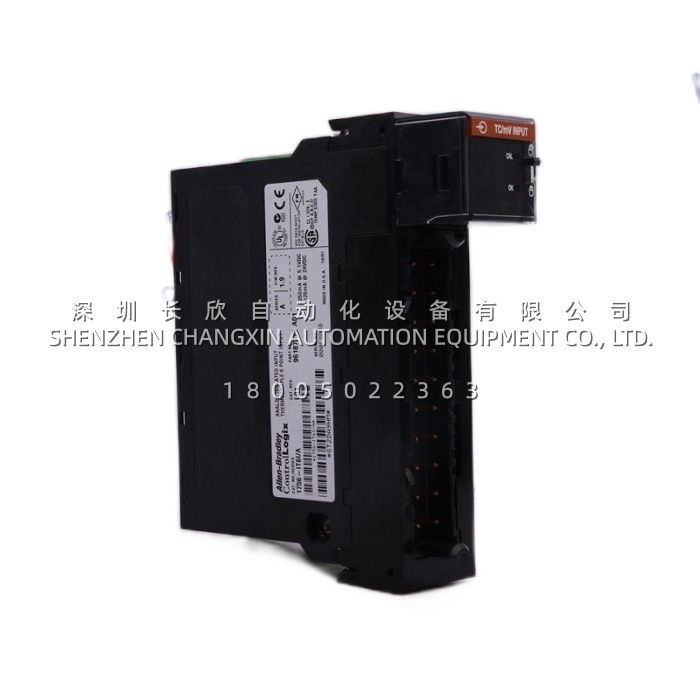
Product Overview
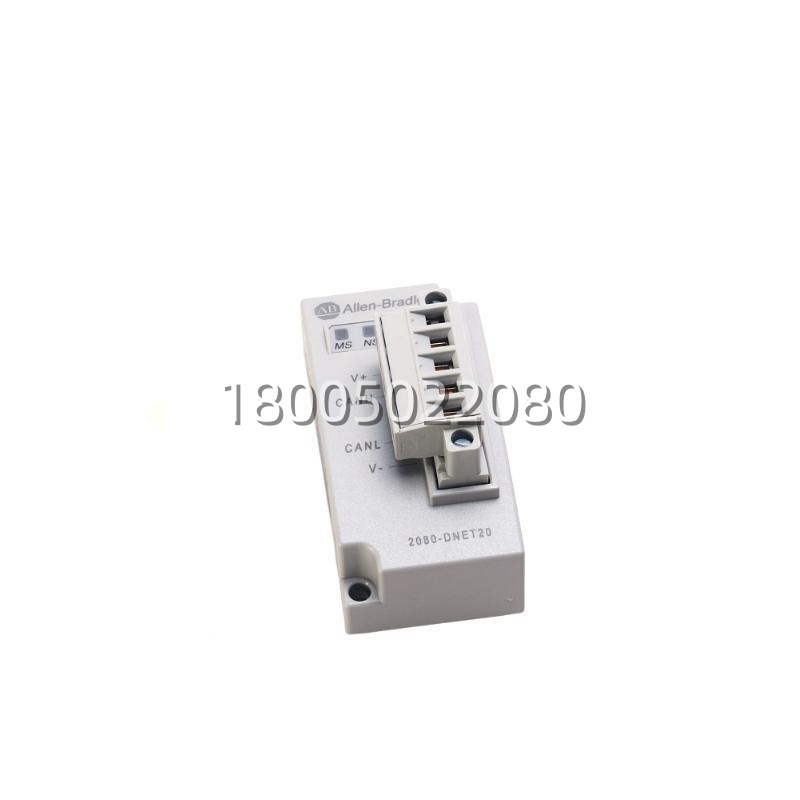
The Allen-Bradley 2080-DNET20 is a plug-in DeviceNet Scanner module purpose-built for Rockwell Automation’s Micro800 controller family (Micro820, Micro830, Micro850, Micro870; select Micro810 models excluded), occupying one of the controller’s front-face expansion bays to grant the compact Micro800 CPU native DeviceNet Master (Scanner) capability without consuming DIN-rail space or migrating to a larger CompactLogix/ControlLogix platform. While the Micro800 line (2080-LC50-24QBB, 2080-LC70-24QBB, etc.) ships standard with EtherNet/IP and/or RS-232/485 on the CPU itself, many legacy plant floors and OEM export machines still standardize on DeviceNet for drives and distributed I/O — PowerFlex 4/40/520/750 VFDs, 1734-ADN Point I/O blocks, 1732D ArmorBlock, and legacy smart devices. The 2080-DNET20 bridges that gap: the Micro800 CPU remains the logic engine running CCW (Connected Components Workbench) programs, while the 2080-DNET20 handles the DeviceNet MAC ID arbitration, poll scheduling, I/O slave messaging (poll command), and explicit message transport to/from up to 20 DN nodes on a single trunk.Physically, the 2080-DNET20 is a 62 × 31.5 × 20 mm (35 g) plug-in that clicks behind the Micro800 CPU’s front cover, presenting a 5-pin removable terminal block for the DeviceNet bus (V+, V−, CAN_H, CAN_L, Shield) and drawing logic power from the CPU backplane (50 mA @ 24V DC) while sourcing its DeviceNet PHY current from the DN trunk (24V DC, 300 mA Class 2). Baud rates follow standard DeviceNet tiers — 125 kbps (420 m), 250 kbps (200 m), 500 kbps (75 m) — with the 2080-DNET20 auto-negotiating or allowing software-select per CCW project. Two diagnostic LEDs (Module Status red/green, Network Status red/green) give at-a-glance health: solid green MS = module OK, solid green NS = DN ring healthy with at least one slave responding, flashing indicates I/O owner/scanning states, red flags fault. Lifecycle is Active (Rockwell current), origin Singapore, 1-year standard warranty, 5-day typical lead. For OEMs building small-to-mid machines on Micro800 that must drop onto a DeviceNet-backbone plant — automotive sub-cells, legacy packaging lines, batch skids tied to DN-central SCADA — the 2080-DNET20 is the low-footprint, CCW-native DN scanner that avoids the cost and panel-space of a 1769-SDN + CompactLogix or 1756-DNB + ControlLogix uplift.
Technical Specifications
| Parameter | Value |
|---|---|
| Product Model | 2080-DNET20 |
| Manufacturer | Allen-Bradley (Rockwell Automation) |
| Product Type | Micro800 Plug-In DeviceNet Scanner (Master) |
| Compatible Controllers | Micro820, Micro830, Micro850, Micro870 (select Micro810 excluded) |
| Network Protocol | DeviceNet, I/O Slave Messaging: Poll Command |
| Max Nodes | 20 nodes (I/O operation) |
| Baud Rates / Distance | 125 kbps @ 420 m, 250 kbps @ 200 m, 500 kbps @ 75 m |
| Communication Interface | 5-pin pluggable terminal block (V+, V−, CAN_H, CAN_L, Shield) |
| Backplane Power (from CPU) | 50 mA @ 24V DC |
| DeviceNet Trunk Current | 24V DC, 300 mA Class 2 |
| Max Power Dissipation | 1.44 W |
| Isolation Voltage | 50V continuous (channel-to-backplane), type-tested 60 s @ 500V AC |
| Preferred PSU | 1606-XLSDNET4 (Rockwell DN PSU) |
| Operating Temperature | −20 °C to +65 °C (−4 °F to +149 °F) |
| Enclosure Rating | IP20 (control-cabinet required) |
| Dimensions (H × W × D) | 62 × 31.5 × 20 mm |
| Weight | 35 g |
| Wire Size | 0.25–2.5 mm² (24–14 AWG) solid/stranded copper |
| Configuration Software | Connected Components Workbench (CCW) |
| Status LEDs | Module Status (RDY/FLT), Network Status (DN health) |
| Certifications | CE (LVD), UL Class 2, CISPR 11 Class A |
| Lifecycle Status | Active |
| Country of Origin | Singapore |
Main Features and Advantages
Front-Slot Plug-In, Zero DIN FootprintThe defining trait of the 2080-DNET20 is that it lives in the Micro800 CPU’s front expansion bay — the same bay that might otherwise hold an analog plug-in (2080-IF2/OF2) or relay plug-in. No DIN clip, no right-side bus, no separate panel cutout: open the CPU’s front cover, click the 2080-DNET20 in, land the 5-pin DN terminal, close the cover. For OEMs building compact machine panels where every 35 mm DIN rail millimeter is fought over, this keeps the DeviceNet scanner “inside the CPU” rather than consuming a separate module position. A Micro850 (2080-LC50-24QBB) with one 2080-DNET20 + one analog plug-in + the right-side 2085 I/O expansion still fits in a 200 mm wide micro-panel.20-Node DN Master in the Micro800 Price TierDeviceNet scanners in the Rockwell catalog typically mean 1769-SDN (CompactLogix, ~900–1200) or 1756-DNB (ControlLogix, ~1300–1800) — both require stepping up to a larger CPU platform. The 2080-DNET20 brings DN Master to the Micro800 tier (~$200–350 class plug-in), unlocking PowerFlex DN drives and 1734-ADN Point I/O for machines where a CompactLogix is overspecified. 20 nodes is ample for a small machine: 4× PowerFlex 523 DN (drive nodes), 2× 1734-ADN 8-point blocks (distributed I/O), a PanelView 800 DN HMI, and spare MAC IDs for future — all scanned by the 2080-DNET20 under CCW’s DeviceNet Master configuration plugin.CCW-Native Configuration (No Studio 5000 Tax)The 2080-DNET20 configures inside Connected Components Workbench, Rockwell’s free-to-light-use IDE for Micro800. CCW includes a DeviceNet Master plugin: you browse the DN trunk, auto-scan MAC IDs, EDS-load slave devices (PowerFlex, Point I/O, etc.), map I/O images into the Micro800 %I/%Q memory map, and set poll rates — all without launching Studio 5000 or owning a Logix license. For OEMs standardizing on Micro800 for cost, this is the differentiator: the 2080-DNET20 + CCW = DN machine for <2k CPU+DN total, versus 8k+ for a CompactLogix 5370 + 1769-SDN + Studio 5000 seat.