
Product Overview
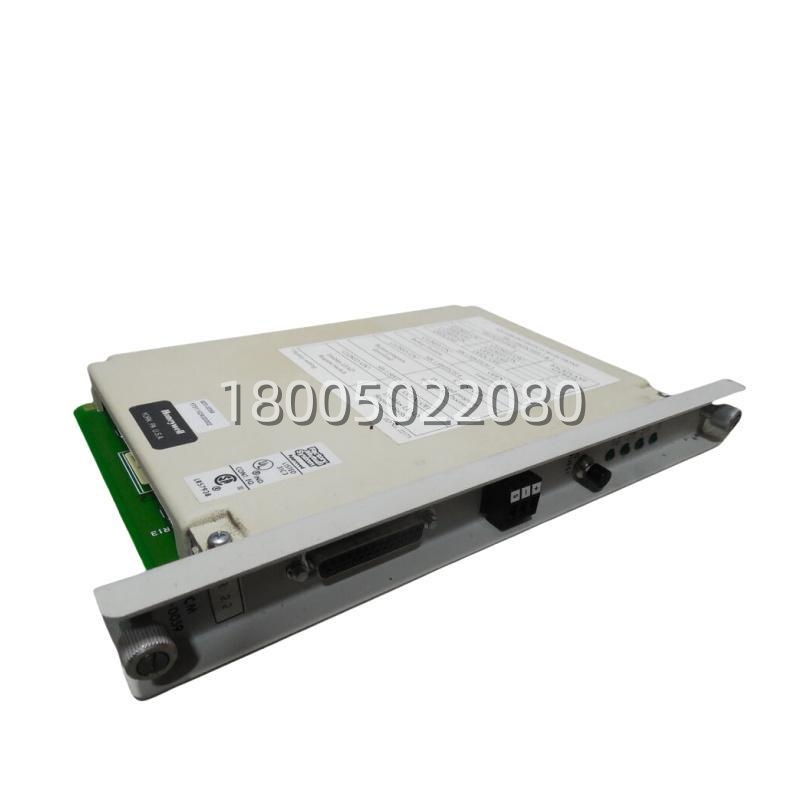
The Honeywell 620-0059 VR 2.2 is a critical Voter Redundancy control module, a fundamental component within Honeywell’s high-availability and fault-tolerant control system architectures, most notably associated with the older Honeywell VDC 3000 and similar distributed control system (DCS) platforms. This module embodies the principle of Triple Modular Redundancy (TMR), a hardware-based design philosophy aimed at achieving exceptional system availability and safety. The core function of the Honeywell 620-0059 VR 2.2 is to act as a “voter” or decision-making unit that continuously compares the outputs from three separate, synchronized processor channels. In a TMR configuration, three identical controller modules execute the same control logic in parallel. The VR 2.2 module receives the output from each of these three channels, performs a majority vote (typically 2-out-of-3), and passes the correct output forward to the field while simultaneously isolating and reporting any channel that has failed or deviated from the others.This sophisticated redundancy mechanism ensures that a single random hardware failure in one processor channel does not cause a system shutdown or produce an erroneous output, thereby guaranteeing both high availability for continuous process operation and enhanced safety integrity. The module is a key element in systems where unplanned downtime is prohibitively expensive or where control failure could have serious safety consequences. The Honeywell 620-0059 VR 2.2 is more than a simple relay; it is an intelligent hardware unit that manages channel synchronization, performs diagnostics, and facilitates online maintenance. It allows a faulty controller channel to be replaced while the remaining two channels maintain uninterrupted control, with the voter seamlessly re-integrating the repaired or replaced channel back into the system. The value of this module lies in its ability to provide near-zero downtime and fail-safe control, which is paramount in critical industries like oil refining, petrochemicals, and power generation.
Technical Specifications
| Parameter Name | Parameter Value |
|---|---|
| Product Model / Part Number | 620-0059 VR 2.2 |
| Manufacturer | Honeywell |
| Product Type | Voter Redundancy Control Module |
| Redundancy Architecture | Triple Modular Redundancy (TMR) |
| Function | Majority Voter (2-out-of-3) for fault-tolerant control |
| Compatible System | Honeywell VDC 3000, TDC 3000 Redundant Components, or similar legacy DCS |
| Form Factor | Typically a card/module for installation in a specific controller chassis |
| Input Channels | 3 (for three independent processor outputs) |
| Voting Logic | Continuous hardware-based comparison and selection |
| Fault Response | Isolates faulty channel, signals alarm, continues operation with remaining channels |
| Diagnostics | Continuous self-test and channel health monitoring |
| Status Indication | LEDs for Power, Channel Status, Fault, Voter Activity |
| Communication | Via proprietary backplane to controller channels and I/O |
| Operating Temperature | 0 to 60°C (typical for control room hardware) |
| Power Requirement | Derived from the system chassis backplane |
| Safety/Reliability Target | Designed to support high system availability (>99.99%) and safety integrity |
Main Features and Advantages
Fault Tolerance and High Availability: The defining feature of the Honeywell 620-0059 VR 2.2 is its implementation of Triple Modular Redundancy. This design ensures that the system can suffer a failure in any one of its three controller channels and continue to operate correctly without interruption, data loss, or a process shutdown. The hardware-based voter makes this decision deterministically and within microseconds, far faster than any software-based solution could manage. This leads to exceptionally high system availability, measured in “nines” (e.g., 99.999%), which is essential for continuous process industries where downtime costs tens of thousands of dollars per hour. The module enables true online maintenance, allowing technicians to diagnose, remove, and replace a failed controller card while the process remains under the control of the other two healthy channels, a capability known as “hot swapping” in this context.


