Description
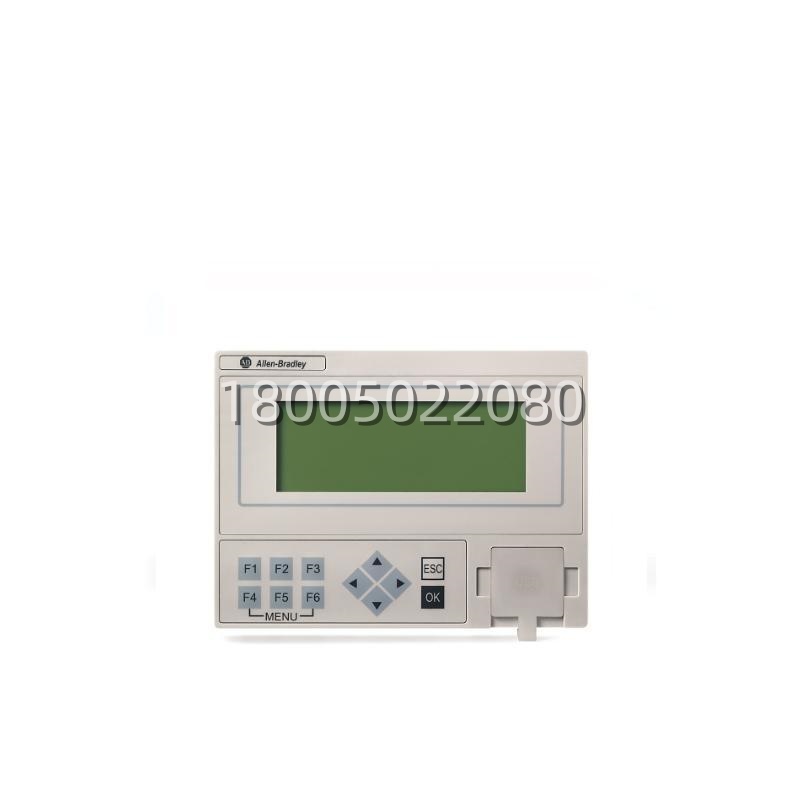
The 2080-LCD is a clip-on LCD display with integrated keypad, part of the Allen-Bradley Micro800 accessory family from Rockwell Automation. Designed specifically to mount directly onto the front of a Micro810 or Micro820 controller, this 2-line × 16-character module provides a low-cost local operator interface—viewing controller status, forcing I/O, editing timer/counter presets, and navigating user-defined screens—without a laptop, without a panel cutout, and without separate 24 V wiring. It is the entry-level HMI choice for machine builders and OEMs where a full PanelView would blow the BOM but “no local interface at all” isn’t acceptable to the end customer.
Application Scenarios
A Midwest grain-handling OEM builds portable auger control skids sold to family-owned elevators—each skid runs a 2080-MICRO810-SE48T (24 I/O embedded, relay outputs) controlling forward/reverse, purge timer, and high-level float. Originally the BOM had zero local interface; any setting change (purge duration, jog time) required the elevator electrician to plug in a laptop with CCW, which 80% of them didn’t have licensed. The OEM added the 2080-LCD to the BOM—clips onto the Micro810, no extra cutout in the NEMA 4X enclosure door, powered off the CPU’s front port. Using CCW’s LCD Screen Editor, the OEM defined four screens: Status(float states + motor run), Setpoints(purge timer 0–60 s, jog time 0–10 s, editable via the keypad), Faults(last 5 fault codes with timestamp), and I/O Force(for commissioning). The result: elevator operators could tweak purge time for dusty conditions without a service call, and the OEM cut post-install truck rolls by ~30%. “It’s sixty bucks that makes the machine feel finished,” the lead designer noted. That’s the 2080-LCD niche—it doesn’t replace a PanelView 800; it replaces nothingbeing there at all.
Parameter
| Main Parameters | Value/Description |
|---|---|
| Product Model | 2080-LCD |
| Manufacturer | Rockwell Automation (Allen-Bradley) |
| Product Category | Micro800 LCD Display with Keypad (Clip-On) |
| Display | 2 lines × 16 characters, monochrome LCD, LED backlight |
| Keypad | 8 tactile keys (Up, Down, Left, Right, Enter, Esc, F1, F2 style) |
| Compatible CPU | 2080-MICRO810-xxx, 2080-MICRO820-xxx (clips to front expansion port) |
| Power Source | Powered from host CPU (no separate 24 V wiring) |
| Communication | Proprietary front-port link to Micro810/820 (no external cable) |
| User Screens | Up to 8 user-defined screens via CCW LCD Screen Editor |
| Mounting | Clips onto CPU front bezel; DIN rail CPU mounting unchanged |
| Operating Temp | 0 °C to +55 °C |
| Agency Approvals | CE, cULus |
| Replacement / Sibling | 2080-LCD is the base; regional/rev variants share same BOM footprint |
Technical Principles and Innovative Values
Innovation Point 1: Zero-Wiring Clip-On Architecture. The 2080-LCD doesn’t consume a communications port, doesn’t need a 24 V feed, and doesn’t require a panel cutout. It physically latches onto the Micro810/Micro820 front bezel and draws power + data over the CPU’s front expansion header. In a compact enclosure (think 10″×10″×4″ NEMA 4 pump skid), saving one cutout and one 24 V pair matters—especially when the alternative is a $400 PanelView 800 + cutout + cable.Innovation Point 2: CCW LCD Screen Editor — No HMI Software License. Screens for the 2080-LCD are built inside Connected Components Workbench (CCW), the same free-tier software used to program the Micro810 itself. Up to 8 screens, each with navigable fields tied to controller tags (timer presets, counter values, bit force, string display). No FactoryTalk license, no ME project—just a tab in CCW. For OEMs shipping 200 skids/year, that license avoidance compounds.Innovation Point 3: Forced I/O and Fault Viewing at the Keypad. Even without custom screens, the 2080-LCD defaults to a system menu that lets the operator view all embedded I/O states, force individual outputs (with password if configured), and scroll through the controller’s fault queue. On a Micro810 with only 48 I/O, this covers 90% of what a service tech needs at 6 a.m. without booting CCW.Innovation Point 4: Micro810 + Micro820 Coverage. The 2080-LCD is one SKU serving two CPUs. Micro810 is the relay-out relay-in entry (no expansion bus), Micro820 adds embedded Ethernet and microSD—but both share the same front profile and LCD clip. Stock one spare for both SKUs on the truck.
Application Cases and Industry Value
A municipal parks-department irrigation pump house had three 5 HP booster pumps on a Micro810 (2080-MICRO810-SE48T) with no HMI—settings lived in the CCW project, and the city electrician only visited quarterly. After a pressure-transmitter drift caused one pump to short-cycle (3-minute on/off) for two weeks before anyone noticed, the department spec’d the 2080-LCD on all three houses. The OEM programmed two screens: Live(suction psi, discharge psi, pump runtime hrs) and Adjust(start/stop delta-psi, min-off timer). The on-site groundskeeper—not an electrician—could now see “Pump 2 cycling fast” on the 2080-LCD, check the delta-psi setting, and nudge it up 2 psi without a laptop or a work order. The short-cycling stopped, and the department estimated ~$1,100/year saved in pump contactor wear across the three houses. The 2080-LCD here acted as a “translator” between a $300 CPU and a non-technical operator—exactly the gap it was built to fill.