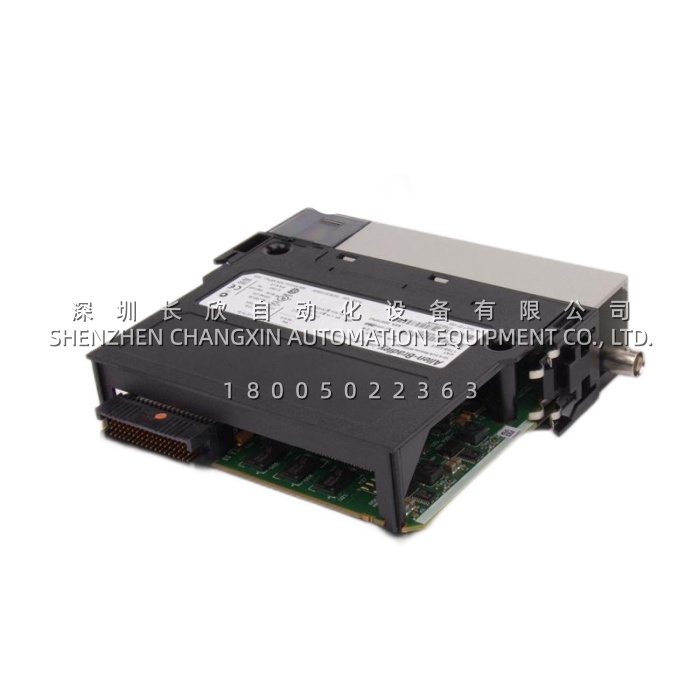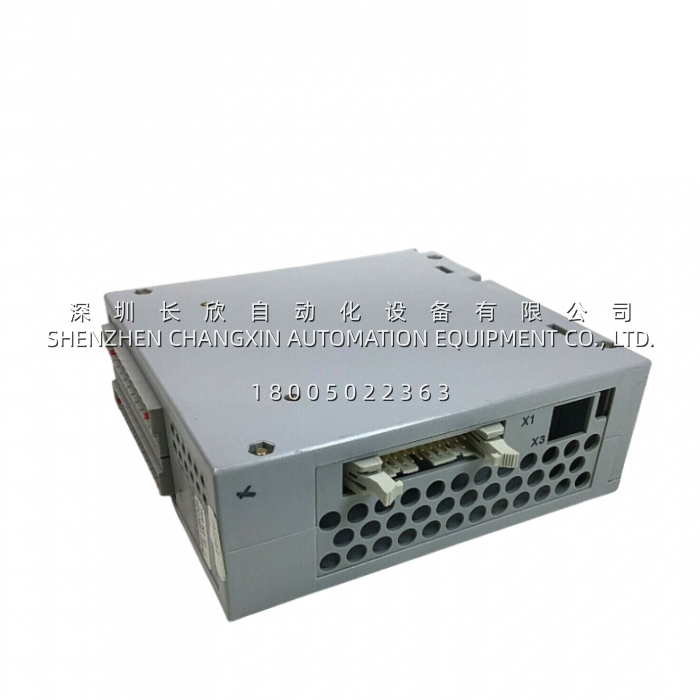
Product Overview
The Siemens 6DD1681-0AH2 is a SIMADYN D Interface Module designated SA10, belonging to the 6DD1681 “interface & signal modules” family that provides signal-adaptation and process-communication bridging inside Siemens’ SIMADYN D and SIMATIC TDC control racks. While the 6DD166x series (CP52M0, CP52IO, etc.) handles GDM memory and fiber-star communication, and the 6DD1607 (FM458-1DP) is the application CPU, the Siemens 6DD1681-0AH2 occupies the analog-I/O layer: 8 analog input channels + 8 analog output channels, each ±10 V signal range, acting as the conditioned gateway between the SIMADYN D control backplane and the field-side analog sensors / actuators — speed feedback tachos, tension transducer amps, position LVDTs, analog setpoint pots, and analog-commanded drive auxiliaries that expect a ±10 V reference.The SA10’s mechanical and electrical footprint is optimized for SU12 subrack integration — the Siemens 6DD1681-0AH2 sits in the SU12 signal-subrack that hangs off a SIMADYN D processor rack (PM4/PM5/PM6 build), and its internal PCB trace routing is engineered for low-parasitic, impedance-matched analog passage: minimized parasitic capacitance, suppressed noise floor, and heavy-duty connectorization to the SU12 backplane and to the field-terminal transition. This is not a “generic analog card” — it is SIMADYN D-architecture-specific, meaning the ±10 V channels are scaled and buffered for the CFC/SFC application layer running on the FM458/PM6/PM7 CPUs, and the SA10’s analog scan is synchronous to the SIMADYN D task cycle (sub-ms class), not to a slow PLC I/O scan. The Siemens 6DD1681-0AH2 therefore slots into applications where analog signal integrity directly feeds closed-loop algorithms — rolling-mill screw-down position loops, unwind/rewind tension loops, hydro-governor wicket-gate position, paper-machine draw-ratio analog trim — places where a noisy or drift-prone analog front-end shows up as visible product-quality deviation, not just a “channel alarm.”Siemens placed the Siemens 6DD1681-0AH2 into PM500 “Discontinued / End of PLM & Support” effective 01.10.2011, deleted without replacement — there is no Siemens-official SA10 successor in the SIMADYN D portfolio, and SIMADYN D itself went end-of-manufacture/support in October 2015. That makes the Siemens 6DD1681-0AH2 a pure aftermarket/spare-channel item for plants that retained SIMADYN D on rolling mills, paper machines, hydro governors, and cement-kiln drives and judged a full SIMADYN D → SINAMICS/S7-1500 R/H migration at >$10 M/line not yet justified. Weight is 0.26 kg, estimated shipping envelope ~4.5 × 15.9 × 12.9 cm, ruggedized PCB rated for thermal cycling and contaminant exposure in marshalling-cabinet environments.
Technical Specifications
| Parameter Name | Parameter Value |
|---|---|
| Product Model | 6DD1681-0AH2 |
| Manufacturer | Siemens (Large Drives / SIMADYN D) |
| Product Type | SIMADYN D Interface Module (Signal / Analog I/O) |
| Designation | SA10 (8 AI + 8 AO) |
| Product Family | Siemens 6DD1681 (Interface & Signal Modules, SIMADYN D / SIMATIC TDC) |
| Analog Inputs | 8 channels |
| Analog Outputs | 8 channels |
| Signal Voltage Range | ±10 V (all AI and AO channels) |
| Integration Target | SU12 signal subrack (SIMADYN D processor rack adjunct) |
| Backplane Interface | SIMADYN D SU12 backplane bus (ribbon-to-field transition architecture) |
| PCB Architecture | Ruggedized, low-parasitic trace routing, impedance-matched I/O span, noise-floor suppression |
| Mechanical / Shipping Size | ~4.5 × 15.9 × 12.9 cm (est.) |
| Weight | 0.26 kg |
| Compatible Platforms | SIMADYN D (PM4/PM5/PM6), SIMATIC TDC (signal-layer retrofits) |
| Operating Environment | Industrial marshalling-cabinet class (thermal cycling, contaminants) |
| Lifecycle Status | PM500 Discontinued, deleted without replacement (since 01.10.2011); SIMADYN D EoL Oct 2015 |
| Commodity Context | Legacy drive-control analog I/O expansion |
Main Features and Advantages
The Siemens 6DD1681-0AH2 exists because SIMADYN D control racks (PM4/PM5/PM6) run CFC/SFC closed-loop algorithms at sub-ms scan — speed, tension, position, torque, draw-ratio — and those loops need analog feedback and analog command that are synchronous to the control task, buffered against the rack’s digital noise floor, and scaled into the ±10 V swing that SIMADYN D’s analog subsystem expects. The SA10 provides exactly that: 8 AI + 8 AO, each ±10 V, each channel buffered and filtered on-entry so the FM458/PM CPU sees a stable word in the CFC input table without the user having to hang external signal conditioners on every tacho or LVDT.The SU12 subrack integration is the first architectural advantage. The Siemens 6DD1681-0AH2 doesn’t plug into the PM4/PM5/PM6 processor rack’s backplane directly — it lives in an SU12 signal subrack that is the processor rack’s analog/terminal adjunct. The SU12 carries the field-terminal blocks and the ribbon-to-backplane transition; the SA10 plugs into the SU12 backplane and the field wires land on the SU12 terminals, not on the SA10 itself. This separation matters: the SU12 takes the mechanical abuse of field wiring (vibration, re-termination, probe), the Siemens 6DD1681-0AH2 stays on the clean side of the SU12 backplane. For maintenance teams, that means a flaky analog channel is diagnosed at the SU12 terminal first; if the terminal is clean and the channel still drifts, swap the Siemens 6DD1681-0AH2 — 5-minute job, no field-wire move.Second advantage: the ruggedized PCB and trace-layout discipline. Per the aftermarket teardown notes, the Siemens 6DD1681-0AH2 internal routing is optimized for “high-speed I/O routing within legacy drive control environments” — low parasitic capacitance, impedance-matched I/O span, suppression of the industrial noise floor in large rolling-mill and power-plant marshalling cabinets. That’s not marketing copy: in a hot-strip finishing-mill MCC room, the EMI floor from 6–10 MVA drive cubicles 3 m away is brutal, and a generic ±10 V analog card (even a S7-300 SM 331/332) would pick up enough hash to jitter a position loop. The SA10’s PCB is hardened for that floor, which is why SIMADYN D BOMs didn’t substitute a generic analog card even when SM 331/332 was sitting in the same cabinet on the S7-300 side.