Product Overview
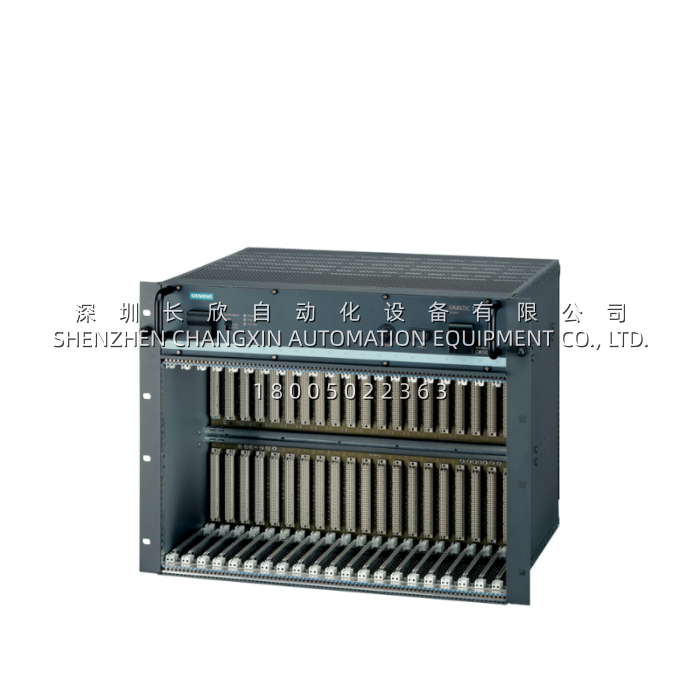
The Siemens 6DD1682-0CH2 is a SIMATIC TDC subrack UR5213 — the 2nd-generation 19-inch chassis that forms the mechanical, power, and backplane foundation of Siemens’ SIMATIC TDC (Technology and Drive Control) platform. Unlike the SIMADYN D family (6DD1600-0Axx PM5/PM6, 6DD1601 PG16, 6DD1662 CS8) whose subracks carry C-bus/L-bus for 32/64-bit PM CPUs, the Siemens 6DD1682-0CH2 carries a 64-bit high-speed parallel backplane designed for nanosecond-level multi-CPU synchronization — up to 20 CPU551/552/553 modules in one UR5213 rack, and up to 44 UR5213 racks linkable via fiber-optic GDM (Global Data Memory) into a single synchronized system of 836 CPUs. This is the scale that justifies TDC’s existence: tandem mills with 30+ stands, HVDC converter stations, large-extrusion multi-motor lines, and test-stand clusters where even SIMADYN D PM6’s C-bus runs out of headroom.The Siemens 6DD1682-0CH2 integrates its own wide-range system PSU (85–264 V AC / 198–253 V DC, 120 V / 230 V nominal, 47–63 Hz, <40 A inrush) delivering +5 V @ 36 A, +3.3 V @ 44 A, +12 V @ 4.6 A, –12 V @ 4 A, 320 W total — enough for a full populate of CPU551 + SM500 + CP51M1 + CP52A0 without hitting the 320 W ceiling. Three module-cooling fans plus one PSU-cooling fan provide forced convection; fan speed is monitored and a single-fan failure asserts the FANAL* backplane-bus signal (detectable in D7-SYS / STEP 7) while the PSU stays alive — the Siemens 6DD1682-0CH2 doesn’t shut down on one-fan loss, it alerts. Three floating 230 V signaling relays (SYSFAIL, POWER, FAN FAIL) land on terminal X1 for plant-DCS/alarm-panel integration. A 5-row female GDM connector at the rear/top enables fiber-star linking to peer UR5213 racks via CP52A0/CP52M0/CP52I0 GDM modules — GDM update <1 ms, 44-rack max, 200 m fiber reach.The Siemens 6DD1682-0CH2 is the middle child: UR5213 Gen1 = 6DD1682-0CH0 (PM500 deleted Oct 2018), UR5213 Gen2 = 6DD1682-0CH2 (PM410 deleted Nov 2015), successor = 6DD1682-0CH3 (UR6021) but with restrictions — new CPU555 cannot mix with old modules in UR6021, and the backup battery changes from the 6DD1682-0CH2 AA lithium to 6ES7971-0BA00 (3.6 V 2.3 Ah). For plants with live UR5213-based TDC cells, the Siemens 6DD1682-0CH2 remains the only fully-compatible chassis — which is why NOS stock commands premium.
Technical Specifications
| Parameter Name | Parameter Value |
|---|---|
| Product Model | 6DD1682-0CH2 |
| Manufacturer | Siemens AG (SIMATIC TDC Series) |
| Product Type | TDC Subrack / Component Carrier, UR5213 (2nd Generation) |
| Number of Slots | 21 Eurocard slots (max 20 CPUs + I/O/comms) |
| Input Voltage – AC | 85 … 264 V AC (120 / 230 V nominal), 47–63 Hz |
| Input Voltage – DC | 198 … 253 V DC |
| Rated Input Current | 4.45 A @ 120 V AC / 2.3 A @ 230 V AC / 2.38 A @ 220 V DC |
| Max Inrush Current | < 40 A |
| Power Failure Hold-Up | min. 20 ms |
| Output Voltages | +5 V @ 36 A / +3.3 V @ 44 A / +12 V @ 4.6 A / –12 V @ 4 A |
| Max Total Output Power | 320 W (must verify per configuration) |
| Cooling | 3 module fans + 1 PSU fan, forced convection, speed monitored |
| Battery | AA lithium (backup monitoring ~20 μA + slots max 180 μA; 2.3 Ah class ≈ 300 days standby) |
| Signal Relays | 3× floating 230 V AC (SYSFAIL, POWER, FAN FAIL), 2 A rated |
| GDM Connector | 5-row female (fiber-star to CP52A0/CP52M0/CP52I0) |
| Backplane Bus | 64-bit high-speed parallel, multi-CPU sync (nanosecond scale) |
| Operating Temp | 0 … +60°C |
| Storage Temp | -40 … +70°C |
| Relative Humidity | 5 … 95 %, non-condensing |
| Protection | IP20, Protection Class 1 with PE |
| Dimensions (W×H×D) | ~482.6 × 354.9 × 343 mm (19″ rack standard) |
| Weight | ~20 kg |
| Lifecycle | PM410 – Discontinued 1 Nov 2015; successor 6DD1682-0CH3 (UR6021) with restrictions |
| Config Software | STEP 7 + D7-SYS (CFC/SFC/ST/LAD/FBD) |
Main Features and Advantages
21-slot capacity for up to 20 synchronized 64-bit CPUs. The Siemens 6DD1682-0CH2 backplane is purpose-built for multi-CPU operation — slot 1 typically hosts CPU551 (64-bit MIPS R5000, 32 MB RAM, 100 µs min cycle, 8 DI with 4 interrupt-capable), slots 2–20 can stack additional CPU551/552/553, SM500 I/O, CP50M1/CP51M1/CP5100 comms, and CP52A0 GDM access modules. One UR5213 rack can run 20 CPUs synchronized on the 64-bit backplane — a 5-stand tandem might use 3 CPUs (uncoiler/stands 1–2, stands 3–4, stand 5/recoiler) while a large HVDC or extrusion line fills all 20. The Siemens 6DD1682-0CH2 320 W budget covers a full populate of CPU551+SM500+CP51M1+CP52A0 without exceeding — Siemens explicitly verified this combo stays under 320 W; any custom mix (e.g., adding CP5100 Ethernet loads) must be re-checked.GDM fiber linking — up to 44 racks, 836 CPUs. The 5-row GDM female connector on the Siemens 6DD1682-0CH2 lands CP52M0 (memory) + CP52I0 (interface) + CP52A0 (access) modules, forming a star-topology fiber network across up to 44 UR5213 racks with <1 ms GDM update, 200 m fiber reach, 630 MB bandwidth class. This is what makes TDC the platform for world-scale multi-stand mills and HVDC valves — scan-time sync, clock sync, shared alarm, and a central data memory visible to all 836 CPUs. A Siemens 6DD1682-0CH2 without GDM is just a local rack; with GDM it becomes a node in a super-computer.Wide-range PSU + 20 ms hold-up. The Siemens 6DD1682-0CH2 eats 85–264 V AC and 198–253 V DC on the same terminals — European 230 V, North American 120 V, and 220 V DC telecom/emergency-bus all land without a buck-boost. 20 ms hold-up covers one line-cycle drop at 50 Hz, letting the CPUs ride through a mains blip without a full rack reboot (the batteries cover longer outages for SRAM retentive data). Internal 20 A fuse on the PSU means only the upstream mains needs external fusing — Siemens recommends 16 A thermomagnetic B-curve or slow-blow.Intelligent fan management, not dumb trip. Three module fans + one PSU fan, all speed-monitored. Single-fan failure → FANAL* backplane signal asserted → D7-SYS/STEP 7 sees it → maintenance gets paged — but the Siemens 6DD1682-0CH2 PSU and backplane stay alive. This is deliberate: a fan failure in a hot-cellar rolling-mill cellar shouldn’t trip 20 CPUs and stop the coil. The dip switch S1.4 (“Shutdown mode”) defaults ON for forced-convection modules (CPU551 demands it at 0–60°C intake); only if intake is guaranteed ≤35°C can S1.4 go OFF — most plants leave it ON.