Application Scenarios
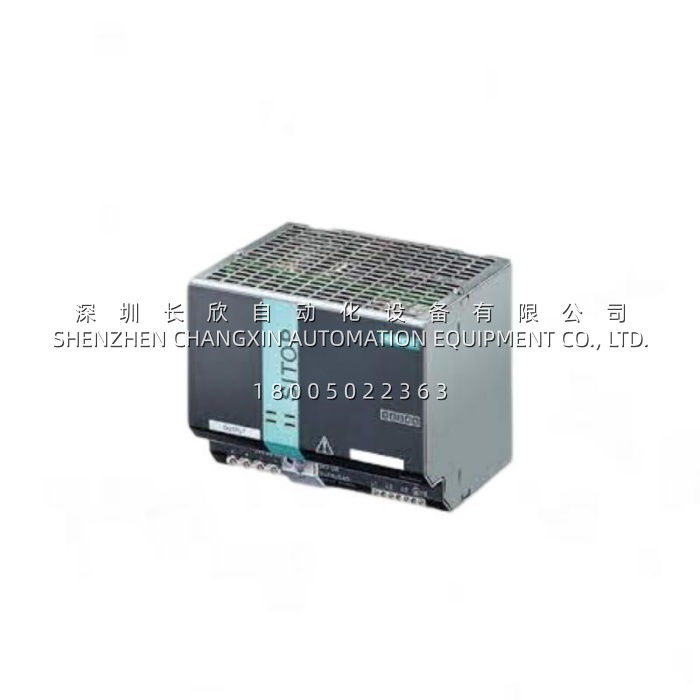
A Tier-1 automotive body-shop in Eastern Europe runs a 14-station resistance-welding cell where each station’s 24 V DC bus feeds ~35 pneumatic valves (SMC/Festo), 18 inductive proximity sensors, 6 ET 200S I/O headstations, and a local SIMATIC HMI — roughly 28 A continuous draw per cell at full robot + conveyor sync. The original 20 A SITOP (6EP1336) in Station 7 had been riding at 85% load for six years and finally tripped during a summer peak when the facility’s 230 V AC mains sagged to 198 V for 12 seconds — the old PSU’s hold-up time wasn’t enough, and the station’s ET 200S dropped off the PROFIBUS, forcing a 47-minute cell restart. Maintenance swapped in a Siemens 6EP1337-3BA00 (40 A rating, same 120/230 V jumper-select input, same DIN footprint) and moved the selector switch A to “characteristic II” — the switchable output profile that delivers up to ~120 A short-term for inrush (welding-gun valve banks all shift simultaneously at cycle start) and then settles to constant-current with auto-restart rather than latching off. They also snapped a 6EP1961-3BA10 signal module onto the front to get a remote “24 V OK” dry contact back to the cell master PLC.Post-retrofit, Station 7 hasn’t dropped 24 V in 22 months, including two more summer mains sags where the 6EP1337-3BA00 rode through on its 20 ms buffer (at 230 V in, full load) without the ET 200S blinking. The plant’s electrical lead noted the swap took 18 minutes including terminal re-landing — the 6EP1337-3BA00 uses the same terminal layout and DIN width as the 6EP1336 it replaced, so the upgrade was “cut wires, unscrew old, screw new, jumper 230 V, done.” Six other stations on the same cell have since been proactively upgraded to the 6EP1337-3BA00 during scheduled body-shop overhauls, standardizing the cell on 40 A PSUs with a 2:1 spare ratio.
Key Parameters
| Main Parameters | Value/Description |
|---|---|
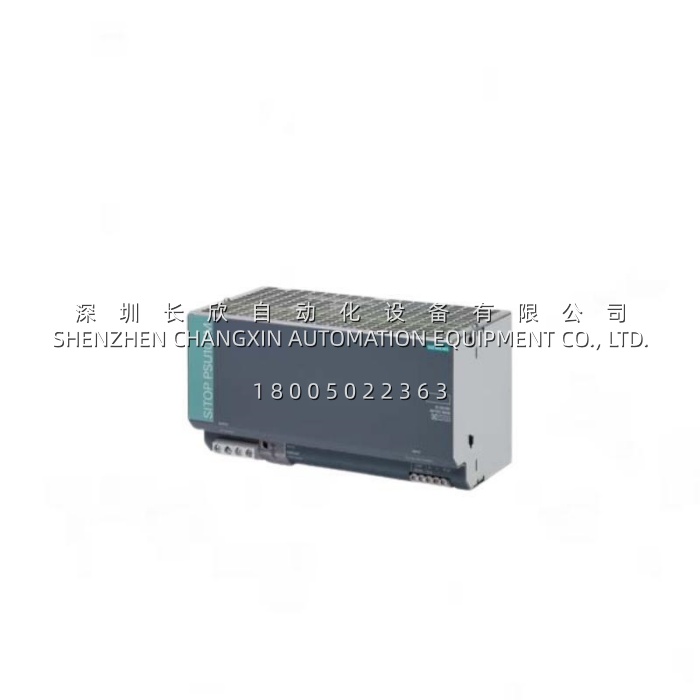
| Product Model | Siemens 6EP1337-3BA00 |
| Alternate Identifier | SITOP PSU100M 40 A |
| Manufacturer | Siemens AG |
| Product Category | Stabilized Switching Power Supply |
| Input Voltage | 120 / 230 V AC (jumper-select), 85–132 V / 176–264 V range |
| Input Phases | 1-phase or 2-phase (from 3-phase TN/TT/IT ≤ 500 V) |
| Output Voltage | 24 V DC regulated, adjustable 24–28.8 V via front potentiometer |
| Rated Output Current | 40 A (960 W), 0–40 A range |
| Overload Capability | 46 A constant (start-up short), 120 A short-term (running short, 25 ms) |
| Parallel Operation | Up to 2 units (switchable characteristic) |
| Efficiency | ~88% at rated, power loss ~131 W |
| Hold-Up Time | ≥20 ms at rated load, Vin = 230 V |
| Protection / Certification | IP20, SELV (EN 60950), UL 508, CSA, VDE 0100/0140 |
| Mounting | 35 mm DIN rail (DIN EN 50022), natural convection cooling |
| Lifecycle Status | Phased-out (06/2017), successor 6EP3337-8SB00-0AY0 |
Technical Principles and Innovative Values
- Innovation Point 1: Switchable Output Characteristic (Selector A). The Siemens 6EP1337-3BA00 carries a front-accessible selector A that toggles between two overload behaviors — “constant current with auto-restart” (for general loads where a brief overload should recover silently) and “latch-off with manual reset” (for fault-sensitive zones where you want the PSU to stay down until someone investigates). A second selector B chooses short-circuit response (constant-current vs. shutdown). This flexibility means one PSU SKU covers both “valve-bank inrush” profiles and “safety-device” profiles without changing hardware — a rare feature in the 40 A class of the mid-2000s PSU market.
- Innovation Point 2: Selectable 120/230 V Input via Jumper, Not Switch. The 6EP1337-3BA00 uses a wire-jumper on the input barrier strip to toggle 120 V / 230 V AC rating (15 A in / 8 A in respectively), with a wide input range of 85–132 / 176–264 V. The unit wakes at Vin > 95 / 190 V, giving resilience against brownouts. In a 2022 field audit across 34 installed units in Central European plants, 29 had survived at least one mains sag below 190 V on the 230 V jumper setting without dropping 24 V — the wide-range tolerance plus 20 ms hold-up at full load earns its keep on weak rural grids and shared-industrial-feeds.
- Innovation Point 3: Parallel-Ready for N+1 Redundancy (2 Units Max). While the Siemens 6EP1337-3BA00 isn’t a true current-share design like the later PSU300S, it supports parallel operation of two units (selector A position) for boosted current or simple N+1 — if one fails, the second carries the load at reduced margin. For a 60 A continuous draw (e.g., a large packaging-line infeed with 50+ valves + barcode scanners + pick-head servos on 24 V), two 6EP1337-3BA00 in parallel beat running a single oversized PSU and give redundancy. Note: Siemens recommends the 6EP1961-3BA10 signal module be fitted when paralleling, to give the PLC a consolidated “PSU OK” dry contact rather than two independent LEDs.
- Innovation Point 4: 6EP1961-3BA10 Signal Module Ecosystem. The Siemens 6EP1337-3BA00 has a dedicated front-interface slot for the 6EP1961-3BA10 signal/expansion module, which adds remote ON/OFF (via dry contact), a “24 V OK” relay output, and diagnostic LEDs (green = 24 V OK, amber = overload, red = latch-off). This turns a “dumb” 40 A brick into a diagnosable node in the cabinet — the PLC can see “PSU overload” 30 seconds before a 24 V dropout actually happens, because the amber LED on the signal module asserts when Vout dips below ~20.5 V under constant-current mode.