Technical Specifications
| Parameter | Value |
|---|---|
| Product Model | 6ES7 313-5BG04-0AB0 |
| Manufacturer | Siemens |
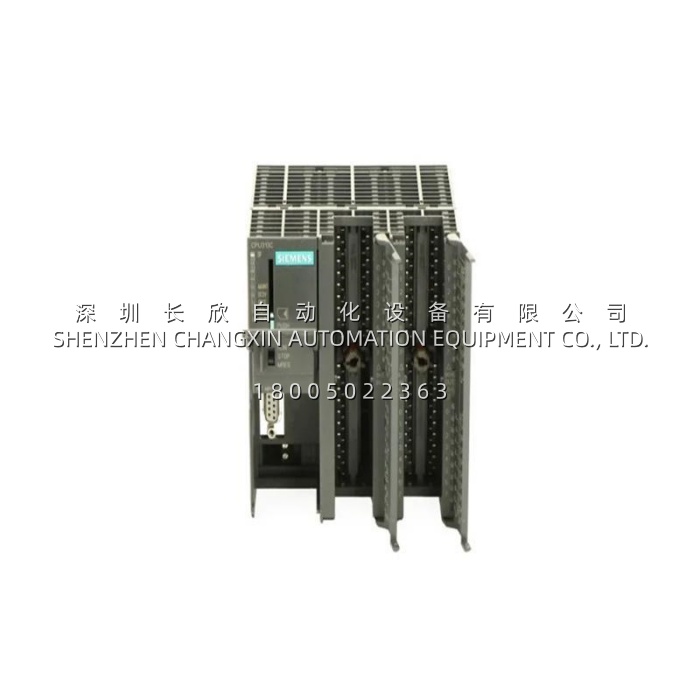
| Product Type | SIMATIC S7-300 Compact CPU (CPU 313C) |
| Work Memory | 64 KB integrated (RAM) |
| Load Memory | Via MMC (Micro Memory Card), up to 8 MB |
| Integrated DI | 24 × DC 24 V (sink/source configurable groups) |
| Integrated DO | 16 × DC 24 V / 0.5 A, transistor sourcing |
| Integrated AI | 4 × 10-bit, ±10 V / 0–20 mA / 4–20 mA |
| Integrated AO | 2 × 8-bit, ±10 V / 0–20 mA |
| Pt100 Input | 1 channel (2-/3-/4-wire) |
| High-Speed Counters | 3 × 30 kHz max (on DI) |
| Communication Interface | 1 × MPI (12 Mbit/s max) |
| Supply Voltage | 24 V DC (L+ terminal, integrated PS for backplane) |
| Current Consumption (typ.) | ~650 mA from 24 V DC |
| Operating Temperature | 0 °C to +60 °C |
| Dimensions (W×H×D) | ~80 × 125 × 130 mm (S7-300 standard width) |
| Mounting | 35 mm DIN rail (EN 60715), S7-300 rack bus |
| Programming | STEP 7 V5.x / TIA Portal (firmware V3.x) |
Main Features and Advantages
Compact all-in-one density. The core value of the Siemens 6ES7 313-5BG04-0AB0 is I/O consolidation. Twenty-four DI + sixteen DO + four AI + two AO + one Pt100 in a single 80 mm S7-300 slot means a small machine cabinet can run on a 3-slot rail: CPU 313C + one SM 321/331 expansion + one communications card (CP 343-1 for Ethernet, or CP 341 for serial), and the job is done. For skid OEMs building packaged compressors, RO-water skids, or chemical-dosing units, this density eliminates an entire expansion rack, saves DIN-rail length, shrinks the enclosure footprint, and cuts marshalling-terminal count. The Siemens 6ES7 313-5BG04-0AB0 therefore shows up repeatedly in EPC “standard skid BOM” templates where the spec calls for “S7-300 compact, ≤64 KB, MPI only.”64 KB work memory with MMC-based load storage. Unlike the older S7-300 CPUs that relied on RAM + battery + EPROM/MMC hybrid, the Siemens 6ES7 313-5BG04-0AB0 stores the executable program in the 64 KB integrated work RAM, loaded at boot from the removable MMC (Micro Memory Card, 6ES7 953-x系列). The MMC is key: it holds the project download, retains the program through power loss without battery dependency, and is swappable—pull the MMC from a failed CPU, seat it in a replacement Siemens 6ES7 313-5BG04-0AB0, power up, and the rack resumes. For plants that keep one cold-spare CPU per panel row, this MMC-carry behavior mirrors what you see on the Teleperm M EEPROM submodules (6DS1832-8AA) but in the S7-300 world—same philosophy, different silicon. The MMC also stores retentive data blocks if configured, though the CPU 313C’s retentive memory pool is modest; for heavy data-logging, most plants push that to an HMI or a CP-based data-exchange.Three 30 kHz fast counters on integrated DI. Many compact PLCs relegate counters to software scan-rate, which caps you at ~几百 Hz on a 10 ms scan. The Siemens 6ES7 313-5BG04-0AB0 hard-wires three counter channels to specific DI pins, clocked at up to 30 kHz, with configurable gating, direction, and compare-values. This makes the CPU viable for small conveyor zones with 500–1000 P/R encoders, rotary-index tables, flow-totalizer pulse inputs from Coriolis meters (where 10 kHz pulse rate at max flow is common), and anti-stall monitoring on small motor drives. You don’t need a FM 350-1 add-on card for these tasks, which keeps the rack thin and the BOM cost down.On-board Pt100 input with 2-/3-/4-wire support. The Siemens 6ES7 313-5BG04-0AB0 includes one dedicated Pt100 channel, usable for local panel-temperature monitoring (is the cabinet overheating? is the compressor-skid lube-oil heater working?) without consuming one of the four AI channels. It’s 10-bit resolution like the AI, adequate for supervision rather than precision control—if the application needs a 3-wire Pt100 for a reactor-jacket loop, that would go on the AI channels with transmitter isolation; the on-board Pt100 is the “free” channel for cabinet/enclosure temp. In hot-ceiling-mounted panels or skid boxes in direct sun, this single channel often feeds a simple “cabinet-fan start at 40 °C” interlock.MPI interface for PG/OP and peer networking. The front-port MPI (RS-485 based, up to 12 Mbit/s) connects to a PG (programming device), an OP/TP HMI panel (MP 277, TP 177, etc.), or a peer S7-300/S7-400 via MPI Global Data. For small cells where the CPU doesn’t need PROFIBUS DP master (that’s the CPU 313C-2 DP, 6ES7 313-6CF03-0AB0), the MPI-only Siemens 6ES7 313-5BG04-0AB0 is cheaper and sufficient—HMI + PG access + maybe a handful of distributed ET 200M I/O over PROFIBUS would push you to the -2DP variant, but for a standalone skid with local I/O only, MPI to a TP170/TP177 is the standard pattern.Mature-platform stability and sparing reality. Siemens officially phased the S7-300 platform toward “end-of-production / spare-only” status as S7-1500 and S7-1200 took greenfield share, but the Siemens 6ES7 313-5BG04-0AB0 remains buyable through authorized distributors and the aftermarket. For plants with 20+ 313C cabinets, the strategic move is stocking 1:10 cold-spare ratio (one spare per ten live CPUs) plus pre-programmed MMCs cloned from the live download images. The 313C’s failure modes are well-known after 15+ years: electrolytic stress on the 24 V DC input filter (shows as “SF” LED + inability to hold 24 V regulation under load), MMC corruption from improper removal (always de-energize or STOP before pulling the card), and the front 40-pin spring connectors fatiguing if repeatedly unplugged. None of these are surprising, which makes the Siemens 6ES7 313-5BG04-0AB0 a predictable spare to manage.