Technical Specifications
| Parameter | Value |
|---|---|
| Product Model | 6ES5102-8MA02 |
| Manufacturer | Siemens |
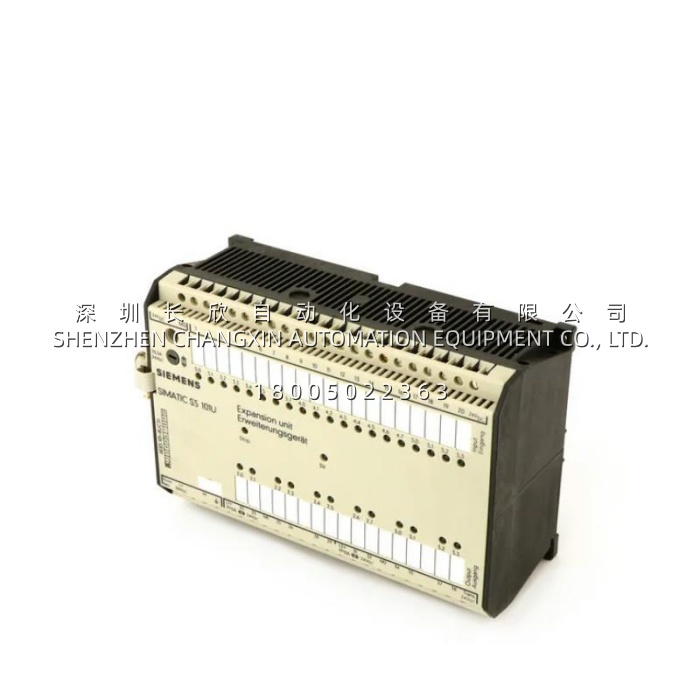
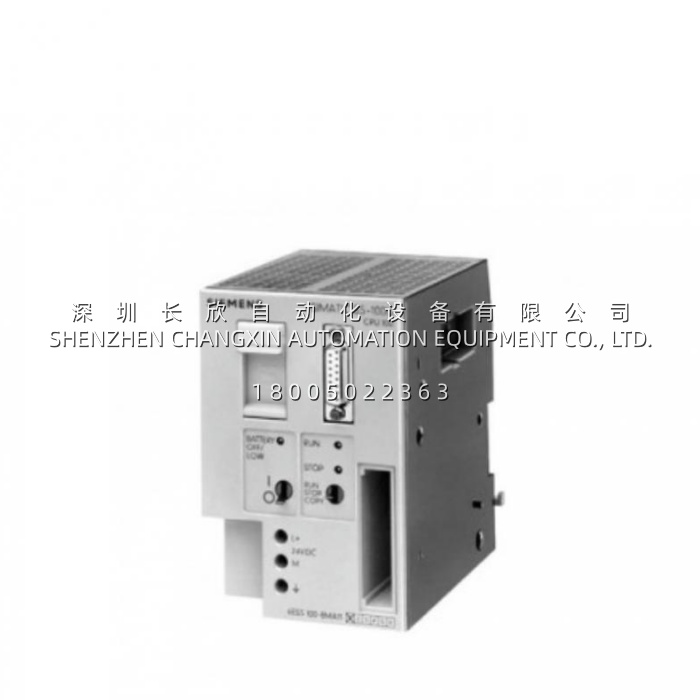
| Product Type | SIMATIC S5-100U CPU 102 Central Processing Unit |
| Compatible System | Siemens SIMATIC S5-100U compact PLC |
| Microprocessor | 8-bit |
| Internal RAM | 2 KB (2048 statements) |
| Program Storage | RAM + EPROM/EERPOM submodule slot (6ES5 370 family) |
| Backup Battery | Lithium 3.4 V / 850 mAh (~5 yr service life) |
| Binary Execution Time | ~7 µs / operation |
| Timers | 32 (0.01 … 9990 s) |
| Counters | 32 (0 … 999) |
| Flags | 1024 total, 512 retentive |
| Max Digital I/O | 256 points (across S5-100U expansion modules) |
| Max Analog I/O | 16 points |
| Input Supply Voltage | 24 V DC (18 … 34 V DC permissible) |
| Integrated Output Voltages | +9 V DC (I/O bus), +5.2 V DC (PG interface) |
| Communication | PG port (RS-485, STEP 5 programming) |
| Dimensions (W×H×D) | 91.5 × 135 × 120 mm |
| Weight | ~0.65 kg |
| Operating Temperature | 0 … +60 °C |
| Mounting | 35 mm DIN rail (EN 60715) |
Main Features and Advantages
All-in-one compactness with integrated triple-rail PS. The signature of the Siemens 6ES5102-8MA02 is that it eliminates the separate S5 PSU module. Feed 24 V DC (18–34 V tolerance, so a standard SITOP PSU100S 24 V/2.5 A or 5 A is perfect) into the CPU’s L+/M terminals, and the unit internally regulates +9 V for the S5-100U expansion-module I/O bus and +5.2 V for the PG programming-device interface. This collapses a three-module S5-115U starter build (PSU + CPU + SM) into one Siemens 6ES5102-8MA02 plus whatever 100U signal expansions the application needs. For small-machine OEMs and skid builders who standardized on S5-100U in the 1990s, this integration is why the 6ES5102-8MA02 shows up in panels where a full S5 rack would be 60 % empty and 40 % over-budget.2 KB RAM + EPROM submodule for classic S5 storage hierarchy. The Siemens 6ES5102-8MA02 executes from 2 KB of internal RAM—tiny by modern standards, but more than enough for the kind of bit-logic + timer + counter sequencing a small conveyor zone or a package-wrapper ancillary cell actually needs (a few hundred networks, mostly AWL/STL). RAM retention is backed by the 3.4 V / 850 mAh lithium; the dedicated front slot accepts a 6ES5 370 EPROM or EEPROM submodule that can be burned from STEP 5 and then used as the boot image if the lithium dies or the RAM gets corrupted during a long outage. Plants that run Siemens 6ES5102-8MA02 in rarely-visited panels (roof-mounted HVAC controllers, remote pump-station sequencers) routinely burn an EPROM once the logic is finalized and keep the RAM as the working copy—exactly the same two-tier philosophy as the S5-95F we covered earlier, but on a smaller RAM footprint.32 timers / 32 counters + 1024 flags in an 8-bit package. For an entry-tier CPU, the Siemens 6ES5102-8MA02 is surprisingly well-resourced on the sequencing side. Thirty-two timers at 10 ms resolution cover things like conveyor-delay zones, pump-post-lube timers, damper-actuator stroke timers, and HVAC fan-stagger intervals; thirty-two counters handle batch-piece counts, pallet-index tallies, and alarm-occurrence accumulators; 1024 flags (half retentive) give enough internal-coil estate for mode bits, alarm latches, HMI-faceplate handshakes, and interlock staging without hitting the ceiling. The 7 µs binary execution means a few-hundred-network AWL scan still lands well under the 10–20 ms typical small-machine cycle budget—no one buys a Siemens 6ES5102-8MA02 for motion-control servo loops; they buy it for sequencing, and it delivers.256 DI/DO + 16 AI/AO expansion budget. Although the Siemens 6ES5102-8MA02 itself carries zero integrated I/O (unlike the S5-95F compact which has 16 DI/8 DO on-body), it backplanes to S5-100U expansion modules—SM 121 (DI 24 V), SM 122 (DO 24 V/0.5 A), SM 131 (AI ±10 V / 0–20 mA), SM 132 (AO) and the like—to a ceiling of 256 digital points and 16 analog points. That is plenty for a small machine: 48 DI (photo-eyes, jam switches, guard-door limits, PB station) + 32 DO (solenoid bank, status beacons, starter coils through interposing relays) + 4 AI (pressure Tx on the pneumatics rail, a torque feedback) + 2 AO (proportional pressure-reducer, VFD ref) = ~86 points, well inside the 256/16 envelope. The Siemens 6ES5102-8MA02 therefore scales from “tiny” (one SM 121 + one SM 122) to “full 100U backplane” without changing the CPU.STEP 5 programming and long-term sparing reality. The Siemens 6ES5102-8MA02 is programmed in STEP 5 (V5.x / V7.x era, via PG-720/740 or a modern laptop with the USB-PG adapter and a virtualized STEP 5 environment). Siemens formally discontinued the S5-100U family in 2022, so the 6ES5102-8MA02 is now spare-only procurement—new-old-stock, pulled-from-operating-surplus, or refurbished. For plants with 10+ S5-100U cabinets (typical in a multi-line packaging hall, a multi-bay conveyor network, or a multi-skid water-treatment plant), the storeroom math is: one cold-spare CPU per 5–8 live units, one pre-burned EPROM per distinct program image, and one fresh lithium per CPU on a 4-year rotate. The Siemens 6ES5102-8MA02 shares the same lithium cell and the same 6ES5 370 EPROM family as the S5-95F, so a plant already sparing those for S5-95F cabinets can cross-pool—small but real storeroom economy.