Application Scenarios:
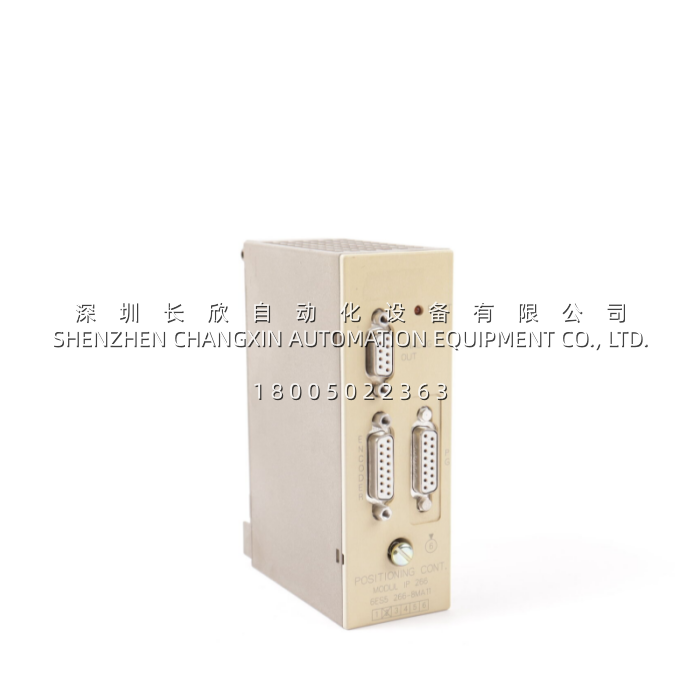
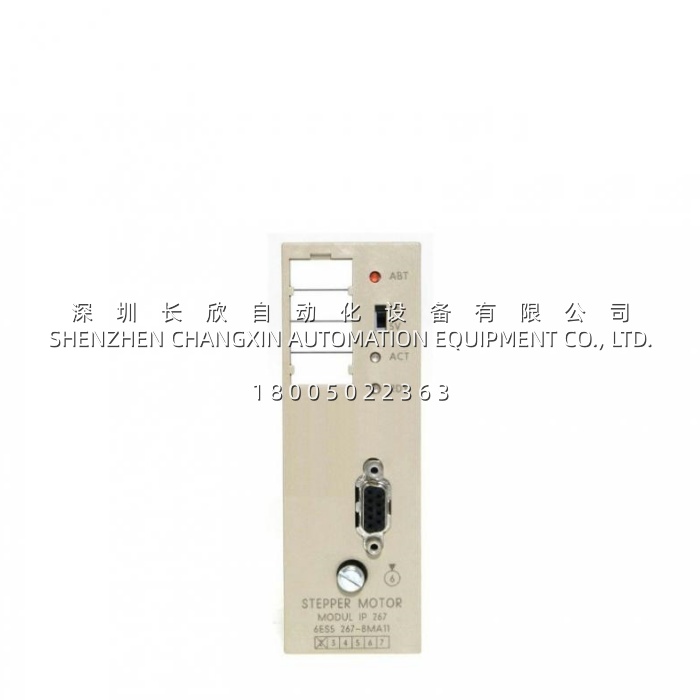
A 1995 vintage hardwood moulder in Southern Germany still runs its infeed-roller indexing and cross-cut carriage on an S5-100U (CPU 941) with a Siemens 6ES5267-8MA11 on the carriage axis — external Siemens 6SN1145 stepper power stage + 1.8°/step motor, 5 mm pitch ball-screw, 1000-step/rev including microstepping. After 27 years, the operator noticed the carriage was landing ~0.6 mm short on a 1.2 m index during third-shift runs — enough to throw the profile off the saw line and scrap a 6 m board. The I&C tech initially blamed the ball-screw (lash) and re-cut the backlash comp in FB252 from 12 pulses → 18 — no fix. Then he scoped the Siemens 6ES5267-8MA11‘s D-sub pins at the power-stage end: TN signal was clean at idle but started ringing at 180 kHz during rapid-traverse (the carriage was being driven at ~1900 mm/min, edging the 204 kHz ceiling on a 5 mm pitch / 1000-step rev). Root cause: aged output-stage buffers on the 27-year-old Siemens 6ES5267-8MA11 were softening the rise time at the top end, and the external power stage was occasionally missing a clock edge — 1 missed pulse per 2000 at 1900 mm/min = 0.005 mm per occurrence, but accumulated over a 40-board batch it landed 0.6 mm short. Swap took 20 minutes (slot 0–7, 9 V BUS, re-seat the D-sub, reload PB1 parameter block from PG backup). First test cut: ±0.08 mm repeatability back to 1995 spec. For any plant still running S5-100U on feeder carriages, bobbin-winders, textile creels, small-press index tables — the Siemens 6ES5267-8MA11 is why those machines haven’t needed a €20k S7-1200 + V90 servo retrofit. The module doesn’t drive the motor — it just counts perfectly and clocks the external power stage — and that’s exactly what a 1990s open-loop feeder needs.
Parameter:
| Main Parameters | Value/Description |
|---|---|
| Product Model | Siemens 6ES5267-8MA11 |
| Manufacturer | Siemens AG (SIMATIC S5, IP family) |
| Product Category | Stepper Motor Control Module (IP 267), open-loop, 1-axis |
| Compatible Racks | S5-90U / 95U / 100U / ET100U (Slot 0–7 analog-address area); electrically compatible with S5-135U/155U but address mapping must be verified |
| Backplane Supply | 9 V BUS, ~150 mA (drawn from S5 rack) |
| Special Voltage V_S | 5–30 V selectable via front DIP (sets output level for external power stage signaling) |
| Digital Inputs | 24 V DC, non-isolated, “0” = –33…+5 V / “1” = 13…33 V, typ. 8.5 mA; 22–30 V supply for 2-wire BERO |
| Pulse Output | 9-pin D-sub female: Clock (TN/TN_N) + Direction (RP/RP_N), 20 mA short-circuit protected |
| Output Level (5 V mode) | “0” ≤ 0.4 V / “1” ≥ 4.5 V |
| Output Level (V_S mode) | “0” ≤ 0.4 V / “1” ≥ V_S − 0.4 V |
| Max Output Frequency | 204 kHz (independent of V_S selection) |
| Max Steps per Job | 2²⁰ − 1 = 1,048,575 pulses |
| Max Cable Length | 50 m @ 50 kHz (twisted pair) |
| Slot Occupancy | Single slot, 0–7 only (analog-address area: 8 bytes/slot, first 4 bytes = CPU↔IP267 exchange) |
| Configuration Blocks | FB251 (job control), FB252 (parameter/reference), PB1 (parameter block stored on module) |
| Status LEDs | RDY (configured), ACT (pulse active), ABT (abort/interrupt, e.g. emergency PD) |
| Weight | ~0.65 kg |
| Lifecycle | SIMATIC S5 discontinued, no factory replacement |
Technical Principles and Innovative Values:
- Innovation Point 1: Pulse generator, not power stage — deliberate architectural split. The Siemens 6ES5267-8MA11 generates clean clock + direction on a 9-pin D-sub and expects an external stepper power stage (e.g., 6SN1145, 3rd-party Gecko/leadshine class) to actually push current into the motor windings. This keeps the S5 rack’s 9 V BUS draw at ~150 mA and lets the user pick whatever power-stage ampacity the axis needs — 2 A for a small feeder, 10 A for a bobbin winder — without changing the S5 BOM. Misunderstanding this (“why won’t my motor turn, I plugged it into the IP267” — answer: you need a power stage) is the #1 new-to-S5-support mistake.
- Innovation Point 2: Slot 0–7 only — analog-address area architecture. The Siemens 6ES5267-8MA11 cannot go in slots 8+ on an S5-100U because those slots map to digital I/O address space; IP267 needs the 8-byte analog-area per slot (first 4 bytes CPU↔module, last 4 idle). Put it in slot 8 and STEP 5 will compile but the CPU can’t exchange PIQ/PII with the module — it’ll sit there with RDY dark. For S5-90U/95U/100U panel builders, this dictates rack layout: IP modules eat the first 8 slots, digital SMs eat the rest.
- Innovation Point 3: 204 kHz on a 1990s S5 IP module was premium spec. The Siemens 6ES5267-8MA11 hitting 204 kHz meant 5 mm pitch / 1000-step rev = 1 m/sec carriage speed before you hit the ceiling — enough for most feeder and indexing duties of the era. Compare with the IP246 (200 kHz, DC closed-loop ±10 V) — the 267 is open-loop stepper sibling, and the 204 kHz ceiling is why long-travel high-speed carriages eventually outgrow it and migrate to S7-1500 TO.
- Innovation Point 4: FB251 + FB252 + PB1 toolchain. The Siemens 6ES5267-8MA11 is configured via PB1 (parameter block, stored in the module’s onboard memory, downloadable from PG via COM267), called from the S5 CPU’s OB1 through FB251 (job control: “move N steps at speed F”) and FB252 (reference/parameter). Built-in backlash compensation, reference-point search, and job queuing live in the IP267’s own ASIC — the S5 CPU only says “go,” the Siemens 6ES5267-8MA11 does the ramp, the step-count, and the backlash bump.