Technical Specifications
| Parameter Name | Parameter Value |
|---|---|
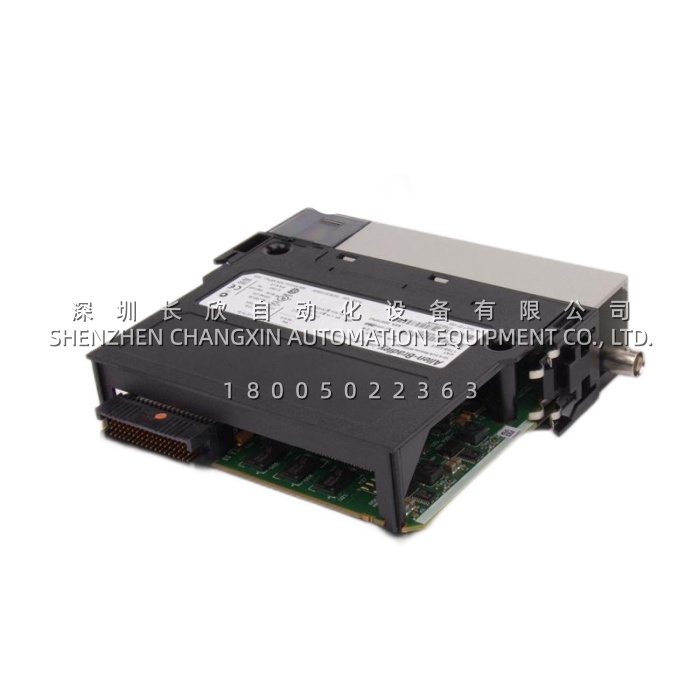
| Product Model | 1336-GM5 (Series A) |
| Manufacturer | Allen-Bradley / Rockwell Automation |
| Product Type | DeviceNet communication interface board / SCANport gateway |
| Compatible Drives | 1336 IMPACT, 1336 PLUS, 1336 PLUS II, 1336 FORCE, 1336 SPIDER |
| Network Protocol | DeviceNet, ODVA compliant |
| Supported Baud Rates | 125 kbps, 250 kbps, 500 kbps, DIP switch selectable |
| Default Baud Rate | 125 kbps |
| Node Address Range | 0-63, set by DIP switches SW2-1 to SW2-6; default 63 |
| Supply Voltage | 12-25 V DC from the DeviceNet network |
| Current Consumption | 40 mA typical |
| Internal Interface | 14-pin SCANport connector carrying power and communication |
| Network Interface | 5-pin removable Phoenix connector |
| Communication Modes | Polled I/O, Change-of-State, Cyclic, Explicit Messaging |
| Datalinks | Up to 4 (A-D), enabled by DIP switches SW1-1 to SW1-4 |
| Status Indication | 2 dual-color LEDs for DeviceNet network status and SCANport status |
| Operating Temperature | 0 °C to 50 °C |
| Storage Temperature | -40 °C to 85 °C |
| Relative Humidity | 0 to 95 % non-condensing |
| ESD Withstand | 8 kV contact discharge |
| Enclosure Rating | Determined by the host drive enclosure |
| Weight | Approx. 0.1 to 0.45 kg depending on source; confirm before shipping calculations |
| Lifecycle Status | Discontinued / obsolete by the manufacturer |
| Country of Origin | United States |
Main Features and Advantages
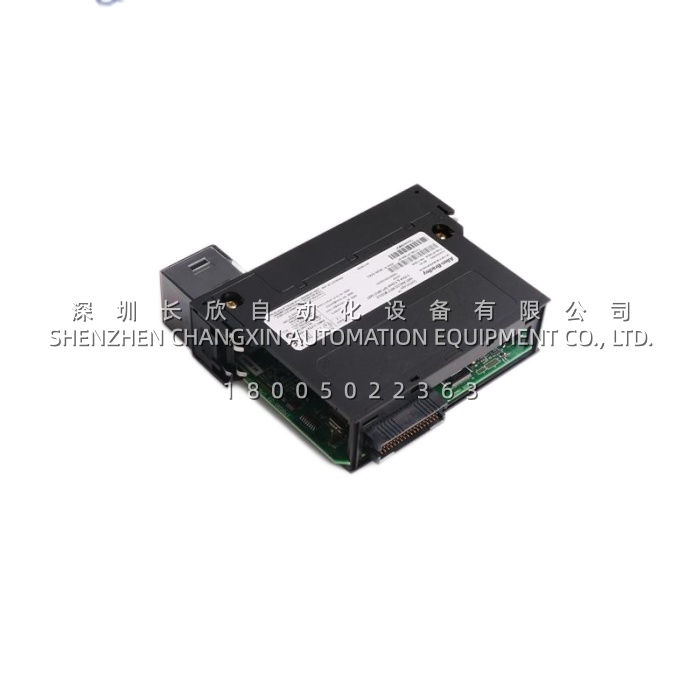
Embedded design removes the external hardware: The Allen-Bradley 1336-GM5 installs inside the drive and connects through the internal SCANport header, so there is no DIN rail, no mounting bracket and no SCANport patch cable to buy or route. In a crowded motor control centre, that saves panel space and eliminates two common failure points — the external cable and its connectors.Configuration without software: Every essential setting on the Allen-Bradley 1336-GM5 is a DIP switch. Node address, data rate and datalink assignment can be set on a bench before the board goes into the drive, which means a spare can be pre-configured and swapped in minutes rather than requiring a laptop running RSNetWorx at the panel.Network diagnostics at a glance: Two dual-color LEDs report network status and SCANport status independently. That separation is genuinely useful during commissioning, because it tells you immediately whether a problem is on the DeviceNet side — duplicate address, missing terminator, bus-off — or on the drive side, such as a datalink the drive does not support.Flexible I/O over one cable: The Allen-Bradley 1336-GM5 supports polled I/O for deterministic cyclic exchange, change-of-state for bandwidth-efficient updates, and explicit messaging for parameter reads and writes. Control, reference, status, current, speed and fault data all move across a single drop, which removes the point-to-point wiring that would otherwise be needed for start, stop, reverse, fault reset, analog reference and analog feedback.Faulted node recovery: With SW2-7 and SW2-8 set to the On position, the Allen-Bradley 1336-GM5 supports changing the node address of a device that has gone bus-off, using the appropriate software tool. That avoids pulling a board out of a drive just to correct an address conflict.Lifecycle economics: Because the 1336 platform is obsolete, the Allen-Bradley 1336-GM5 is a textbook last-time-buy item. A tested spare keeps a working drive on the network instead of triggering an unplanned migration to PowerFlex hardware.
Application Field
Networking legacy drives is the core purpose of the Allen-Bradley 1336-GM5. Many plants run DeviceNet backbones with SLC, PLC-5 or ControlLogix scanners and a population of 1336 drives installed years earlier. Adding the board brings those drives onto the network without touching the power wiring or the motor, turning standalone local control into PLC-controlled operation with full feedback.Process industries with distributed drives benefit most. In water and wastewater, HVAC plants, pulp and paper mills and material handling systems, drives are spread across a large site. With the Allen-Bradley 1336-GM5, a single DeviceNet trunk carries commands and feedback to each one, replacing long analog runs that are vulnerable to noise and ground loops.Diagnostic visibility is the second driver. Once on the network, output current, motor speed, DC bus voltage and fault codes are available to the PLC and to SCADA. Plants use that data for trending and predictive maintenance, catching a rising current on a pump or a conveyor before it becomes a trip, rather than discovering the problem after an operator resets a fault.Retrofit projects where the drive stays but the control system is modernised are the third case. When an old relay or serial control scheme is replaced by a networked PLC, the Allen-Bradley 1336-GM5 lets the existing 1336 hardware participate in the new architecture instead of being scrapped.One practical constraint: on smaller horsepower drives an external 1203-GM5-class module may be the specified route, and compatibility varies by drive sub-family and firmware version. Confirm the drive model and firmware before ordering, since the board is not interchangeable across all 1336 variants.