Technical Specifications
| Parameter Name | Parameter Value |
|---|---|
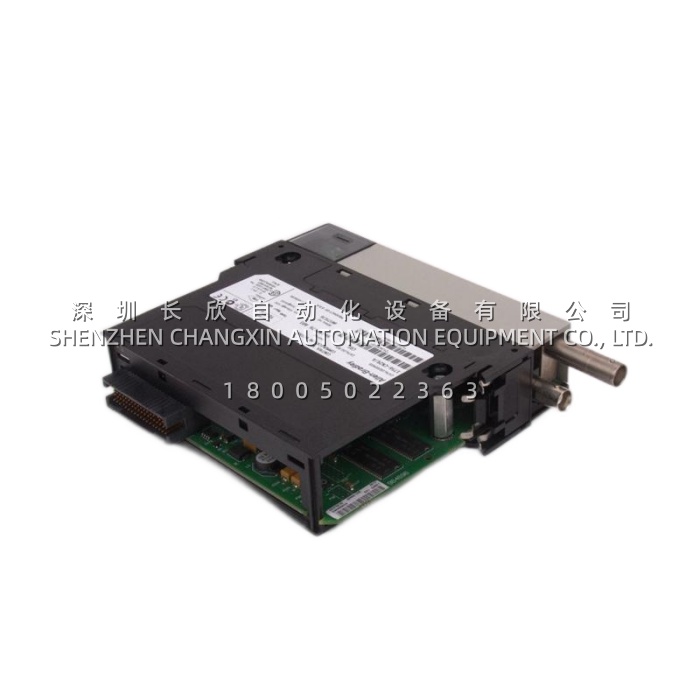
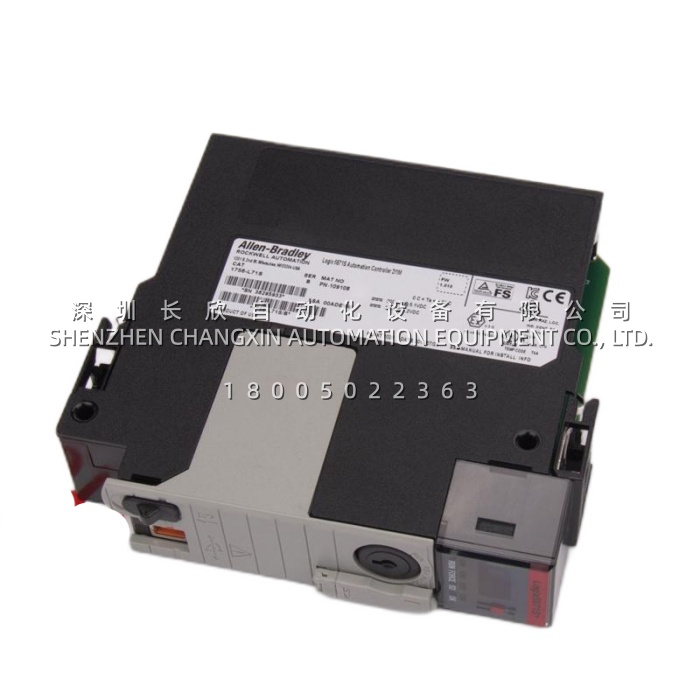
| Product Model | 1756-L72S |
| Manufacturer | Allen-Bradley (Rockwell Automation) |
| Product Type | GuardLogix Integrated Safety Controller |
| Series | GuardLogix 5570 / Logix 5572S |
| Standard User Memory | 4 MB |
| Safety Memory | 2 MB |
| Non-Volatile Storage | Secure Digital (SD) card |
| Local Programming Port | 1 × USB |
| Energy Storage Module | 1756-ESMCAP |
| Power Dissipation (Full Load) | 2.5 W |
| Software Environment | Studio 5000 Logix Designer v21+; RSLogix 5000 v20+ |
| Safety Partner Required | 1756-L7SP (must be immediately to the right, firmware-matched) |
| Safety Rating | SIL CL 3 (IEC 61508/62061); PL e Cat 4 (ISO 13849-1) |
| Safety Protocol | CIP Safety |
| Lifecycle Status | Active Mature |
| Standard Warranty | 1 year |
| Country of Origin | Multiple countries based on manufacturing location |
Main Features and Advantages
Integrated Safety Architecture on a Single Platform: The core design philosophy of the 1756-L72S is the convergence of standard control and safety control within a single controller. Traditional approaches require separate safety PLC and standard PLC hardware, with data exchange between them implemented via hardwiring or gateways, increasing wiring complexity and potential failure points. The 1756-L72S isolates safety tasks from standard tasks through the safety partner processor, with safety programs executing in a dedicated safety task that shares the backplane and data with standard logic while maintaining logical separation. This architecture reduces hardware count and cabinet space while simplifying data association between safety and standard functions.
SIL 3 Certification and CIP Safety Integration: The GuardLogix 5570 system, of which the 1756-L72S is a part, is certified for SIL CL 3 safety applications. The CIP Safety protocol enables safety devices (such as Guard I/O modules and safety drives) to communicate with the controller over EtherNet/IP, with safety data and standard data traversing the same physical network while integrity is ensured through the black channel principle. This means safety signal transmission no longer depends on dedicated safety buses or hardwiring, and safety I/O can be distributed near equipment, reducing long-distance safety cable installation costs.
Memory Configuration and Program Capacity: The combination of 4 MB standard memory and 2 MB safety memory positions the 1756-L72S in the middle of the GuardLogix 5570 range. Compared to the 1756-L71S (2 MB / 1 MB), the 1756-L72S provides more ample space for medium-scale safety programs. Compared to the 1756-L73S (8 MB / 4 MB), it suits applications where safety logic is relatively concentrated and large-scale distributed safety I/O is not required. For medium-sized machines or process units containing dozens of safety I/O points, multiple safety drives, and several safety zones, this memory configuration is typically sufficient to cover programs, tags, and configuration data.
Safety Programming Within Studio 5000: Safety program development for the 1756-L72S is performed in Studio 5000 Logix Designer, using the same project file as standard logic. Safety tasks, safety programs, and safety tags are identified by specific colors and locking mechanisms, and the signature mechanism of safety tasks ensures the program has not been modified without authorization during download and runtime. Safety task execution periods are independent of standard tasks and can be set separately based on safety response time requirements, preventing scan fluctuations in standard logic from affecting the determinism of safety interlocks.