Product Overview
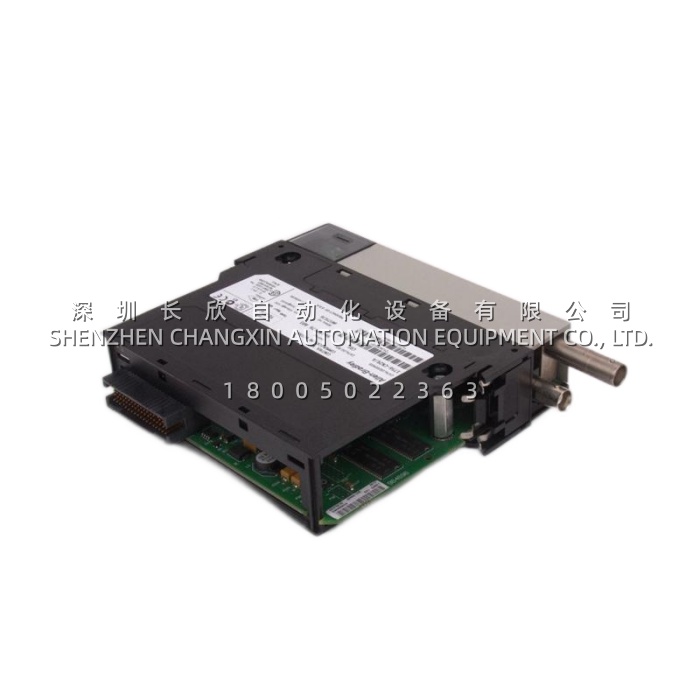
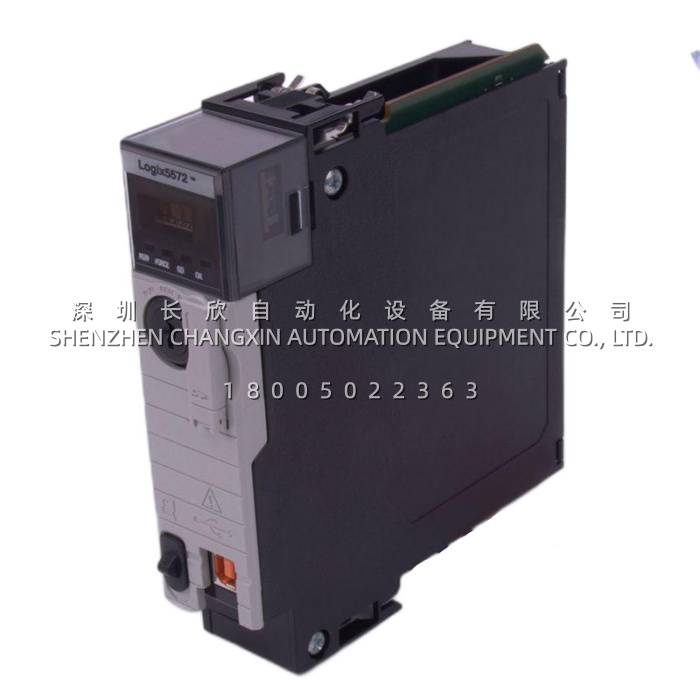
The Allen-Bradley 1756-L72 is a high-performance Programmable Automation Controller (PAC) within Rockwell Automation’s renowned ControlLogix 5570 platform, also known as the Logix5572. As a fourth-generation ControlLogix controller, it represents a significant architectural advancement over legacy L6x processors, delivering enhanced processing power, expanded memory capacity, and a modernized design that eliminates the need for lithium batteries. The Allen-Bradley 1756-L72 is engineered to serve as the “brain” of industrial automation systems, executing complex control logic, coordinating motion, managing process data, and communicating across multiple industrial networks simultaneously.At the heart of the Allen-Bradley 1756-L72 is 4 MB of user memory for logic and data, paired with 0.98 MB of dedicated I/O memory. This memory configuration positions the controller in the mid-tier of the L7x family — doubling the capacity of the entry-level 1756-L71 while providing ample headroom for complex ladder logic, function block diagrams, structured text programs, and extensive tag-based data structures. The controller supports up to 32 independent tasks (one continuous plus 31 periodic or event-driven tasks), with each task capable of containing up to 1,000 programs in newer firmware revisions. This multi-tasking architecture enables precise control of time-critical processes alongside lower-priority background operations within a single controller.The Allen-Bradley 1756-L72 is distinguished by its battery-free design philosophy. Unlike legacy controllers that relied on lithium batteries for volatile memory retention, the L72 utilizes a capacitor-based Energy Storage Module (ESM) — specifically the 1756-ESMCAP — which provides sufficient stored energy during a power interruption to safely transfer memory contents to the onboard Secure Digital (SD) card. A 1 GB SD card (1784-SD1) ships pre-installed with every controller, providing non-volatile storage for program backup, fault logging, and firmware images. The card can be upgraded to a 2 GB 1784-SD2 for applications requiring expanded data logging or larger program images. Programming and configuration are handled via the front-panel USB 2.0 full-speed port, supporting direct connection from a programming workstation without requiring serial port configuration or external communication modules.
Technical Specifications
| Parameter Name | Parameter Value |
|---|---|
| Product Model | 1756-L72 |
| Manufacturer | Allen-Bradley / Rockwell Automation |
| Product Type | Programmable Automation Controller (PAC) |
| Controller Series | ControlLogix 5570 (Logix5572) |
| User Memory | 4 MB |
| I/O Memory | 0.98 MB |
| Non-Volatile Storage | 1 GB SD card (1784-SD1), expandable to 2 GB (1784-SD2) |
| Controller Tasks | 32 (1 continuous + 31 periodic/event) |
| Programs per Task | 1,000 (firmware v24+) |
| Total CIP Connections | 500 (maximum) |
| Digital I/O Capacity | 128,000 points (maximum) |
| Analog I/O Capacity | 4,000 points (maximum) |
| Communication Ports | 1 × USB 2.0 Type-B (programming/configuration) |
| Network Options | EtherNet/IP, ControlNet, DeviceNet, DH+, Remote I/O (via modules) |
| Energy Storage Module | 1756-ESMCAP (capacitor-based, no battery required) |
| Backplane Current (5.1V DC) | 800 mA |
| Backplane Current (1.2V DC) | 5 mA |
| Power Dissipation | 2.5 W (maximum) |
| Thermal Dissipation | 8.5 BTU/hr |
| Motion Control | Up to 100 axes per motion group |
| Supported Languages | Ladder Diagram, Structured Text, Function Block, SFC (IEC 61131-3) |
| Programming Software | Studio 5000 Logix Designer / RSLogix 5000 (v20–v36+) |
| Controller Redundancy | Full support (with 1756-RM2 or 1756-RM3 modules) |
| Chassis Compatibility | 1756-A4, A7, A10, A13, A17 (and K-suffix variants) |
| Slot Width | 1 ControlLogix slot |
| Weight | 0.25 kg (0.55 lb) |
| Operating Temperature | 0 °C to +60 °C (32 °F to 140 °F) |
| Storage Temperature | -40 °C to +85 °C (-40 °F to 185 °F) |
| Relative Humidity | 5% to 95% (non-condensing) |
| Certifications | c-UL-us, CE, RCM, ATEX, IECEx, UKEx |
| Isolation Voltage | 30V continuous (basic insulation per IEC/UL 61010-1) |
| Lifecycle Status | Active Mature |
Main Features and Advantages
The Allen-Bradley 1756-L72 delivers a compelling blend of processing power, memory capacity, and architectural flexibility that makes it a cornerstone of modern industrial automation. Its 4 MB user memory provides the ideal balance for mid-scale to large automation projects — offering sufficient capacity for complex control algorithms, extensive tag databases, historical data collection, and future program expansion without the cost premium associated with higher-tier controllers in the L7x family. This makes the 1756-L72 particularly well-suited for applications that have outgrown 2 MB controllers but do not require the full 8 MB or 16 MB capacity of the L73 or L75 models.Battery-free operation is a transformative advantage of the Allen-Bradley 1756-L72. The traditional lithium battery backup approach used in legacy PLCs introduced ongoing maintenance burdens — batteries required periodic replacement, had finite shelf lives, and posed environmental disposal challenges. The L72’s capacitor-based Energy Storage Module (ESM) eliminates these concerns entirely. During a power interruption, the ESM provides enough energy to transfer volatile memory contents to the SD card, ensuring that programs, data, and configuration settings are preserved without any battery-related maintenance. For hazardous locations or applications where stored energy capacitors are restricted, the 1756-ESMNSE variant provides a no-stored-energy option, while the 1756-ESMNRM offers a non-removable security-enhanced version.Multi-tasking capability sets the Allen-Bradley 1756-L72 apart from simpler controllers. With support for 32 independent tasks, engineers can assign specific priority levels and execution rates to different control functions. Critical safety interlocks and high-speed motion control loops can run as high-priority periodic tasks with deterministic scan times, while less time-sensitive operations such as recipe management, data logging, and HMI communications run at lower priorities. This ensures that mission-critical control functions always receive processing attention when needed, regardless of background activity.Communication flexibility is built into the core of the Allen-Bradley 1756-L72. While the controller itself features a single USB 2.0 programming port, it supports a vast ecosystem of communication modules that enable connectivity to EtherNet/IP, ControlNet, DeviceNet, Data Highway Plus, Remote I/O, SERCOS, and SynchLink networks. With support for up to 500 CIP connections, the controller can simultaneously communicate with HMIs, SCADA systems, enterprise-level MES/ERP platforms, remote I/O racks, and peer controllers using Producer/Consumer messaging. The integrated motion control capability supports up to 100 motion axes per motion group via CIP Motion over EtherNet/IP, enabling precise coordination of Kinetix servo drives for applications ranging from packaging machinery to automotive assembly lines.