
Application Scenarios
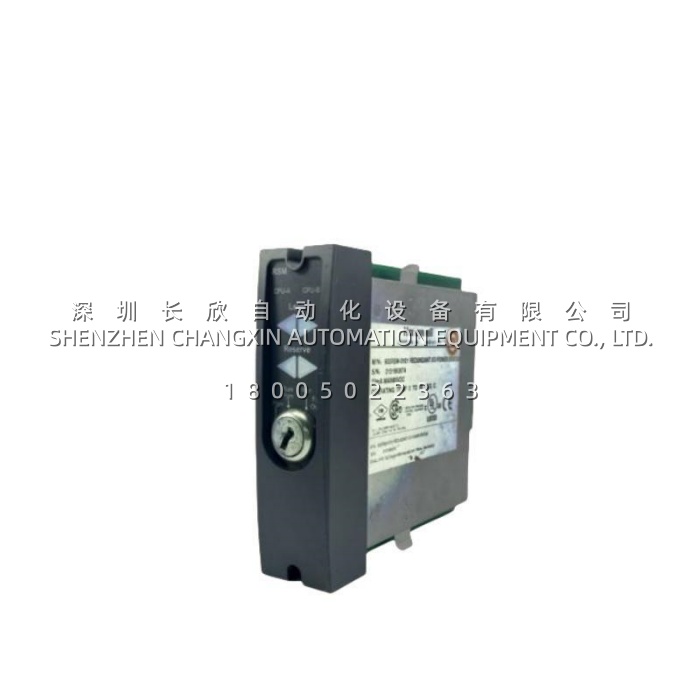
Imagine a chemical reactor under continuous control where a momentary CPU fault could trigger an emergency shutdown, venting toxic intermediates and forcing a multi-day restart. The Honeywell 900RSM-0101 addresses this vulnerability by continuously monitoring the heartbeat signals from both the primary and standby controllers. When the primary CPU stops responding, the Honeywell 900RSM-0101 arbitrates the switchover to the standby unit in under 100 milliseconds, allowing the standby controller to resume output with its fully synchronized memory image. Operators monitoring the SCADA screen may only notice a controller status icon change color, while process variables, valve positions, and control outputs remain undisturbed. For facilities with annual redundancy validation requirements, the module’s key-switch provides a manual transfer position, enabling forced primary-to-standby switchover tests without pulling cables or restarting the system.
Parameter
| Parameter | Value / Description |
|---|---|
| Product Model | Honeywell 900RSM-0101 |
| Manufacturer | Honeywell International Inc. |
| Product Category | Redundant Switch Module (RSM) |
| Series | ControlEdge HC900 Hybrid Controller |
| Compatible Controllers | C70R, C75, C75S redundant pairs (matched models required) |
| Compatible Rack | 900RR0-0001 (C70R/C75) redundant controller rack |
| Core Function | Lead/Reserve CPU status indication and mode control |
| Switchover Time | < 100 ms typical (fault detection to standby takeover) |
| Redundancy Architecture | 1:1 Hot Standby |
| Mode Control | Key-switch, 3 fixed positions + 1 momentary transfer position |
| Status Indicators | Green arrow LEDs for Lead/Reserve roles |
| Power Supply | 5 V DC (via backplane) |
| Current Draw | 22 mA maximum |
| Hot-Swap Support | Yes (insertion and removal under power) |
| Mounting | Dedicated redundant controller rack |
| Dimensions (H×W×D) | Approx. 137 mm × 35.6 mm × 151.7 mm |
| Weight | Approx. 448 g |
| Operating Temperature | 0°C to +60°C |
| Relative Humidity | 10% to 90%, non-condensing |
| Country of Origin | USA |
Technical Principles and Innovative Values
Innovation Point 1 – Visual Role Clarity Without Software Dependency: The Honeywell 900RSM-0101 features front-panel green arrow LEDs that directly indicate which CPU is the active Lead and which is the Reserve. This eliminates the need for maintenance personnel to open engineering software or navigate diagnostic screens to determine controller status—a critical time-saver during fault events when every second of confusion extends downtime.
Innovation Point 2 – Physical Mode Locking for Synchronization Assurance: The module’s key-switch serves a purpose beyond manual transfer. By locking both CPUs into matched operating modes, the Honeywell 900RSM-0101 prevents the standby controller from being inadvertently placed into a different mode than the primary. This physical safeguard ensures that memory synchronization and control program execution remain aligned, preventing the “dual-primary” or “dual-standby” conditions that can destabilize a redundant system.
Innovation Point 3 – Hot-Swap Capability Preserving Process Continuity: The Honeywell 900RSM-0101 supports insertion and removal under power. If the module itself requires replacement, technicians can extract it and insert a new unit without de-energizing the controllers or interrupting the running process. This capability is essential for facilities where the RSM is identified as a spare-part priority but cannot justify a production shutdown for its replacement.
Innovation Point 4 – Contact Outputs for External Monitoring Integration: The module provides relay contact outputs that indicate primary controller identity and switchover events. These dry contacts can be wired into the plant’s alarm or DCS system, enabling operators and instrument technicians to track redundancy status from a remote monitoring location rather than relying solely on local panel inspection.


