Application Scenarios:
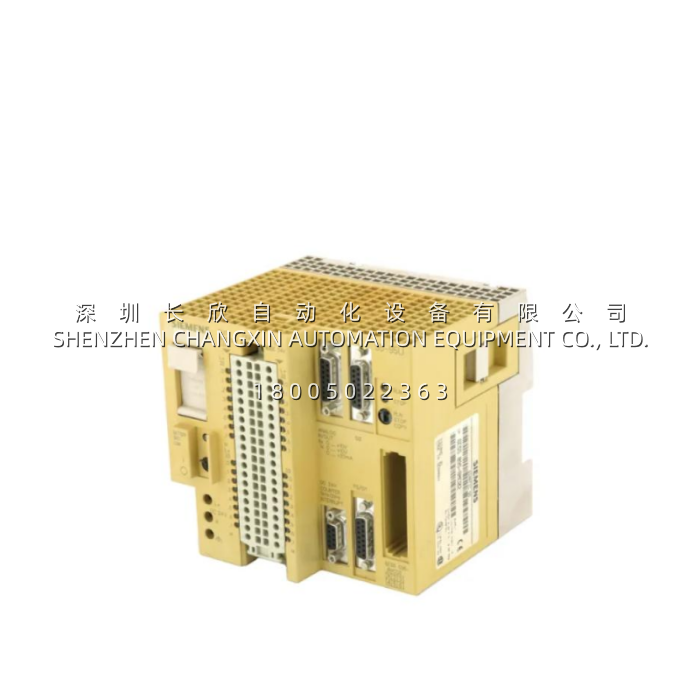
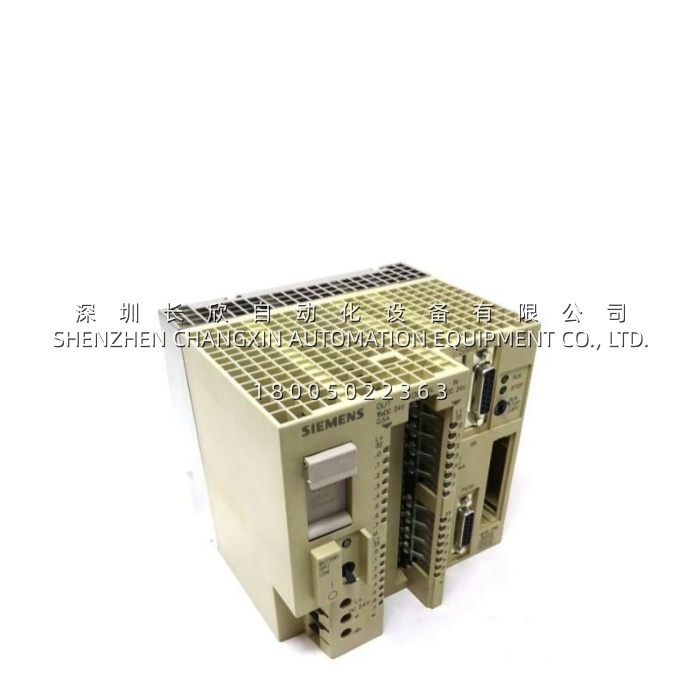
A small Austrian window-profile extrusion line still runs its haul-off + cutter sequencing on a Siemens 6ES5095-8MC03 mounted in a 250 mm wide local panel — the kind of install where a full S7-300 rack would have eaten half the cabinet. The dual AS511 ports are the quiet win here: Port 1 stays permanently dressed to a Siemens PG720 via the 6ES5734-2BD20 cable for occasional STEP 5 online edits; Port 2 feeds a 20-year-old OP7 operator panel that the line setter uses for recipe select and fault ack. When the original Siemens 6ES5095-8MC03 began throwing sporadic “RAM checksum” errors after 22 years (battery had been missed on the last two PM rounds), the integrator had a 20-minute window during a tool-change to swap in a tested spare — reseat the EEPROM (27C256 with the backed-up program), clip the 3.6 V lithium, power up, RUN. The line was back before the next profile length hit the saw. For woodworking CNC add-ons, small packaging OEMs, pump-skid kiosks, gate-control panels, and any 1990s–2000s machine where “re-engineer to S7-1200” costs 20× the panel value, the Siemens 6ES5095-8MC03 is why those panels are still earning their keep in 2025.
Parameter:
| Main Parameters | Value/Description |
|---|---|
| Product Model | Siemens 6ES5095-8MC03 |
| Manufacturer | Siemens AG (SIMATIC S5-90U/95U family) |
| Product Category | Compact Unit (all-in-one CPU + I/O, S5-95U class) |
| Supply Voltage | 24 V DC |
| Built-in Digital Inputs | 16 × DC 24 V (including 4 alarm DI, 2 counter DI) |
| Built-in Digital Outputs | 16 × DC 24 V |
| Built-in Analog Inputs | 8 channels |
| Built-in Analog Outputs | 1 channel |
| Communication Interfaces | 2 × AS511 (S5 dedicated programming/monitoring ports) |
| Program Memory | 16 KB (8 KB RAM + 8 KB EEPROM) std / 20 KB (16+4) on Rev 4+ hardware |
| Load Memory | EEPROM socket accepts UVPROM (27C256/27C512) or EEPROM module |
| Backup Battery | 3.6 V lithium (buffered RAM, user-replaceable) |
| Expandability | Max 32 S5-100U I/O modules on expansion bus |
| Operating Temperature | 0 °C to +60 °C |
| Mounting | 35 mm DIN rail |
| Dimensions (W×H×D) | ~151 × 154 × 159 mm |
| Weight | 1.272 kg (Siemens official) |
| Ingress Protection | IP20 (cabinet) |
| Lifecycle | Discontinued 01 Oct 2020, deleted without replacement (PLM PM490) |
| Programming | STEP 5 (STL/LAD/CSF) |
Technical Principles and Innovative Values:
- Innovation Point 1: All-in-one compactness — CPU + I/O + battery in 151 mm. The Siemens 6ES5095-8MC03 fits a complete small-machine controller onto one DIN rail segment — no backplane, no rack, no separate PSU for the logic side (24 V DC in powers everything including the 16 DI/16 DO sink drivers). For OEMs building woodworking add-ons, door/gate controls, small conveyor interlocks, or pump-skids, this meant a €300 controller fit in a €40 cabinet — a value prop that kept S5-95U on many BOMs well into the 2000s.
- Innovation Point 2: Dual AS511 on a compact head — no CP card needed. Most S5-95U variants (8MAxx) give one AS511; the Siemens 6ES5095-8MC03 gives two. That means Port 1 can stay permanently cabled to a PG/PC for STEP 5 online edits while Port 2 feeds an OP7/OP15 or TD200 HMI — simultaneously. On a production floor where you can’t steal the PG port away from the HMI for a quick timer tweak, this is the difference between “five-minute edit” and “two-hour cable shuffle.”
- Innovation Point 3: 16 KB → 20 KB RAM growth across revisions without footprint change. Early Siemens 6ES5095-8MC03 units shipped with 16 KB total (8 KB program RAM + 8 KB EEPROM); Rev 4+ bumped to 20 KB (16 KB program + 4 KB data) on the same PCB. For plants that have grown their STEP 5 project over 20 years (extra PBs, bigger DBs, more FB copies), checking the Rev level before buying a spare avoids a “memory not adequate” surprise on download — a classic S5-95U pain point documented in Siemens Industry Support [#124583].
- Innovation Point 4: UVPROM/EEPROM socket as architectural backup discipline. The Siemens 6ES5095-8MC03 doesn’t rely solely on battery-backed RAM — it carries a socket for a 27C256 or 27C512 UVPROM/EEPROM. The site practice on many 1990s machines: RAM holds the active program, UVPROM holds the “golden” compile. If the battery dies or someone cycles power without the RAM saved, popping the EPROM back in recovers the last known-good project. Old-school, but bulletproof for panels that only get touched once every three years.