Application Scenarios
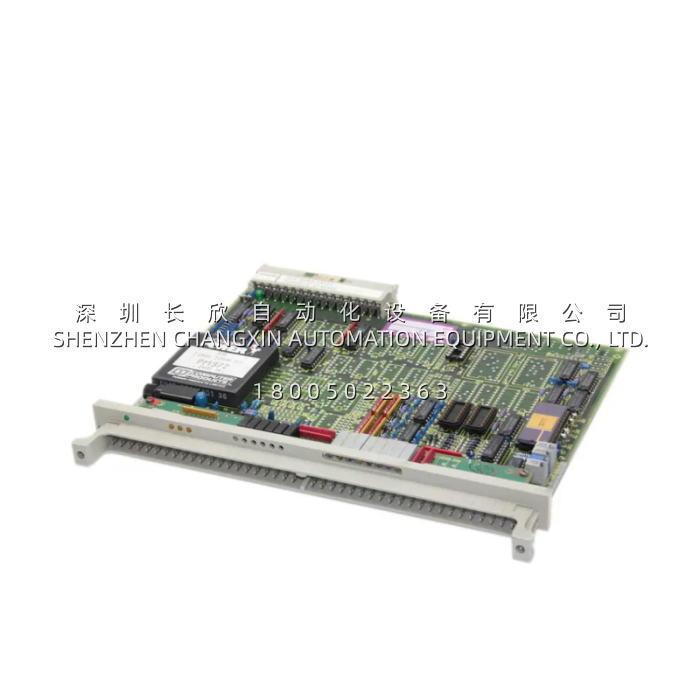
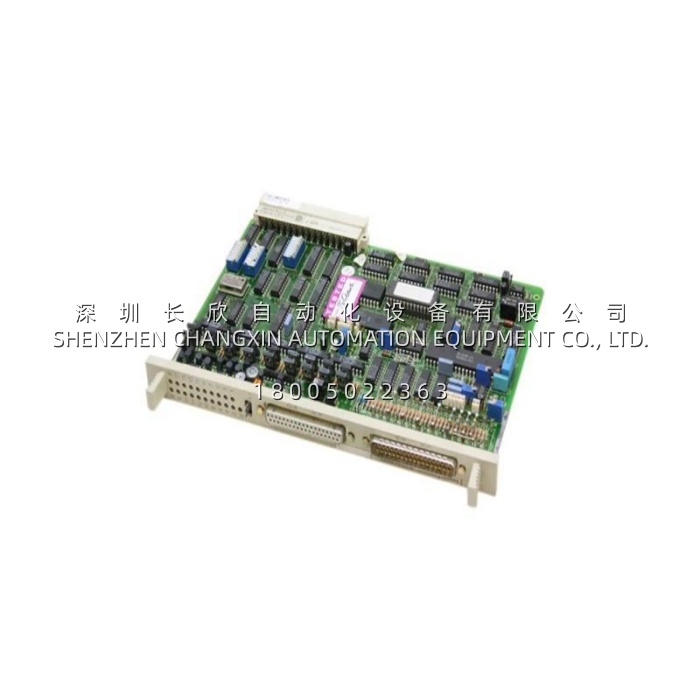
A compounding plant in the Ruhr runs a 65 mm twin-screw extruder with a 4-zone barrel (feed, compression, metering, die) plus a melt-temperature tap at the screw tip. The original panel (1996 vintage) used four standalone Eurotherm 2404 single-loop controllers bolted to the extruder local cabinet, each talking to the S5-135U master rack via 4–20 mA PV/OP links — 16 analog wires, 4 separate HMI faces, and a perennial headache when the Eurotherms drifted out of sync during recipe changes. During a 2021 panel consolidation, the integrator dropped a Siemens 6ES5244-3AA13 into slot 6 of the S5-135U rack: zone 1–4 TC (J-type, barrel) on inputs 1–4, melt TC on input 5 (spare loop repurposed as monitor), and the 4 analog outputs (0–10 V) drive the barrel heater-SSR banks via 4–20 mA signal conditioners. The 6ES5244-3AA13 runs its own PID per zone — the S5-135U CPU’s OB1 doesn’t touch the temperature math — and the integrator used the module’s built-in auto-tuning routine on each zone during commissioning (heat the zone to 60% SP, let the IP244 excite the loop, measure dead time and gain, compute Kp/Tn/Tv).There’s a critical S5-era detail here that separates the 6ES5244-3AA13 from a plug-and-play SM card: before the first power-up, the module has to be hardware-adapted via resistors and solder bridges on the PCB to match the specific input/output wiring and sensor types landed on the rack slot. The integrator spent 45 minutes with the IP244 manual and a soldering iron setting the bridge patterns for “J-type TC + 0–10 V out” on all 4 loops before seating it — skip this step and you’ll either read garbage or, worse, backfeed voltage into a TC input and cook the input stage. Once bridged and seated, the 6ES5244-3AA13 ran 18 months without a PID parameter touch, and the plant retired the four Eurotherms to the spares shelf. The extruder lead’s comment: “One 6ES5244-3AA13, one S5 slot, four zones — and the auto-tune actually nailed the compression zone without us fiddling Kp for two shifts.”
Key Parameters
| Main Parameters | Value/Description |
|---|---|
| Product Model | Siemens 6ES5244-3AA13 |
| Alternate Identifier | SIMATIC S5 IP244 Compact Temperature Control Module |
| Manufacturer | Siemens AG |
| Product Category | Intelligent Temperature Control Module (S5 IP Series) |
| Compatible Racks | S5-115U / S5-135U / S5-155U (central or expansion via IM) |
| Control Loops | 4 independent PID loops |
| Input Types | Thermocouple (J, K, T, etc.), RTD (Pt100), resistance, voltage (0–10 V / 0–5 V) |
| Output Types | Analog (0–10 V / 4–20 mA) or digital/PWM per loop config |
| Supply Voltage | 24 V DC (via S5 backplane bus) |
| Operating Temperature | -25 °C to +60 °C |
| Dimensions (L × W × H) | ~21.2 × 26.2 × 3.4 cm |
| Weight | ~0.401 kg |
| Front Protection | IP24 (module face) |
| Hardware Adaptation | Resistor/solder-bridge configuration required before first commissioning |
| Lifecycle Status | End of Life (SIMATIC S5 family) |
Technical Principles and Innovative Values
- Innovation Point 1: 4-Loop Autonomous PID Offloads the S5 CPU. The Siemens 6ES5244-3AA13 carries its own processor and executes all 4 PID loops locally — the S5-115U/135U/155U CPU’s OB1 never sees the temperature math, only reads PV/OP via the backplane bus when needed for supervisory logic (recipe selection, alarm aggregation, production-data logging). On a loaded S5-135U running 12 ms OB1 with 300+ NETZWERKs, offloading 4 PID loops at 100–500 ms each is the difference between a stable scan and a creeping overrun. For plastics extruders and kilns where temperature loop count scales with barrel/kiln length, the IP244 gives 4 loops per S5 slot versus 1 loop per FM455 — slot economy matters in crowded 155U racks.
- Innovation Point 2: Solder-Bridge Hardware Adaptation = Precision, But Fiddly. Unlike SM331/SM332 signal modules that are software-configured in STEP 5 HW Config, the 6ES5244-3AA13 requires PCB-level resistor stuffing and solder-bridge selection for input type (TC vs. RTD vs. voltage), TC type (J/K/T), and output type (voltage vs. current) per loop. This dates from the mid-’80s S5-135U design era where EEPROM/flash per module was expensive. The upside: once bridged, the 6ES5244-3AA13 is hardened to that sensor profile and won’t be accidentally reconfigured via a stray STEP 5 download. The downside: you need the IP244 manual and a soldering iron on the bench before first power-up. Siemens documentation explicitly warns: “Incorrect setting might cause damage of the unit itself and destroy other connected components” — meaning a wrong bridge on a TC input fed from a live 24 V can fry the input amp.
- Innovation Point 3: Auto-Tuning and Self-Optimization Lineage. The IP244 family evolved across steppings: -3AA11/-3AA12 (“temperature card”) → -3AA13 (“compact temperature controller”, the subject here) → -3AA21/-3AA22 (“with self-optimization / Start-Stop”). The Siemens 6ES5244-3AA13 sits in the middle — it has the compact-controller firmware with autotune capability (the module can excite the loop and compute Kp/Tn/Tv), while the -3AA22 stepping adds the explicit “Selbstoptimierung” runtime self-adaptation that retunes during production. For plants that don’t need runtime re-adaptation but want commissioning autotune, the -3AA13 is the sweet spot — and it’s the stepping most commonly stocked in legacy S5 spares lockers.
- Innovation Point 4: Cascade, Ratio, and Feedforward on a Single IP Module. Beyond simple single-loop PID, the 6ES5244-3AA13‘s 4 loops can be internally cross-wired in firmware: loop 1 as master SP, loop 2 as slave tracking loop 1’s OP (cascade, e.g., jacket temp master → coolant-valve slave), or loop 2’s setpoint = loop 1’s PV × ratio factor (ratio blending on a heat exchanger). This kind of inter-loop math normally eats OB1 NETZWERKs on the CPU; on the IP244 it’s configured in the module’s parameter set (loaded via STEP 5 with the IP244-specific DB structure). For a 4-zone extruder barrel where zones 2–4 track zone 1’s ramp rate, this keeps the S5 CPU out of the temperature business entirely.