Application Scenarios
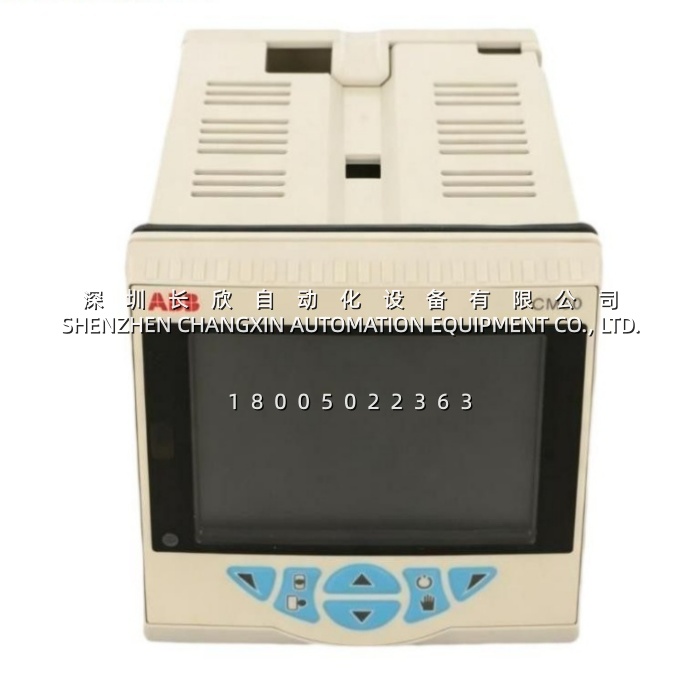
A food and beverage plant operating multiple jacketed tanks faced inconsistent batch temperatures because its original single-loop controllers could not coordinate temperature measurement, steam-valve control, and recipe-driven alarms in one device. Replacing the instruments with the ABB CM30/3 allowed each tank to use two analog inputs for temperature and a secondary process value, two analog outputs for valve or setpoint control, six digital I/O points for pump status and interlocks, and four relays for heating-stage and alarm switching. Operators could view trends and process parameters locally while engineers used PC configuration tools to standardize control strategies across the line.The practical benefit was not simply fewer instruments. By consolidating loop control, logic, and alarms in the ABB CM30/3, the plant reduced external wiring and panel complexity while retaining the ability to add Modbus RTU or Ethernet communication if a future SCADA integration project required it. The color display and autotune functions also shortened commissioning, allowing maintenance staff to identify a failed sensor or incorrect parameter setting directly at the panel rather than tracing wiring through a distributed I/O cabinet.
Parameter
| Main Parameters | Value / Description |
|---|---|
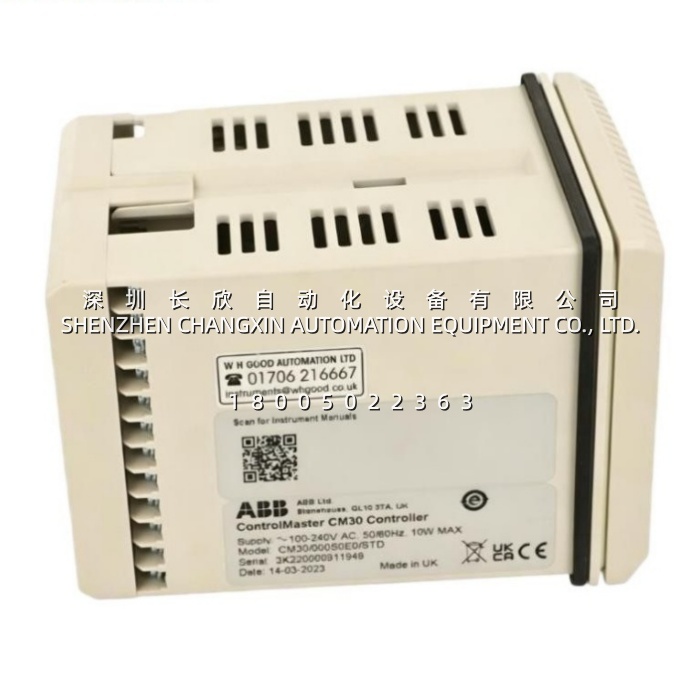
| Product Model | ABB CM30/3 (ControlMaster CM30, I/O build code 3) |
| Manufacturer | ABB Measurement & Analytics |
| Product Category | Universal 1/4 DIN PID process controller |
| Panel Size | 1/4 DIN; 96 × 96 mm nominal panel cutout |
| Overall Dimensions | Approximately 97 × 97 × 141 mm, depending on configuration |
| Depth Behind Panel | Approximately 121 mm |
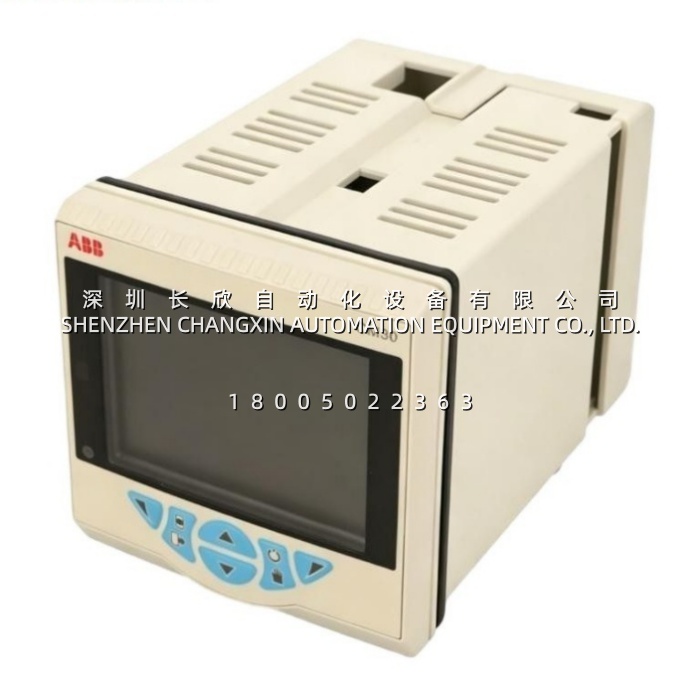
| Display | Color TFT display with process values and historical trend capability |
| Configuration | Configurable through front-panel menus or PC configuration software |
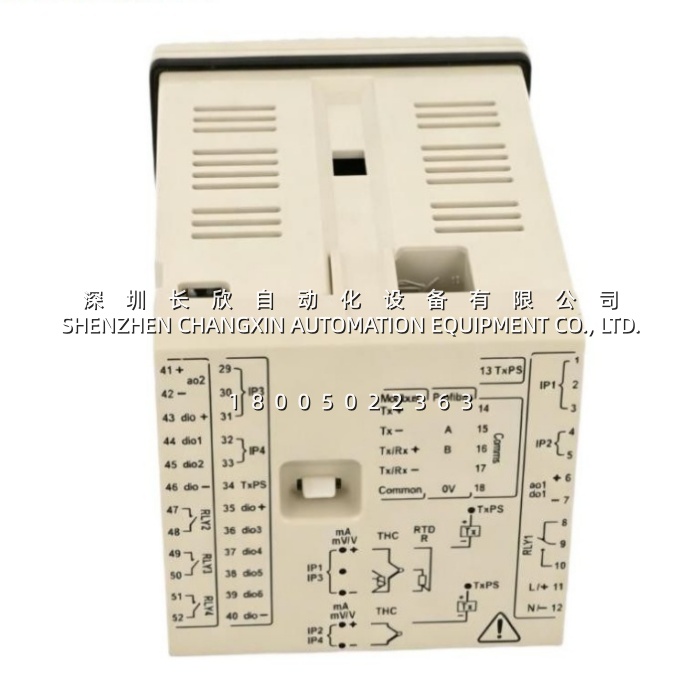
| Analog Inputs | Four universal inputs in the build-3 configuration |
| Input Signal Types | Thermocouple, Pt100 RTD, mV, V, mA, resistance, frequency, and digital input |
| Analog Outputs | Two analog outputs; typical isolated 0/4–20 mA output |
| Digital I/O | Six digital inputs/outputs |
| Relay Outputs | Four relays; typical rating 5 A at 240 V AC |
| Control Functions | PID, cascade, feedforward, ratio, adaptive control, logic, mathematics, and totalization |
| Tuning | Advanced autotune capability |
| Supply Voltage | 100–240 V AC standard; 24 V DC mainboard available for selected configurations |
| Communication Options | Modbus RTU via RS-485 and Ethernet as optional upgrades |
| Front-Panel Protection | IP66 / NEMA 4X |
| Rear Protection | IP20 |
| Operating Temperature | 0 to +55 °C typical for panel-mount operation |
Technical Principles and Innovative Values
- Innovation Point 1 — Scalable I/O architecture. The ABB CM30/3 provides four analog inputs, two analog outputs, six digital I/O points, and four relays in one 1/4 DIN device. This eliminates the need to combine several fixed-function instruments for measurement, control, logic, and alarming.
- Innovation Point 2 — Universal input flexibility. Each supported input can be configured for thermocouple, RTD, current, voltage, frequency, or digital signals. One controller platform can therefore cover multiple process variables across different machines and production lines.
- Innovation Point 3 — Advanced control without a separate PLC. The ABB CM30/3 supports PID, cascade, feedforward, ratio, adaptive, mathematics, logic, and totalization functions. This enables coordinated control strategies inside the instrument rather than relying solely on external control logic.
- Innovation Point 4 — Fast, accurate commissioning. Advanced autotune and full configurability through the front panel or PC software reduce manual trial-and-error tuning. The result is shorter start-up time and more stable control after process changes or maintenance.
- Innovation Point 5 — Local operator visibility. The color TFT display presents detailed process information, setpoints, and historical trends at the machine. Local visibility helps operators detect abnormal behavior immediately, even when the controller is not connected to a central SCADA system.
- Innovation Point 6 — Communication-ready design. Modbus RTU and Ethernet options allow the ABB CM30/3 to exchange process data with PLCs, HMIs, and plant historians when the application requires remote supervision or data logging.
- Innovation Point 7 — Rugged panel interface. The IP66 and NEMA 4X front-panel rating supports reliable operation in washdown, dusty, and humid environments common in food, beverage, water, and chemical applications.