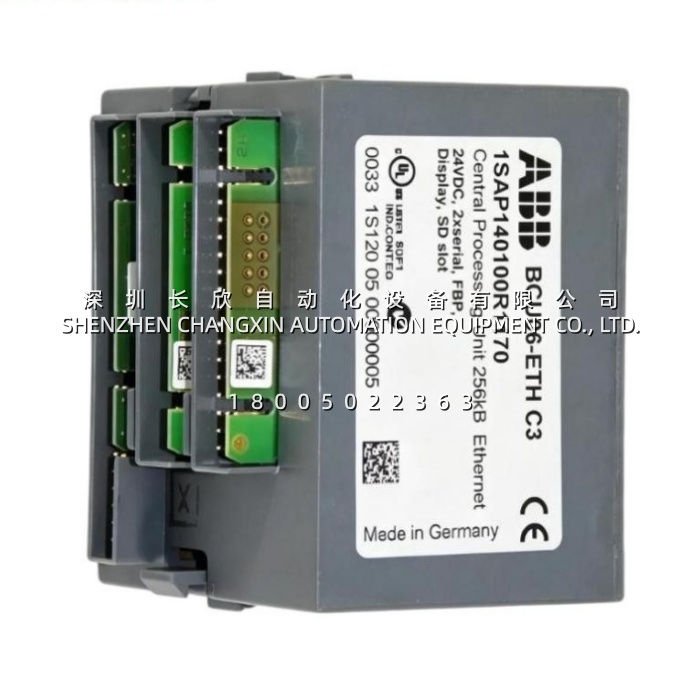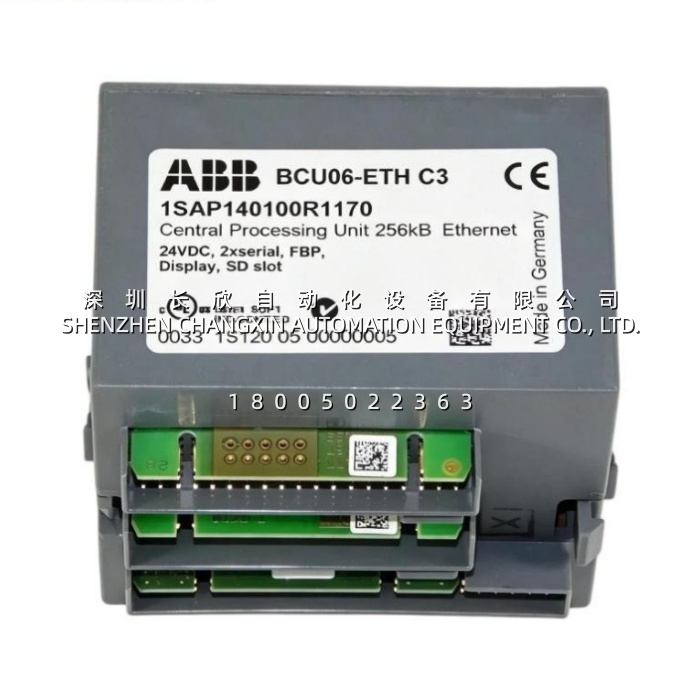
Product Overview
The ABB BCU06-ETH C3, ordered under article number 1SAP140100R1170, is a compact Central Processing Unit (CPU) belonging to the Basic Control Unit (BCU) family within the ABB PLC Automation portfolio. Conceived as a self-contained, Ethernet-enabled controller for machine-level and small-to-mid scale process applications, the ABB BCU06-ETH C3 integrates the processor, memory, communication interfaces, power input, operator display, and removable storage into a single DIN-rail-mountable module — eliminating the need for a separate rack or backplane and making it one of the most space-efficient controllers in the ABB line-up.
Functionally, the ABB BCU06-ETH C3 is engineered to execute user control programs, acquire data from digital and analog I/O devices, drive outputs, and exchange information with other automation equipment across a modern industrial network. A built-in Ethernet interface running TCP/IP — complete with an integrated web server — anchors the upstream communication to engineering tools, operator interfaces, and supervisory systems, while two independent serial ports provide legacy connectivity to Modbus RTU devices, remote I/O, text displays, and field peripherals. A dedicated FieldBus Plug (FBP) interface allows the controller to attach to PROFIBUS DP, CANopen, DeviceNet, or MODBUS through a pluggable module, giving system integrators the flexibility to match the fieldbus protocol to each individual installation.
Storage on the BCU06-ETH C3 is provided by an onboard SD memory card that retains the user program, configuration data, and retentive variables through power loss and simplifies controller replacement by allowing a pre-loaded card to be inserted into a swapped unit. The “C3” suffix identifies the conformal-coated hardware revision, offering enhanced protection against humidity, condensation, and corrosive atmospheres. With 256 kB of program memory, 24 V DC supply, an integrated display for status indication, and DIN-rail mechanical format, the ABB BCU06-ETH C3 1SAP140100R1170 is the pragmatic CPU choice for OEM machine builders, system integrators, and end users who require a compact, network-ready controller that carries forward the proven ABB automation heritage into today’s installations.
Technical Specifications
| Parameter Name | Parameter Value |
|---|---|
| Product Model | BCU06-ETH C3 |
| Article Number (Product ID) | 1SAP140100R1170 |
| Manufacturer | ABB |
| Product Type | Central Processing Unit (CPU) / Basic Control Unit — Ethernet variant |
| Product Family | ABB PLC Automation (Basic Control Unit family) |
| Program Memory | 256 kB |
| Supply Voltage | 24 V DC |
| Ethernet Interface | Onboard TCP/IP Ethernet with integrated web server |
| Serial Interfaces | 2 × independent serial ports (COM1, COM2) |
| FieldBus Plug (FBP) | Pluggable interface for PROFIBUS DP / CANopen / DeviceNet / MODBUS |
| Display | Integrated status/operator display |
| Memory Card | SD memory card slot for program and data storage |
| Hardware Revision | C3 (conformal-coated variant for harsh environments) |
| Mounting | DIN rail (compact single-module form factor) |
Main Features and Advantages
Compact single-module architecture: The ABB BCU06-ETH C3 integrates the CPU, memory, communication interfaces, power input, display, and SD card slot into one DIN-rail-mountable housing, eliminating the cabinet space and wiring overhead typically associated with rack-based PLC systems. For machine builders and OEMs, this means a smaller control panel, less inter-module cabling, and lower cabinet cost per machine — an advantage that compounds across a production series where the BCU06-ETH C3 is deployed as a standardized controller across multiple machines or production cells.
Ethernet TCP/IP with embedded web server: The onboard Ethernet port of the ABB BCU06-ETH C3 operates on TCP/IP with a built-in web server, so engineering tools, SCADA nodes, operator panels, and browser-based diagnostics all reach the controller through a single modern interface. This native Ethernet connectivity removes the need for external gateway modules when integrating the controller into a plant-wide Ethernet backbone, and allows remote status checks or firmware-level diagnostics to be performed from a standard web browser without installing proprietary software on the technician’s workstation.
Flexible FieldBus Plug interface: A dedicated FBP interface on the 1SAP140100R1170 accepts a pluggable FieldBus Plug module, so the same CPU can be adapted to PROFIBUS DP, CANopen, DeviceNet, or MODBUS simply by changing the module. This architecture allows one controller SKU to cover multiple machine variants and multiple fieldbus standards, reducing the inventory burden on system integrators and simplifying long-term spares strategy for plants that operate a mixed-protocol environment.
Dual serial connectivity for legacy integration: The ABB BCU06-ETH C3 provides two independent serial ports that connect directly to Modbus RTU devices, remote I/O racks, text displays, weighbridges, barcode readers, and older field peripherals. In retrofit and mixed-generation installations, this means new Ethernet-based control can be introduced alongside existing serial equipment without forcing a parallel gateway or protocol converter into the cabinet.
SD card program and data storage: User programs, retentive data, and configuration are held on a removable SD memory card, so a controller replacement after a failure is reduced to inserting a pre-loaded card into the swapped unit — restoring behaviour without re-engineering effort on the shop floor.
Conformal-coated “C3” revision: The C3 hardware revision of the ABB BCU06-ETH C3 carries a protective conformal coating over the circuitry, providing resistance against condensation, dust-borne moisture, and mildly corrosive atmospheres commonly encountered in water treatment, food and beverage wash-down areas, marine environments, and outdoor cabinets in tropical climates.
Integrated operator display: The front-panel display of the ABB BCU06-ETH C3 presents controller status and diagnostic information directly at the unit, so a technician standing in front of the panel can assess CPU health, communication activity, and error conditions at a glance during commissioning or troubleshooting — without needing to open an HMI or engineering tool.