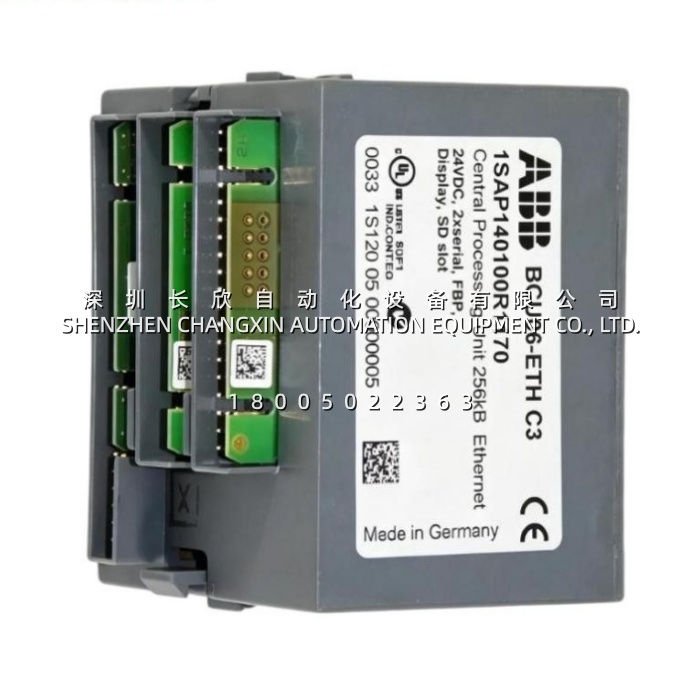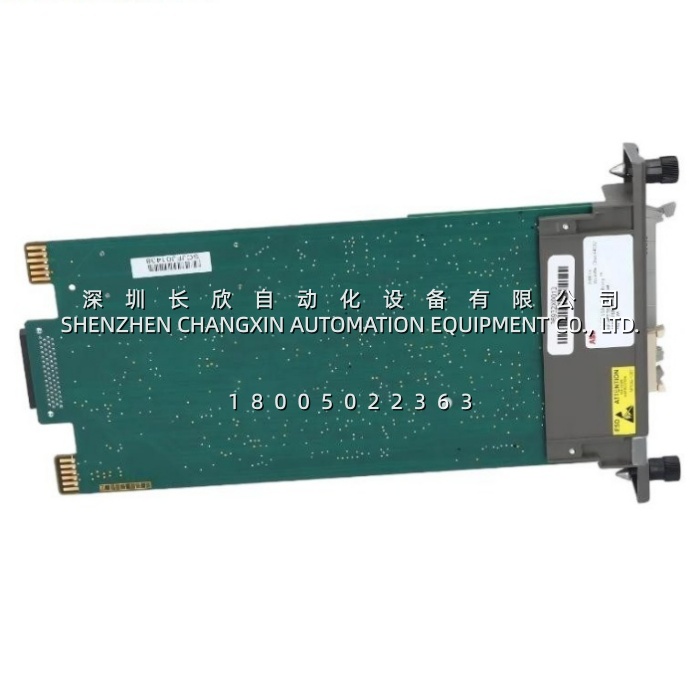
Technical Specifications
| Parameter Name | Parameter Value |
|---|---|
| Product Model | INICT13A (also referenced as ICT13A; variants: PINICT13A, INICT13AR) |
| Manufacturer | ABB (originally Bailey Controls) |
| Product Type | Infi-Net to Computer Transfer Module (ICI / Computer Communication Interface Module) |
| System Platform | ABB Bailey INFI 90 / Network 90 / Symphony Harmony |
| Network-Side Interface | INFI-NET control bus, dual redundant links supported, approximately 1 Mbps class |
| Host Computer Interface | 50-pin SCSI (primary) + RS-232-C via NTPM01 termination unit |
| SCSI Communication Rate | Up to 4 Mbytes/sec |
| RS-232-C Baud Rate | 50 to 19,200 baud (selectable) |
| Memory | 512 kbytes ROM; 2 Mbytes RAM |
| Point Definition Capacity | Up to approximately 30,000 point definitions, depending on point types |
| Associated Network Module | INNIS21 (communicates via I/O expander bus) |
| Compatible Termination Unit | NTPM01 |
| Power Supply | Backplane supplied; +5 VDC typical, with ±15 VDC referenced in some configurations |
| Typical / Maximum Power Consumption | 5.1 W typical / 7 W maximum |
| Mounting | Single slot in standard INFI 90 Module Mounting Unit (MMU) |
| Status Indicators | Front-panel status LEDs (Power, Run, Error, SCSI Activity) |
| Dimensions | Approximately 360.7 × 73.7 × 269.2 mm (14.2 × 2.9 × 10.6 in) |
| Weight | Approximately 0.658 kg (0.66 kg reference) |
| Operating Temperature | 0°C to +55°C (some documentation references −20°C to +60°C) |
| Relative Humidity | 20% to 95% up to 55°C, non-condensing |
| Lifecycle Status | Discontinued; recommended successor: SPICT13A |
Main Features and Advantages
Bidirectional supervisory bridge: The INICT13A is not a one-way data passer. It simultaneously uploads process values, sequence-of-events records, and alarms from the INFI-NET control network to the host computer, while carrying configuration downloads, setpoint changes, and engineering commands back down to the control layer. This makes it the single conduit through which all supervisory interaction with the DCS flows.Hardware-level data integrity: The module performs CRC verification, link self-checking, and automatic retransmission during bus fluctuations using its own onboard microprocessor and buffering. By handling communication overhead independently, the INICT13A preserves the scan-cycle determinism of the underlying controllers—a critical distinction from generic serial gateways that merely move bytes without regard for control-loop timing.Dual-role SCSI and serial host connectivity: The high-density 50-pin SCSI interface provides high-throughput parallel communication with compatible host adapters, making it the preferred choice for historian servers and OPC data acquisition. The RS-232-C port, delivered through the NTPM01 termination unit, offers a flexible alternative for serial host or engineering-laptop connections. Together, these interfaces let a single INICT13A serve both local diagnostic access and plant-wide data collection without an external protocol multiplexer.Drop-in legacy compatibility: For existing INFI 90 and Harmony installations, the INICT13A installs directly into the standard MMU slot and communicates with existing operator stations without requiring changes to the DCS configuration or host-driver stack. This preserves a working architecture and avoids forcing a migration timeline dictated by a single failed component.MMU-native hot-swap discipline: Designed for the Bailey MMU chassis with guided insertion and backplane-keyed connectors, the INICT13A supports replacement following ABB’s established hot-swap procedure—take the host driver offline, unseat, insert the replacement, and re-enable—allowing communication to be restored without powering down the MMU and dramatically shortening maintenance windows on continuously running units.
Application Field
The INICT13A is purpose-built for industrial facilities operating ABB Bailey INFI 90, Network 90, or Symphony Harmony distributed control systems where reliable access to INFI-NET process information is essential. Its primary role is to maintain the communication link between the DCS control backbone and the plant’s supervisory layer—operator stations, engineering workstations, plant historians, and enterprise data-management systems.In power generation facilities, the INICT13A delivers high-throughput trend and event data from boiler, turbine, and auxiliary controllers to plant historian archives, ensuring that turbine hall and switchgear-room environments retain full process visibility. In chemical and petrochemical plants, it bridges real-time process graphics and critical alarm events from the DCS ring to main operator HMI and alarm servers. For pulp and paper operations, the module connects engineering software such as Composer or WinCAD to the control network for live logic tuning and configuration downloads. In steel processing and other continuous manufacturing lines, the INICT13A routes supervisory setpoint commands from host optimization software directly to field control units.Because the module reads the INFI-NET highway as an active network participant and publishes to the host on an independent physical channel, adding or removing a host computer has no impact on BCU control-layer performance. This architectural separation is precisely why many INFI 90 plants have refreshed their operator and historian layers repeatedly over the years without ever touching the control layer. For any facility still running legacy Bailey infrastructure, the availability of a tested INICT13A spare is a direct determinant of whether the control room remains functional when a transfer module begins to fail.