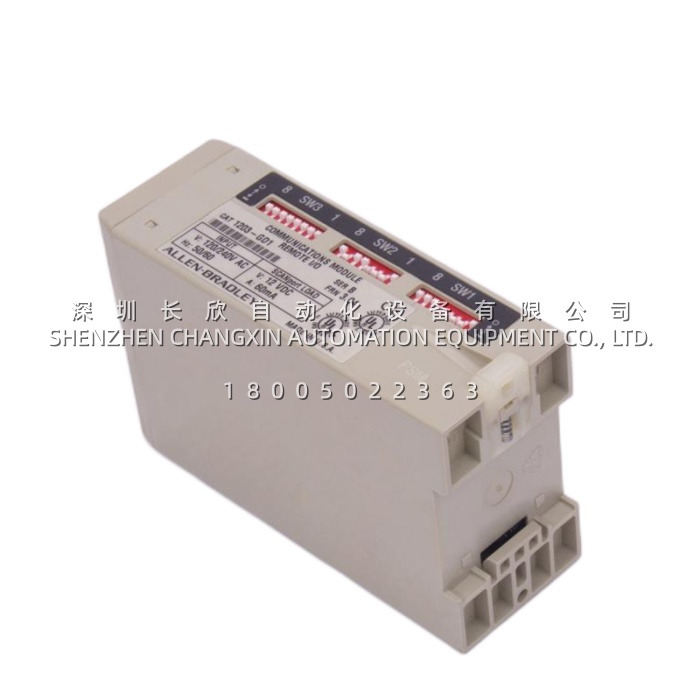
ABB MV03 MV-03 Conitronic: 4–20 mA / 1–5 V Signal Converter with Adjustable Alarm Trip Point缩略图

ABB MV03 MV-03 Conitronic: 4–20 mA / 1–5 V Signal Converter with Adjustable Alarm Trip Point

ABB MV03 MV-03 Conitronic: 4–20 mA / 1–5 V Signal Converter with Adjustable Alarm Trip Point插图

Description:

The MV03​ (also written MV 03 or MV-03), part of ABB’s legacy Conitronic® family, is an analog signal conditioning and alarm trip module designed to interface with ABB 2600 / 3000 series electronic pressure, differential pressure, and temperature transmitters or to condition any standard 4–20 mA / 1–5 V process signal. It accepts a DC analog input, provides galvanic isolation, scales or repeats the signal, and offers one or two adjustable alarm setpoints with SPDT relay outputs—commonly used to drive local annunciators, initiate emergency shutdowns, or provide a secondary high/low limit contact to a DCS/PLC when the transmitter itself lacks digital alarm capability.h2 Application Scenarios:A chemicals blending plant still operates a battery of ABB Conitronic 264 series differential-pressure flow transmitters installed in the 1990s. The original loop drawings called for a local high-flow alarm and an emergency trip contact when flow exceeded 110 % of range—functions handled by an MV03​ trip amplifier mounted in the local field auxiliary rack. After 25 years one MV03 began failing to pick up the high-alarm relay even though the analog meter showed correct mA on the loop. The instrument technician verified the input signal with a calibrator, adjusted the setpoint pot, and confirmed the relay was sticky—a sign of aged reed or contact wear. He replaced the unit with a verified MV03 (MV 03)​ module (24 V DC version), reconnected the loop via the screw terminals, set the alarm potentiometer to the documented 18.4 mA (110 %), and tested the relay operation with a decade box. The high-flow alarm and ESD contact functioned perfectly on first trial. The plant’s senior I&E tech noted that “the MV03​ is one of those unglamorous boxes that quietly protects the process—when it fails you realize how much you depend on it.”h2


Parameter:

Main Parameters Value/Description
Product Model MV03​ (MV 03 / MV-03 — ABB Conitronic Signal Conditioner / Trip Amplifier)
Manufacturer ABB (formerly Taylor / Kent / BBC Conitronic line)
Product Category Analog Signal Conditioner & Alarm Trip Module (Conitronic 2600/3000 Family)
Input Signal 4–20 mA DC or 1–5 V DC (selectable / fixed per variant; some accept 0–10 V DC)
Input Impedance ≈ 250 Ω (for 4–20 mA loop-powered mode) / > 100 kΩ (voltage mode)
Number of Alarm Setpoints Typically 1 or 2 (Hi / Lo) — adjust via front panel potentiometer
Alarm Output 1 × or 2 × SPDT (Form C) relay — 5 A @ 250 V AC / 30 V DC (resistive) typical
Deadband (Hysteresis) Adjustable via onboard pot or fixed ≈ 1–2 % of span
Isolation ≥ 1 kV between input / output / power circuits (galvanic isolation per IEC 61010)
Supply Voltage 24 V DC (most common) or 110 / 230 V AC 50/60 Hz — verify your unit’s label
Response Time ≤ 200 ms typical (to relay operate at setpoint crossing)
Status Indication Power LED + Alarm LED per relay; test / calibrate pushbutton on some versions
Mounting Method 35 mm DIN rail (TS35) or dedicated Conitronic rack slot / plug-in card format per sub-type
Operating Temperature 0 °C to +50 °C (typical for Conitronic field units)
Certifications CE (as component of Conitronic system), complies with IEC 60654 / IEC 61010
Key Note MV03 exists as both a DIN-rail module and a rack-plug-in PCB — confirm form factor & supply voltage from your removed unit before ordering


h2 Technical Principles and Innovative Values:

  • Innovation Point 1 — Self-Contained Alarm Tripping Without Reprogramming the Transmitter or DCS.​ The MV03​ adds independent, fail-safe alarm capability to any analog loop. Because it operates on the mA signal itself and requires no HART or FF configuration, it is ideal for legacy plants where the transmitter has no digital alarm function or the DCS cannot be easily modified to add a software alarm on a third-party signal. The alarm setpoint is set with a simple front-panel pot and locked with a small grub screw—intentionally manual to prevent accidental drift.
  • Innovation Point 2 — Galvanic Isolation Protecting Sensitive Loop Electronics.​ The input stage of the MV03​ is opto-isolated from both the relay contacts and the supply rail. This breaks ground loops between the field transmitter loop (which may be grounded at the sensor) and the control-room return or relay-wired MCC, a common source of reading drift or noise in mixed-ground plants. The isolation also allows the MV03’s relay contacts to switch voltages different from the loop supply—e.g., the input is a 24 V DC 4–20 mA loop while the alarm relay switches 110 V AC to a local horn.
  • Innovation Point 3 — Adjustable Deadband Prevents Chattering on Noisy or Slowly Varying Signals.​ Many process variables (level in an agitated tank, temperature with long time constant) hover near an alarm limit. The MV03​ includes an adjustable deadband (hysteresis) control so that the relay does not chatter on minor fluctuations. This is a simple but critical feature that distinguishes purpose-built trip amplifiers from generic volt-free relays and prevents nuisance annunciation that erodes operator trust.
ABB NBIO-21CU Analog I/O Module – Seamless Integration with ABB CI854A / CI867 Fieldbus Interface Modules缩略图

ABB NBIO-21CU Analog I/O Module – Seamless Integration with ABB CI854A / CI867 Fieldbus Interface Modules

ABB NBIO-21CU Analog I/O Module – Seamless Integration with ABB CI854A / CI867 Fieldbus Interface Modules插图


Description:

The ABB NBIO-21CU​ (also written NBIO21CU) is an Analog Input/Output Unit within ABB’s S800 I/O family, designed for use with Symphony Plus, Freelance 800F (AC 800F), and Advant OCS systems via appropriate interface modules (CI854A, CI867, etc.). It provides eight independent analog input channels (typically 4–20 mA, 0–20 mA, ±10 V DC — jumper or software selectable per revision) and four analog output channels (4–20 mA or 0–10 V DC), all with 12/16-bit resolution and galvanic isolation between field-side and system backplane. The module is housed in the standard S800 I/O terminal base (TU8xx series) and draws 24 V DC auxiliary power from the terminal base, making it a compact, hot-swappable analog interface for continuous-process measurement and control — temperature, pressure, flow, level, and position feedback loops.

Application Scenarios:

Picture a petrochemical distillation column where the original analog input card feeding column-top temperature (7 × RTD-transmitter 4–20 mA signals) and reflux-flow setpoint (1 × AO to the control valve positioner) begins showing frozen values on two AI channels — traced to a failed A/D multiplexer after 14 years. The DCS engineer selects the ABB NBIO-21CU​ as the direct replacement. After a LOTO check, the old module is unlatched from its TU805 terminal base (field wiring stays on the base — no re-termination), and a new NBIO-21CU​ is clicked into place. The system automatically recognizes the module type via the backplane PROM, the green PWR and RUN LEDs illuminate, and within the next scan cycle all eight temperature and flow values return live to the operator graphics. The single analog output driving the reflux valve is re-verified via a manual output test from the DCS. Total swap time: under 3 minutes, zero impact on the running process. The key pain point solved: a hot-swappable, form-fit analog I/O module that preserves all field wiring and DCS addressing, restoring measurement fidelity and loop control instantly in continuous-process applications.

Parameter:

Main Parameters Value/Description
Product Model NBIO-21CU​ (NBIO21CU)
Manufacturer ABB (Sweden / Switzerland)
Product Category Analog Input / Output Module (S800 I/O Family)
System Compatibility ABB Symphony Plus (S800 I/O), Freelance 800F (AC 800F), Advant OCS via CI854A / CI867 / IMDSI / IMCISxx interfaces
Analog Inputs (AI) 8 × channels, individually configurable: 4–20 mA, 0–20 mA, ±10 V DC, 0–10 V DC (resolution 12–16 bit; accuracy ±0.1–0.2 % FS)
Analog Outputs (AO) 4 × channels: 4–20 mA (default) or 0–10 V DC (jumper selectable on many revisions); 12-bit D/A, drive capacity ≥ 500 Ω @ 20 mA
Input Impedance (AI) ≈ 250 Ω (current mode) / > 100 kΩ (voltage mode)
Isolation ≥ 1.5 kV AC channel-group-to-backplane & channel-to-channel (group-wise) galvanic isolation
Supply Voltage 24 V DC (from S800 terminal base TU8xx; typ. 70–120 mA @ 24 V DC)
Indicators PWR (green), RUN/Comm (green), per-channel Status LED (yellow — reflects input > 2 mA or output active)
Process Alarms Low / High / Low-Low / High-High configurable per AI channel; broken-sensor (open-loop) detection on 4–20 mA inputs
Mounting Plugs into S800 terminal base (e.g., TU805, TU810, TU813) on 35 mm DIN rail; hot-swappable
Operating Temp. -20 °C to +60 °C (storage: -40 °C to +85 °C); 5–95 % RH non-condensing
Certifications CE, UL / cULus, FM (Div. 2 optional), ATEX / IECEx (selected versions), RoHS, IEC 61131-2


Technical Principles and Innovative Values:

The NBIO-21CU​ is a process-grade analog interface — not a generic data-acquisition card — qualified for continuous-operation in classified process areas.

  • Innovation Point 1: Live-Zero Broken-Sensor Detection on 4–20 mA Inputs.​ The NBIO-21CU​ can be configured to flag a “Sensor Break / Wire Break” alarm if the measured current falls below ~3.6 mA (configurable threshold), and a “Low Signal” or “High Signal” if process values exceed limits. This lets the control system distinguish between a true low-flow condition (e.g., 3.8 mA = 0 %) and a failed transmitter or open circuit — a critical distinction for safety and asset availability in SIL-rated or EPA-regulated processes.
  • Innovation Point 2: Backplane-Powered with No External Aux Wiring on the I/O Side.​ The NBIO-21CU​ draws its operating power and the AO loop excitation (where loop-powered) from the 24 V DC supplied through the S800 terminal base. Field wiring is confined to the removable terminal block on the TU base — the module itself has no separate power terminals. This reduces panel wiring, eliminates polarity errors on the module, and makes hot-swap replacement truly tool-minimal.
  • Innovation Point 3: Per-Channel Software Selectability Reducing Spare-SKU Count.​ Although the NBIO-21CU​ has fixed hardware (8 AI + 4 AO), each AI channel can be independently assigned as current or voltage in the engineering tool without changing jumpers on the module. Plants can standardize on a single analog I/O spare (the NBIO-21CU) for mixed voltage/current analog-input needs — only the configuration download differs — simplifying obsolescence planning and spare-holding cost.


Application Cases and Industry Value:

  • Case 1 – Oil Refinery Crude-Unit Reboiler Temperature Loop Restoration (Middle East):​ A crude distillation unit’s bottom-reboiler temperature loop (4–20 mA from a thermowell transmitter) went stale — traced to a failed AI channel on an aging S500 analog card. The I/O was migrated to an S800 rack with a NBIO-21CU. The module was installed in an existing TU810 base, the original field wires transferred to the base’s screw terminals, and the DCS configuration mapped the 8 AI + 4 AO points. Loop check passed first time; the plant standardized the NBIO-21CU​ for all future analog-point additions across three process units, retiring five different legacy analog-card spares.
  • Case 2 – Pharmaceutical Water-For-Injection (WFI) Skid Local I/O (Western Europe):​ A GMP WFI generation skid used a compact S800 I/O station with a NBIO-21CU​ reading conductivity (AI), temperature (AI), and driving the divert-valve positioner (AO). The module’s 16-bit resolution allowed the skid’s PLC to resolve conductivity changes down to 0.01 µS/cm — well within the pharmacopeia requirement. After 7 years of continuous steam-sanitization cycles in the warm MCC room, the NBIO-21CU​ showed no drift; the site’s validation team cited the module’s stable performance as a positive finding in the periodic re-qualification audit.
ABB NASM03 Module: Remote Analog Acquisition Slave for ABB Procontrol P13 Distributed I/O Stations缩略图

ABB NASM03 Module: Remote Analog Acquisition Slave for ABB Procontrol P13 Distributed I/O Stations

ABB NASM03 Module: Remote Analog Acquisition Slave for ABB Procontrol P13 Distributed I/O Stations插图

Description

The ABB NASM03​ (NASM-03) is an analog input slave module designed for use within ABB Procontrol P13​ distributed I/O stations and compatible Symphony Harmony vintage installations. It functions as a remote analog acquisition submodule that connects to a master analog multiplexer (typically NAMP03​ or NAMM03) via the station’s internal analog bus, providing eight differential analog input channels (configurable for 4–20 mA, 0–10 V, thermocouple, or mV signals depending on master configuration). The NASM03​ contains the input buffering, cold-junction compensation reference (where applicable), and channel-select logic but delegates A/D conversion to the master — making it a cost-effective way to expand analog-point count in a Procontrol P13 rack.h2 Application ScenariosConsider a petrochemical blending unit still running an ABB Procontrol P13 DCS where the reactor section monitors ten temperature zones and six pressure loops via a NAMP03 analog master in the field I/O rack. The original configuration used one NASM03 (8 channels) plus direct master inputs — but a recent process upgrade added three new RTD-temperature transmitters requiring three spare analog channels. Rather than installing a completely new I/O rack with power supply, communication interface, and bus cabling, the instrumentation team simply adds a second ABB NASM03​ to the empty slave slot in the existing P13 rack, lands the new 4–20 mA loops on its screw terminals, and updates the master’s channel-scan list in the Procontrol engineering software. The additional eight channels are immediately available — no new fieldbus node, no additional power supply, no re-wiring of the existing loops. This scenario shows the NASM03‘s practical value: it is the modular, low-cost analog expansion building block that preserves the integrity of a proven Procontrol P13 installation while accommodating incremental process changes.h2


Parameter

Main Parameters Value/Description
Product Model NASM03​ (NASM-03, ABB P13 Analog Slave Module)
Manufacturer / Series ABB / Procontrol P13 (Symphony Harmony legacy compatible)
Product Category Analog Input Slave Module (Sub-Multiplexer Card for NAMP03 / NAMM03 Master)
Number of Channels 8 differential analog input channels
Input Signal Types (via Master Config) 4–20 mA, 0–20 mA, 0–10 V, ±10 V, Thermocouple (Type J/K/T/E/S — via master CJC), mV (±50 mV)
Input Impedance > 1 MΩ (voltage mode); ≤ 250 Ω (current mode with int. shunt)
Resolution (System) Determined by master A/D — typically 12–14 bit effective (0.025 % FS)
Accuracy ±0.1 % FS (typical, with calibrated master & proper CJC on TC types)
Isolation Galvanic isolation between analog inputs, module logic, and Procontrol station bus (≥ 500 V AC test)
Bus Interface Procontrol P13 analog slave bus (ribbon to NAMP03 / NAMM03 master in same rack)
Connectors Screw terminals for field analog signals + pin-header / ribbon to master backplane
Operating Temperature 0 °C to +60 °C
Mounting Method Plugs into dedicated slave slot in Procontrol P13 I/O rack (guided rails + ejector / fixing screw)
Dimensions (approx.) 263 × 20 × 198 mm (P13 card format)
Weight ≈ 0.35 kg


*Note: The NASM03 does NOT contain its own A/D converter — it buffers and routes the selected channel to the master multiplexer (NAMP03/NAMM03) which performs the conversion. Channel configuration (signal type, range, alarm limits) is done in the master module’s parameter set, not on the NASM03 itself.h2 Technical Principles and Innovative ValuesThe NASM03​ implements a classic slave-multiplexer architecture optimized for high-channel-count, cost-sensitive analog acquisition in process DCS.

  • Innovation Point 1 – Master-Slave Analog Bus Architecture Minimizes Cost per Point: By offloading A/D conversion, cold-junction compensation, and digital communication to the NAMP03 / NAMM03 master, each NASM03​ adds eight analog channels for a fraction of the cost of a standalone intelligent AI module. This design was ahead of its time in recognizing that many process applications need lots of slow-changing analog data (temp, press, level) but not high-speed simultaneous sampling — the sequential scan via the master is perfectly adequate and far more economical.
  • Innovation Point 2 – Differential Inputs with High Common-Mode Rejection: All eight channels on the NASM03​ are differential (positive and negative lead per input), providing excellent rejection of ground loops and induced noise — a common issue when thermocouple or low-level mV signals are routed through electrically noisy plant cable trays. This ensures measurement integrity even when field grounds differ from the DCS ground reference.
  • Innovation Point 3 – Hot-Swap Capable Within Rack Power Budget: The NASM03​ draws its operating power from the P13 rack backplane (+5 V / ±15 V DC) and can be inserted/removed with the rack powered (subject to site safety policy and ESD precautions). Because configuration lives on the master, a replacement NASM03​ is automatically recognized on the next scan cycle — no download, no re-addressing — which is invaluable during off-hour troubleshooting when a channel group fails.
Genuine ABB NAOM01 (6631966D1) Analog Output Module – ±0.1% Accuracy, Channel-to-Channel Isolation缩略图

Genuine ABB NAOM01 (6631966D1) Analog Output Module – ±0.1% Accuracy, Channel-to-Channel Isolation

Genuine ABB NAOM01 (6631966D1) Analog Output Module – ±0.1% Accuracy, Channel-to-Channel Isolation插图


Description:

The ABB NAOM01​ (Bailey Part No. 6631966D1) is an Analog Output Module designed for ABB Bailey INFI 90, Network 90, and Symphony / Symphony Plus Harmony DCS systems. It converts digital control signals from the DCS controller into standard industrial analog signals — typically 4–20 mA DC or 0–10 V DC — to drive field final control elements such as control valves, variable frequency drive speed references, dampers, and analog recorders, with high accuracy and electrical isolation between channels.

Application Scenarios:

A 600 MW coal-fired power plant’s boiler combustion control system used an ABB INFI 90 DCS rack to modulate the forced draft (FD) and induced draft (ID) fan inlet guide vanes via 4–20 mA analog outputs. During a routine alarm review, the operators noticed that one FD fan’s positioner was not tracking the setpoint despite correct digital logic in the controller. Loop checks revealed the corresponding ABB NAOM01​ AO channel was outputting a fixed 0 mA with the module’s green COM LED blinking normally — a classic symptom of an internally degraded output amplifier stage. The I&C technician powered down the rack (NAOM01 is not hot-swappable on most legacy racks), removed the NAOM01, inserted a verified replacement, restored power, and re-ramped the loop — the 4–20 mA signal tracked perfectly and the FD fan vane responded. No database changes or I/O re-mapping were required. This real-world scenario highlights the NAOM01‘s role as the critical D/A translation point in process control loops, and why keeping a tested spare in the storeroom avoids extended process upsets.

Parameter:

Main Parameters Value/Description
Product Model NAOM01​ (Bailey P/N: 6631966D1)
Manufacturer ABB (Bailey Controls / Process Automation)
Product Category Analog Output Module (AO) for DCS I/O Rack
Compatible System ABB INFI 90 Open, Network 90, Symphony Plus Harmony (MFP / ICP Rack)
Output Channels 4 or 8 independent channels (model variant / firmware dependent; commonly 4-ch per MIL-spec, 8-ch per later revision)
Output Signal Types 4–20 mA DC, 0–20 mA DC (current mode), 0–10 V DC, ±10 V DC (voltage mode — per configuration)
Output Accuracy ±0.1 % of Full Scale (FS) at 25 °C
Resolution 12-bit typical / 16-bit on later revisions
Load Capability ≤ 500–750 Ω (current output); ≥ 1 kΩ (voltage output)
Isolation ≥ 500 V AC channel-to-channel & channel-to-system (galvanic)
Module Power +5 V DC & +24 V DC from rack backplane (no external PSU required)
Response Time < 10 ms (full-scale step change)
Status Indication Module Power (PWR), Communication Active (COM), individual channel activity / fault via system diagnostics
Operating Temperature 0 °C to +60 °C
Storage Temperature -40 °C to +85 °C
Humidity 5 %–95 % RH, non-condensing
Mounting Method Standard DCS rack slot (card-guide + backplane edge connector); secured by front panel screw / ejector
Protection Class IP20 (for enclosed cabinet installation)
Dimensions (approx.) 290 × 130 × 40 mm (L × W × H)
Weight (approx.) 0.40 – 0.50 kg


Technical Principles and Innovative Values:

  • Innovation Point 1 — High-Resolution D/A Conversion with Per-Channel Software Configuration.​ The ABB NAOM01​ uses precision digital-to-analog converters to transform the controller’s digital output word into a proportional analog current or voltage. Each channel’s signal type (4–20 mA vs 0–10 V) and range scaling are software-selectable via the INFI 90 / Symphony engineering tool (e.g., SysCon / Control Builder), eliminating the need for DIP switches or jumper changes — a flexibility that simplifies spare-part standardization across different loop types.
  • Innovation Point 2 — Galvanic Channel Isolation & Transient Protection.​ Every output channel on the NAOM01​ is galvanically isolated from the system backplane and from other channels (≥ 500 V AC test). This prevents ground-loop errors in multi-loop applications and protects the sensitive DCS logic from field-side transients such as inductive kickback from solenoid valves or VFD common-mode noise.
  • Innovation Point 3 — Built-In Output Diagnostics & Fault Reporting.​ The module continuously monitors each channel for open-circuit (broken wire in current loop), over-range, and compliance voltage drop below minimum. Fault conditions are reported to the controller’s diagnostic database and can trigger operator alarms — allowing maintenance to identify a failed loop transmitter or wiring break before it impacts process control, rather than discovering it during a trip.
ABB NAMC-03 Control Board Kit — Analog Measuring Card for ACS600 / ACS800 Drive Control Unit缩略图

ABB NAMC-03 Control Board Kit — Analog Measuring Card for ACS600 / ACS800 Drive Control Unit

ABB NAMC-03 Control Board Kit — Analog Measuring Card for ACS600 / ACS800 Drive Control Unit插图 ABB NAMC-03 Control Board Kit — Analog Measuring Card for ACS600 / ACS800 Drive Control Unit插图1

Description:

The ABB NAMC-03​ (Stock / Order No. typically 63940135, sometimes referenced as part of the SDCS NAMC kit family) is a Non-Isolated Analog Measuring & Control Interface Board — often shipped as a kit​ including the PCB, mounting hardware, jumper links, and sometimes the ribbon cable to the SDCS-CON-2 / SDCS-CON-4 CPU — used in ABB ACS 600, ACS 800, and certain DCS 600 drive control units. It processes analog feedback signals (motor current, DC-link voltage, external analog references 0–10 V / 4–20 mA), provides speed/torque reference inputs, and in some configurations handles tacho/encoder-derived feedback scaling. The NAMC-03​ works in tandem with the SDCS-CON-x CPU board to close the regulation loops that determine drive output frequency and voltage.h2 Application Scenarios:A paper-machine sectional drive using ABB ACS800 units began showing subtle speed-regulation drift on one rewinder section — the drive itself was healthy but the 0–10 V analog speed-reference from the master PLC read inconsistently at the drive’s AIN terminals. Loop-check revealed the NAMC-03’s on-board A/D reference trim had drifted beyond tolerance after 15 years of service. The maintenance team replaced the entire ABB NAMC-03 Control Board Kit, re-applied the factory-default jumper configuration, and re-calibrated the analog input span in the drive menu. Speed-reference tracking returned to ±0.01% of setpoint and the rewinder tension control stabilized — eliminating off-spec roll rejects. The NAMC-03 kit​ solved the pain point of degraded analog measurement accuracy that mimics a bad PLC signal or motor problem, and because the kit includes correct jumpers and hardware the swap was completed without scavenging parts from decommissioned units. This underscores why the NAMC-03​ is a high-value critical spare for process lines where analog precision directly affects product quality.h2


Parameter:

Main Parameters Value/Description
Product Model NAMC-03​ (Order / Stock No. 63940135 / 3BHT… series depending on kit revision)
Manufacturer ABB (ABB Drives / Motion Control — SDCS Accessory Family)
Product Category Non-Isolated Analog Measuring & Control Interface Board (sold as Kit w/ hw & cable)
Compatible Drives ABB ACS 600, ACS 800 (cabinet & wall-mount with SDCS-CON-2 / CON-4), DCS 600 (DC Drive)
Analog Inputs 2–3 channels typical — 0–10 V, ±10 V, 4–20 mA (jumper-selectable range & mode per channel)
Analog Functions Speed ref, Torque Ref, External Feedback, DC-Link Mon, Motor Current Mon (scaled)
Connection to CPU Ribbon cable / header to SDCS-CON-2 or SDCS-CON-4 control board
Calibration On-board trimmers for zero & span (or via drive menu in later fw)
Mounting Method Internal drive chassis — screws to standoffs; often piggy-backed or adjacent to SDCS-CON-x
Kit Contents PCB, mounting screws/spacers, jumper links, ribbon cable (length per kit variant)
Operating Temp. -20 °C to +65 °C (drive-cabinet ambient)
Protection Rating IP00 (bare PCB — installed inside enclosed drive enclosure)
Associated Board SDCS-CON-2 (3ADT220090R0022) / SDCS-CON-4 — usually replaced/maintained as a pair


h2 Technical Principles and Innovative Values:

  • Tightly Coupled Analog Front-End to Drive Regulation Loop:​ The NAMC-03​ conditions external analog reference and feedback signals through precision op-amp buffers and A/D conversion staged close to the SDCS-CON-x CPU, minimizing noise pickup compared to routing low-level analog signals over long external wiring. This yields more stable speed/torque regulation — particularly important in paper, printing, and web-handling lines.
  • Jumper-Selectable Input Ranges & Modes Reduce External Components:​ Instead of requiring external signal-conditioning transmitters to force 0–10 V into a 4–20 mA drive input, the ABB NAMC-03​ lets the installer choose input mode (voltage/current, unipolar/bipolar) via on-board jumpers — simplifying panel design and reducing points of failure in the analog reference chain.
  • Part of a Modular, Replaceable Control Section:​ Sold as a kit with the correct ribbon and hardware, the NAMC-03​ can be swapped in minutes without hunting for compatible cables or guessing jumper positions. Because it stores no user parameters (those reside on the SDCS-CON-x CPU), replacement requires only a visual re-check of jumper settings against the drive documentation — no re-commissioning of the drive application logic.
ABB NAIO-03F​ Analog I/O Option Board Kit — Plug-In Analog Interface for ACS350 / ACS550 / ACS880 Drives缩略图

ABB NAIO-03F​ Analog I/O Option Board Kit — Plug-In Analog Interface for ACS350 / ACS550 / ACS880 Drives

ABB NAIO-03F​ Analog I/O Option Board Kit — Plug-In Analog Interface for ACS350 / ACS550 / ACS880 Drives插图


Description

The NAIO-03F​ (ABB type designation NAIO-03, variant F — supplied as Option SP Kit including the board and mounting hardware) is an ABB plug-in Analog Input / Output Option Module for ABB low- and medium-voltage AC drives including the ACS 350, ACS 550, ACS 800, and ACS 880 families equipped with a free option slot. It provides three configurable analog inputs (AI1–AI3) accepting 0/4–20 mA or ±10 V DC signals for speed reference, torque limit, process-variable feedback, or external setpoint, plus two analog outputs (AO1–AO2) sourcing 0/4–20 mA to represent drive status such as motor current, speed feedback, DC-link voltage, or fault level — all scalable and configurable through drive parameters. The NAIO-03F​ is powered from the drive’s internal 24 V DC supply via the option-slot backplane, requires no external power, and is conformal-coated for industrial environments. It extends the drive’s native I/O capability without adding panel space or external signal-conditioning hardware.

h2 Application Scenarios

Consider a chemical dosing pump driven by an ABB ACS 550, where the speed setpoint must come from a 4–20 mA signal representing tank level from a remote PLC, and the drive must in turn output a proportional 4–20 mA signal reflecting actual motor current back to the plant’s SCADA. The base drive has only one analog input (already used for local pot-setpoint) and no analog output. Installing the NAIO-03F​ in Option Slot 1 gives three additional analog inputs and two analog outputs. The level signal is wired to AI1 (scaled 4–20 mA = 0–50 Hz), and AO1 is parameterized to output “Motor Current × 0.1” on 4–20 mA. During commissioning the drive’s keypad shows the live AI1 value confirming correct scaling; the AO LED on the NAIO-03F​ (where present on the variant) blinks proportionally. When the level transmitter drifts, the PLC sees the corresponding current deviation via SCADA — all without external isolators or marshalling. This scenario shows how the NAIO-03F​ solves the pain point of insufficient drive analog I/O and eliminates the cost / panel space of separate signal-conditioning modules.

h2 Parameter

Main Parameters Value/Description
Product Model NAIO-03F​ (Type: NAIO-03, Variant F — Option SP Kit)
Manufacturer ABB (ABB Motion — Drives Low Voltage Products)
Product Category Plug-In Analog Input / Output Option Module for AC Drives
Compatible Drives ABB ACS 350, ACS 550, ACS 800 (with Option Slot), ACS 880 series — verify free Option Slot 1 / 2 per drive nameplate
Analog Inputs (AI) 3 channels (AI1, AI2, AI3) — 0/4–20 mA DC or ±10 V DC selectable per channel (12-bit resolution, < 10 ms update)
Analog Outputs (AO) 2 channels (AO1, AO2) — 0/4–20 mA DC (max. load 500 Ω) (Scaled to any drive-internal variable — speed, current, power, fault code)
Input Impedance (Current Mode) 250 Ω (for 0/4–20 mA)
Input Impedance (Voltage Mode) 100 kΩ (for ±10 V)
Supply Voltage (Internal) 24 V DC from drive backplane (no external supply required)
Configuration Method Via Drive Keypad / Assistant Control Panel or ABB Drive Composer — parameter groups 15.xx (AI) & 98.xx (option assignment)
Resolution 12 bit (AI & AO)
Accuracy ±0.5 % of full scale (typical @ 25 °C)
Mounting Insert into designated Option Slot inside drive control compartment; keyed edge connector + retaining screw / clip
Operating Temperature -20 °C to +60 °C (drive-cabinet ambient)
Conformal Coating Yes (standard for drive internal option boards)
Certifications CE, cULus, IEC 61800-5-1 / IEC 60947


h2 Technical Principles and Innovative Values

  • Innovation Point 1 — Drive-Bus Powered with No External 24 V DC Feed Required:​ Unlike panel-mounted analog I/O cards that need a separate power supply, the NAIO-03F​ draws its operating rails from the drive’s internal auxiliary PSU through the option-slot backplane. This removes one potential failure point (external PSU) and simplifies panel layout — only the signal wires (shielded twisted pair recommended) need to be landed on the drive’s terminal strip or the NAIO’s pigtail terminals.
  • Innovation Point 2 — Fully Parameter-Assignable I/O Mapped to Any Drive-Internal Variable:​ Each analog input can be freely assigned as speed ref., torque limiter, process feedback, or external interlock — scaled via minimum/maximum raw values and user-defined engineering units. Each analog output can be mapped to motor speed, output current, DC-link voltage, power, or even a coded fault word. This flexibility allows one hardware SKU to serve vastly different application needs across a plant’s drive population.
  • Innovation Point 3 — Built-In Diagnostics & Live Value Display on Drive Keypad:​ The ACS/ACH drive firmware continuously monitors the NAIO-03F​ channels — loss of 4–20 mA signal (broken-wire detection on selected inputs), over-range, or short-circuit on outputs can be trapped as drive faults or warnings. The actual digitized value of each AI/AO is viewable in real time on the drive’s keypad or via Drive Composer — an invaluable commissioning aid that external signal conditioners cannot provide.


h2 Application Cases and Industry Value

Case Study — Water Treatment Plant Chemical Metering Pump Drives:A municipal water utility retrofitted six chemical-dosing pumps (ACS 350, 2.2 kW) with NAIO-03F​ analog I/O boards to accept chlorine-residual 4–20 mA setpoints from the SCADA system and feed back actual pump-motor current on a second 4–20 mA loop. Previously the pumps ran on local potentiometers with no SCADA visibility. Post-retrofit the plant achieved closed-loop dosing control, reducing chlorine overfeed by 12 %. The instrument tech reported that seeing the AI raw value on the drive keypad during loop checks “saved hours of chasing down scaling errors” — a direct benefit of the NAIO-03F‘s native integration. The boards have operated fault-free for 4+ years with no replacements needed.

Operating Temperature           -20 °C to +60 °C; Storage: -40 °C to +85 °C缩略图

Operating Temperature -20 °C to +60 °C; Storage: -40 °C to +85 °C

Operating Temperature           -20 °C to +60 °C; Storage: -40 °C to +85 °C插图


Technical Principles and Innovative Values

  • Innovation Point 1 – DDCS Fiber-Optic Decoupling:​ The ABB NAIO-01​ communicates with the drive CPU over ABB’s DDCS (Distributed Digital Control System) plastic optical fiber, providing total galvanic isolation between the noisy power section and sensitive analog measurement circuits—eliminating ground-loop errors common with copper-linked I/O.
  • Innovation Point 2 – Software-Configurable Signal Types:​ Both AI and AO channels are freely assignable in drive parameters to voltage (±10 V, 0–10 V) or current (0/4–20 mA) modes, with independent scaling (offset/gain), min/max clamping, and inversion—no hardware jumpers required beyond the node-address DIP switches.
  • Innovation Point 3 – Transparent I/O Mapping to Drive Parameters:​ The NAIO-01​ analog inputs and outputs are mapped directly into the ACS drive’s parameter set (e.g., Group 14/15 for external references or Group 40 for supervision), making them appear indistinguishable from the drive’s onboard I/O—no additional programming or PLC ladder logic needed.
  • Innovation Point 4 – Compact Retrofit Without Panel Expansion:​ Because the ABB NAIO-01​ can be DIN-rail mounted inside the existing drive enclosure and draws power from the 24 V DC auxiliary supply, it adds four analog channels with zero incremental panel footprint—ideal for brownfield drive upgrades.


Application Cases and Industry Value

In a municipal water treatment facility, three ABB ACS600​ pumps lacked enough analog inputs to accept both local level-transmitter feedback and a SCADA speed trim. Installing a ABB NAIO-01​ on each drive’s DDCS link provided the extra 2 AI channels per unit, which were parameterized to read the tank level (4–20 mA) and apply it as a cascaded setpoint via drive Group 11. The result: tighter level control (±15 mm vs. previous ±50 mm), elimination of a standalone PID loop in the SCADA, and zero additional panel cutouts. Facility engineers noted the NAIO-01’s optical isolation was especially valuable given the long, unshielded analog runs from outdoor tanks to the MCC room.

Related Product Combination Solutions

  • ABB NIOC-01 / NIOC-02 (3BHT200012R0001)​ – Standard I/O interface board in ACS600/800; hosts the DDCS fiber link to which the ABB NAIO-01​ connects (CH1 or CH2).
  • ABB NAMC-03 / NAMC-11 (3BHT200014R000x)​ – Application & Motor Control Board; master for DDCS option modules including NAIO-01—ensure firmware supports NAIO parameter 98.06.
  • ABB NDIO-01 / NDIO-02 (3BHT200008R0001)​ – Digital I/O extension module (2 DI + 2 RO) that shares the same DDCS architecture; often paired with NAIO-01​ on the same fiber ring.
  • ABB NTAC-02 (3BHT200013R0001)​ – Pulse encoder interface module; also DDCS-linked—useful when full option suite (analog + digital + encoder) is needed on one drive.
  • ABB AINT-02 / AGDR-02 (3BHE006446R0101)​ – Inverter control / gate driver boards in ACS800; NAIO-01 is not directly linked but shares the same option-slot ecosystem—verify NIOC presence before ordering.
  • ABB RDCO-02 / RDCO-03 (3BHE006232R0101)​ – DDCS communication option board for NAMC-11; may be required if all DDCS channels are occupied before adding ABB NAIO-01.


Installation, Maintenance, and Full-Cycle Support

Mount the ABB NAIO-01​ on a 35 mm DIN rail inside the drive cabinet or option compartment. Connect the 24 V DC auxiliary supply (+24 V to terminal X1-1, 0 V to X1-2) and plug in the plastic optical fiber cables from the NIOC or NAMC board’s DDCS port (typically CH1; if a ring topology is used, insert NAIO-01 in series). Set the 7-way DIP switch inside the module cover to the desired node address—for ACS600 Standard Application, address 4​ is the factory-recommended default for the first NAIO module. Power up the drive, navigate to parameter 98.06 (AI/O EXT MODULE 1) and set it to NAIO-01; the drive will poll the module and activate the analog channels. Wire field signals to terminals X2 per the NAIO-01 manual(AI1+/−, AI2+/−, AO1+/−, AO2+/−) using shielded twisted-pair cable, grounding the shield drain only at one end.

ABB MZ03 (CONTRONIC MZ-03 H.B.): Microprocessor Unit for ABB Uras 10 / Limas 11 / Magnos 16 Gas Analyzers缩略图

ABB MZ03 (CONTRONIC MZ-03 H.B.): Microprocessor Unit for ABB Uras 10 / Limas 11 / Magnos 16 Gas Analyzers

ABB MZ03 (CONTRONIC MZ-03 H.B.): Microprocessor Unit for ABB Uras 10 / Limas 11 / Magnos 16 Gas Analyzers插图


Description

The MZ03 (MZ-03 H.B. CONTRONIC)​ is a microprocessor-based Controller / Display Module manufactured by ABB for the CONTRONIC P and ABB Advance Optima series of continuous gas analyzers (NDIR-IR, paramagnetic O₂, thermal conductivity, etc.). It serves as the analyzer’s “brain”—processing detector signals from the optical bench, executing calibration routines (zero / span), driving the front-panel LCD and keypad for local operation, and providing analog (0/4–20 mA) plus relay outputs to the plant DCS or CEMS data-acquisition system.

Application Scenarios

Consider a coal-fired power plant running ABB Uras 10 infrared CO/CO₂ analyzers in its CEMS (Continuous Emission Monitoring System) stack. After 15 years of service one analyzer begins showing “EEPROM Error” on the local display and intermittently drops its 4–20 mA output to the DCS—despite the optical bench and IR source testing healthy. The fault is traced to a failing MZ03 (MZ-03 H.B. CONTRONIC)​ controller module. Rather than replace the entire analyzer (involving re-piping sample lines, re-zeroing, and re-certifying the CEMS), the technician powers down the unit, unplugs the old module from the analyzer backplane, inserts a verified MZ03 (MZ-03 H.B. CONTRONIC)​ with matching firmware/H.B. version, and restores power. The analyzer boots, loads the backed-up configuration from its EEPROM (or accepts a quick upload via service PC), and the measured values return—total intervention under 20 minutes with no re-sampling-line work. The MZ03​ directly solves the legacy-CEMS spares gap for plants extending the certified life of proven ABB gas-analysis assets.

Parameter

Main Parameters Value/Description
Product Model MZ03 (MZ-03 H.B. CONTRONIC)​ — also referenced as MZ-03, CONTRONIC MZ03, H.B. = Hardware/Board Version
Manufacturer ABB (Analyzer & SENSYS Division — formerly Hartmann & Braun CONTRONIC)
Product Category Microprocessor Controller / Display & Evaluation Module for Gas Analyzers
Compatible Analyzers ABB CONTRONIC P series; Advance Optima AO2000 (Uras 10/14, Limas 11/21, Magnos 16, Caldos 17 etc.)
Core Function Signal evaluation from detector preamp, zero/span calibration control, local LCD/keypad HMI, analog & relay output generation
Display / HMI Backlit LCD (alphanumeric / bargraph per firmware) + foil keypad for menu navigation, calibration, alarm ack
Analog Outputs 1–2 × 0/4–20 mA isolated (measurand), configurable range & scaling
Digital / Relay Outputs 2–3 × SPDT relays (Alarm 1/2, Fault, Calibration Active — per configuration)
Serial / Service Port RS-232 / RS-485 service interface for ABB service PC software (COMM-SET, AO-ServiceTool)
Memory / Config Onboard EEPROM / Flash for calibration constants, alarm thresholds, linearization, component ID
Supply Voltage 24 V DC ± 10 % (derived from analyzer main power supply inside the AO2000 / CONTRONIC P housing)
Operating Temp. 0 °C to +50 °C (analyzer internal environment)
Mounting Plugs into dedicated slot of analyzer mainboard / backplane; secured by captive screw or clip
Dimensions (Approx.) 180 × 120 × 35 mm (typical — exact per ABB CONTRONIC MZ03 drawing)
Weight (Approx.) 0.25–0.35 kg
Certifications CE, suitable for use in certified CEMS enclosures (purged / temp-controlled)


Technical Principles and Innovative Values

  • Innovation Point 1 — Integrated Detector-Signal Linearization & Component Recognition:​ The MZ03​ doesn’t merely pass through raw detector voltage—it applies stored IR-source intensity compensation, reference-beam ratio calculations, and component-specific linearization curves (Beer-Lambert law adaptation) for the installed gas type (CO, CO₂, NO, SO₂, CH₄, O₂ para-mag, etc.). This allows a single controller hardware to serve multiple analyzer technologies via firmware/EEPROM configuration.
  • Innovation Point 2 — Automatic Zero / Span Scheduling with Drift Monitoring:​ The module can be programmed to execute timed zero and span calibrations using an external solenoid valve train. It tracks measured drift against configurable alarm limits and can force the analyzer into “Maintenance Mode” or latch a relay if drift exceeds tolerance—giving CEMS operators early warning of contamination or source degradation.
  • Innovation Point 3 — EEPROM-Based Plug-Compatibility & Config Retention:​ The MZ03 (MZ-03 H.B. CONTRONIC)​ stores all calibration data, alarm setpoints, and analyzer type in non-volatile memory. When swapped, the replacement can either inherit the old module’s EEPROM (if transferred) or be quickly reloaded from a service-PC backup—no re-piped sample lines, no re-alignment of the optical bench required.


Application Cases and Industry Value

A waste-incineration plant operates ABB Advance Optima Uras 10 analyzers measuring CO and NOx in the stack gas. One unit began displaying corrupted characters and occasionally lost its 4–20 mA output to the CEMS DAS. Diagnostics pointed to the MZ03​ controller module. The plant had stocked a spare MZ03 (MZ-03 H.B. CONTRONIC)​ matched to the same H.B. hardware version.During a scheduled afternoon lull the analyzer was powered down, the old module removed, the new one inserted, and power restored. The analyzer booted, the service laptop confirmed all calibration constants were retained (or reloaded from backup in < 2 minutes), and the CO/NOx readings came back online. The environmental compliance officer noted: “The MZ03​ swap took 15 minutes. We avoided re-zeroing the optical bench and kept our QAL2/QA requirements intact. That module is now a mandatory spare for all three stacks.”The plant deferred an analyzer-replacement project (est. €25 K per unit) and maintained uninterrupted compliance reporting.

Related Product Combination Solutions

  • ABB Advance Optima AO2000 / CONTRONIC P Analyzer Housing (Uras 10, Limas 11, Magnos 16, Caldos 17)​ — The gas-analyzer main unit into which the MZ03 (MZ-03 H.B. CONTRONIC)​ plugs as the controller/evaluator; verify H.B. version compatibility with your analyzer firmware.
  • ABB Analyzer Optical Bench / Detector Preamp PCB (e.g., Uras IR-cell + preamp, Magnos O₂ cell + amp)​ — The sensing element whose signal is evaluated by the MZ03; often inspected / cleaned during the same maintenance window.
  • ABB Sample-Conditioning System (pumps, filters, coolers, solenoid valves)​ — The peripherals cycled by the MZ03‘s calibration relays for auto zero/span; valve timing is configured in the MZ03 menu.
  • ABB Service PC Software (COMM-SET / AO-ServiceTool / EasyServe)​ — Used to back up / restore MZ03 configuration, read drift logs, and perform manual calibration; essential companion tool when swapping the MZ03.
  • ABB 24 V DC DIN-Rail Power Supply (e.g., CP-C 24/10, SD822)​ — Powers the analyzer housing and consequently the MZ03​ module; often audited together for CEMS cabinet spares.
  • ABB 4–20 mA Isolator / Barrier (e.g., KFD2 series from Pepperl+Fuchs — if used in hazardous area)​ — Sits between the MZ03​ analog output and the DCS AI card; sometimes replaced when analog signal issues are suspected.
ABB 1SAM550000R1008 (MS495-1.0A): Rotary-Operated Motor Protection Circuit Breaker, 3-Pole, 690 V AC缩略图

ABB 1SAM550000R1008 (MS495-1.0A): Rotary-Operated Motor Protection Circuit Breaker, 3-Pole, 690 V AC

ABB 1SAM550000R1008 (MS495-1.0A): Rotary-Operated Motor Protection Circuit Breaker, 3-Pole, 690 V AC插图


Description

The ABB MS495 (Order Code: 1SAM550000R1008)​ is a compact Manual Motor Starter (MMS) / Motor Protection Circuit Breaker (MPCB) from ABB’s MS495 series, designed to provide manual ON/OFF switching, overload protection (adjustable bimetal), short-circuit protection (fixed magnetic instantaneous trip), and phase-failure (phase-loss) sensitivity for three-phase AC induction motors up to approximately 0.37–0.55 kW at 400 V. It combines the functions of a disconnect switch, overload relay, and short-circuit protector in a single 45 mm wide DIN-rail device, typically mounted alongside an ABB AF contactor in a starter combination.

Application Scenarios

A packaged water-booster skid used three 0.37 kW stainless-steel centrifugal pumps, each controlled by an ABB AF09 contactor. Originally protected by separate thermal overload relays and a fused isolator, the panel was crowded and required frequent re-fusing after nuisance trips. The OEM replaced the fuse-holder + OL relay with ABB MS495 1SAM550000R1008​ manual motor starters — set to the motor’s FLA of 0.85 A via the front dial. During commissioning, a single-phase voltage loss on L2 caused the MS495’s phase-loss sensitive bimetals to trip within minutes — alerting the panel builder to a loose terminal before the motor could overheat. The built-in test/reset button and clearly marked current-adjustment dial saved time during site acceptance testing. The skid designer commented: “The 1SAM550000R1008​ shrank our starter width by 35 mm per pump, eliminated fuses, and gave us phase-loss protection we didn’t have before. It’s now our standard MMS for anything ≤1 A motor rating.”

Parameter

Main Parameters Value/Description
Product Model MS495​ (Specific: 1SAM550000R1008 = MS495-1.0A)
Order / Article No. 1SAM550000R1008
Manufacturer ABB (Control Products — MS495 Series Manual Motor Starters / MPCB)
Product Category Manual Motor Starter / Motor Protective Switch (MPS) / MMS
Poles 3 (3-phase, 3NO main contacts)
Rated Operational Current (Ie) Adjustable 0.63–1.0 A (thermal OL range)
Rated Operational Voltage (Ue) Up to 690 V AC (50/60 Hz); 250 V DC (limited poles)
Magnetic Trip (Short-Circuit) Fixed 13 × Ie max ≈ 13 A instantaneous (non-adjustable, for short-circuit protection up to 50 kA @ 400 V with proper upstream coordination)
Motor Rating (Typical) ≤ 0.37 kW @ 400 V AC (AC-3), ≤ 0.55 kW @ 230 V AC
Rated Insulation Voltage (Ui) 690 V AC
Rated Impulse Withstand (Uimp) 6 kV
Operating Temp. -25 °C to +60 °C (-13 °F to +140 °F)
Mounting 35 mm DIN rail (TH35), 45 mm width
Switching Capacity Make: 10 × Ie; Break: 1.5 × Ie (AC-3 duty)
Phase-Loss Protection Yes — bimetal elements are phase-loss sensitive (trips on loss of any one phase)
Handle / Operation Black rotary handle: OFF — 0 — ON; padlockable in OFF position (up to 3 locks)
Auxiliary Contacts Optional side-mount (early-break NC for door interlock, NO/NC alarm, UNDERVOLTAGE release MX, shunt-trip MN — sold separately)
Terminal Capacity Rigid: 1× 1.5–10 mm²; Flexible: 1× 1.5–6 mm² + ferrule
Standards IEC 60947-1, IEC 60947-4-1 (Motor Starters), IEC 60947-2 (Circuit-Breakers), UL 508, CSA, CCC
IP Rating IP20 (fingersafe IP2X terminals with shrouds), IP40 with optional front cover


Technical Principles and Innovative Values

The ABB 1SAM550000R1008 (MS495)​ consolidates three conventional devices into one certified enclosure-mount unit:

  • Innovation Point 1 — True Phase-Loss Sensitive Bimetal Overload:​ Unlike some electronic OL relays that require an auxiliary supply, the MS495’s three independent bimetal strips respond to heating from motor current in each phase. If one phase is lost (e.g., blown fuse upstream, loose terminal), the remaining two phases heat faster and trip — typically within the UL / IEC stipulated time — protecting the motor from single-phasing damage.
  • Innovation Point 2 — Fixed High-Breaking-Capacity Magnetic Instantaneous Trip:​ The electromagnetic trip coil is calibrated to 13 × Ie_max (≈13 A for the 1.0 A frame) and is series-connected in all three poles. It responds in < 0.1 s to short-circuit faults without relying on fuse clearing, allowing coordinated protection when backed by appropriately rated upstream MCB/MCCB.
  • Innovation Point 3 — Padlockable OFF Handle & Clear Current Dial:​ The rotary handle can be locked in the OFF (0) position with up to three padlocks — satisfying LOTO/OSHA requirements. The front-mounted current-setting dial is directly calibrated in amps (0.63–1.0 A) with a clear pointer, eliminating guesswork during commissioning.
  • Innovation Point 4 — Side-Mount Expandability (No Wiring Changes):​ The MS495 accepts ABB’s full range of side-mounted accessories — auxiliary contact blocks (1NO+1NC early-break), undervoltage release (MX), shunt-trip (MN), and alarm contacts — clipped onto the left or right side without altering the main power terminations or DIN-rail footprint.
ABB 3BHE014105R0001 5SXE08-0167 Gate Unit + 5SGY55L4500 IGCT – for ACS 6000 / HVDC Light MV Converters缩略图

ABB 3BHE014105R0001 5SXE08-0167 Gate Unit + 5SGY55L4500 IGCT – for ACS 6000 / HVDC Light MV Converters

ABB 3BHE014105R0001 5SXE08-0167 Gate Unit + 5SGY55L4500 IGCT – for ACS 6000 / HVDC Light MV Converters插图


Description:

The ABB 3BHE014105R0001, commercially typed as 5SXE08-0167, is a Gate Driver / Interface Module (GDM) engineered to drive the ABB 5SGY55L4500​ — a 4500 V class Press-Pack Integrated Gate-Commutated Thyristor (IGCT) with a typical current rating of ~450–500 A average / ~2000 A surge. Together they form the IGCT Power & Control Assembly used in ABB ACS 1000 / ACS 6000 medium-voltage AC drives and HVDC Light valve stations. The 5SXE08-0167​ receives fiber-optic firing commands from the converter master controller, generates the precisely shaped gate-current pulse for the 5SGY55L4500, monitors desaturation/undervoltage/overtemperature, and reports status back—providing the critical interface between low-voltage control electronics and the megawatt-level power semiconductor.

Application Scenarios:

In a 12 MW ore-grinding mill driven by a three-level NPC inverter (ABB ACS6000), each phase-leg contains multiple 5SGY55L4500​ IGCTs paired with 3BHE014105R0001 (5SXE08-0167)​ gate units. After 18 years, one gate unit began logging sporadic “Gate Supply UV” warnings correlated with high-ambient days. Since the IGCT tested healthy, only the gate driver was replaced. The team isolated the converter, discharged the DC link, labeled and disconnected the fiber leads and 24 V DC pigtail, extracted the old 5SXE08-0167​ from its card-guide, installed the new 3BHE014105R0001, reconnected fibers (verifying Tx/Rx polarity), and ran the built-in gate-pulse test. All three phase-legs passed, the inverter resumed full operation, and the alarm cleared permanently—saving the cost and 12-week lead time of a full IGCT stack replacement. The 3BHE014105R0001‘s front-panel LEDs gave immediate visual confirmation of readiness, a critical advantage during unplanned outages.

Note:​ If the IGCT itself is also being replaced, the 5SGY55L4500​ press-pack must be re-torqued to ABB’s specified clamping force in the phase-leg heat-sink. The gate unit is a plug-in board that mounts alongside it.


Parameter:

Main Parameters Value/Description
Product Model (Gate Unit) 3BHE014105R0001​ (Type: 5SXE08-0167 / GDM)
Paired IGCT Model 5SGY55L4500​ (Press-Pack IGCT, 4500 VDRM, ~450–500 A avg, ~2000 A non-repetitive surge)
Manufacturer ABB (ABB Semiconductors / Drives & MV Systems Division)
Product Category IGCT Gate Driver & Interface Module + Matching IGCT Power Semiconductor (Assembly)
IGCT Blocking Voltage 4500 V (typ. VDRM@ 25°C)
Gate Unit Supply Voltage 24 V DC nominal (range 20.4–28.8 V DC), from converter 24 V DC PSU
Gate Pulse Capability 15–20 A peak gate current, sub-μs rise/fall — tuned to IGCT hard-turn-off requirement
Control Interface Fiber-optic Rx (firing cmd), Fiber-optic Tx (status/fault) + backplane bus to converter master
Protection Functions Desaturation (VAKmonitor), gate-supply UV/OV, overtemp, fiber-loss detect, power-up self-test
Isolation ≥ 2500 V AC (logic ↔ gate-drive); fiber-optic galvanic isolation to master controller
Status Indication PWR (green), Ready/Fault (bi-color), Fiber Rx/Tx Activity LEDs per channel
Mounting (Gate Unit) Card-guide / slot in inverter cubicle or DIN-rail adapter sub-base
Mounting (IGCT) Press-pack clamped between water-cooled or air-cooled heat-sink & clamp plate (torque per manual)
Operating Temperature Gate Unit: 0 °C to +60 °C; IGCT: –40 °C to +125 °C (junction/storage per datasheet)
Dimensions (Gate Unit) Approx. 185 × 125 × 28 mm (H × W × D), Weight ≈ 0.32 kg
Certifications CE, UL (per drive system cert.), RoHS-compliant


Technical Principles and Innovative Values:

  • Innovation Point 1: Hard-Turn-Off IGCT with Matched Gate Driver Timing.​ The 5SGY55L4500​ is a true hard-turn-off device (vs. conventional thyristor). The 3BHE014105R0001 (5SXE08-0167)​ delivers the high-peak negative gate current required for sub-μs turn-off, eliminating forced-commutation circuits and reducing inverter footprint vs. GTO-based designs.
  • Innovation Point 2: Fiber-Optic Firing with Integrated Desaturation Protection.​ All commands/status travel via fiber between the RCU and the 5SXE08-0167, immune to ground loops and EMI. The gate unit continuously monitors anode–cathode voltage during conduction; on detecting desaturation (overcurrent/failed turn-on), it initiates a controlled soft turn-off and reports the fault—protecting the expensive press-pack IGCT.
  • Innovation Point 3: Built-In Self-Test & LED-Assisted Field Diagnosis.​ On power-up the gate unit auto-tests its DC/DC converter, fiber receiver, and gate-driver stage; results show on front-panel LEDs. Technicians confirm gate health without oscilloscopes—cutting troubleshooting time from hours to minutes during 24×7 plant outages.


Application Cases and Industry Value:

Case 1: Cement Plant Finish Mill ID Fan Drive – AsiaA 5.5 MW ID fan ACS6000 logged intermittent “Phase C Gate Unit Comm Loss.” Loop-back test identified a degrading receiver stage on one 3BHE014105R0001. Replaced during a kiln cool-down, the new 5SXE08-0167​ passed the 6-pulse gate test immediately. Zero gate-unit alarms over the following 24 months; plant avoided a full stack swap quoted at >$25k USD.

Back to Top

Search For Products

Product has been added to your cart