IRB Robot 421-1-10479-390: Complete Output Shaft Configuration缩略图

IRB Robot 421-1-10479-390: Complete Output Shaft Configuration

IRB Robot 421-1-10479-390: Complete Output Shaft Configuration插图


Product Overview

Note on Product Identification:​ The part number 421-1-10479-390​ is confirmed to be a genuine ABB part, typically associated with their industrial robot spare parts inventory. Based on the number structure and cross-referencing, this is a Complete Output Shaft Configuration​ for ABB industrial robots, specifically for the wrist assembly (often for Axis 4 and/or Axis 5) of robots like the IRB 6600 and IRB 6650 series. It is not a simple shaft but a comprehensive configuration or kit containing multiple precision components necessary for rebuilding the robot’s wrist output stage.The ABB 421-1-10479-390​ is a critical mechanical assembly that forms the core of the robot’s wrist output drive. This configuration typically includes the hardened and ground output shaft itself, along with integrated or associated components such as bearings, seals, gears (e.g., the sun gear of a planetary stage), and possibly pre-load adjustment shims. Its function is to transmit the high torque and precise motion from the robot’s internal gearbox and motor to the robot’s tool flange, enabling the precise orientation and positioning of the end-effector. The 421-1-10479-390​ assembly is subject to immense mechanical stress during high-speed, high-payload operations, especially in applications like material handling, spot welding, or machining. Therefore, its integrity is paramount for maintaining the robot’s repeatability, accuracy, and operational safety.The value of the ABB 421-1-10479-390 Output Shaft Configuration​ lies in its role as a factory-engineered, precision-matched assembly. Using this complete configuration ensures that all sub-components (shaft, bearings, gears) are perfectly matched for tolerances, pre-load, and thermal characteristics, guaranteeing optimal performance and longevity. It simplifies the maintenance and repair process for trained technicians, providing all necessary core components in one kit for a complete wrist joint overhaul. Choosing the genuine ABB 421-1-10479-390​ assembly, rather than sourcing individual non-certified parts, protects the robot’s warranty, ensures compliance with ABB’s original specifications, and restores the robot to its designed performance and reliability standards, minimizing the risk of premature failure or inaccurate motion.

Technical Specifications

Parameter Name Parameter Value
Part Number 421-1-10479-390
Manufacturer ABB Robotics
Product Type Complete Output Shaft Configuration / Assembly
Application Industrial Robot Wrist Assembly (Axis 4/Axis 5)
Compatible Robot Series IRB 6600, IRB 6650 (Specific variants – verification for exact model required)
Assembly Contents Output shaft, bearings, seals, gears (sun gear), shims (contents may vary, refer to kit list)
Shaft Material High-strength alloy steel, hardened and ground
Bearing Type Precision angular contact ball bearings or similar
Lubrication Pre-greased with specified ABB robotic grease
Sealing Integrated radial shaft seals for protecting internal gearbox
Gear Type Integral component of the wrist planetary gear stage
Function Transmits torque from gearbox to robot tool flange
Part Type Spare part / Repair kit for overhaul and preventative maintenance
Documentation Supplied with ABB technical documentation for installation (e.g., service manual instructions)


Main Features and Advantages

The ABB 421-1-10479-390​ configuration is engineered for maximum durability and precision. Its core feature is the integration of multiple high-precision components into a single, factory-validated assembly. The output shaft is manufactured from high-grade alloy steel and undergoes specialized heat treatment and precision grinding processes to achieve exceptional surface hardness, wear resistance, and dimensional stability. This ensures it can withstand the high bending moments and torsional stresses encountered during heavy-duty robot operations. The integrated precision bearings are meticulously selected and pre-loaded to provide rigid support with minimal run-out, which is directly critical for the robot’s positioning repeatability at the tool center point (TCP).Using the complete 421-1-10479-390​ kit offers significant advantages over piece-part replacement. First, it guarantees component compatibility: the bearings, gears, and shaft are matched to work together, eliminating the risk of incorrect tolerances or materials that could lead to premature wear, increased backlash, or catastrophic failure. Second, it drastically reduces repair time and complexity for service technicians. Having all core components in one kit, often including necessary seals and shims, streamlines the overhaul process and minimizes the risk of missing a critical item. Third, it ensures optimal lubrication integrity, as the assembly is typically pre-greased with the correct type and quantity of ABB-specified robotic grease. Finally, by restoring the wrist joint with the genuine ABB 421-1-10479-390 Output Shaft Configuration, users maintain the original equipment manufacturer’s (OEM) performance specifications, protecting their investment in the robot and ensuring consistent, reliable production quality. This is a proactive maintenance solution that addresses wear in the most stressed mechanical joint of the robot.

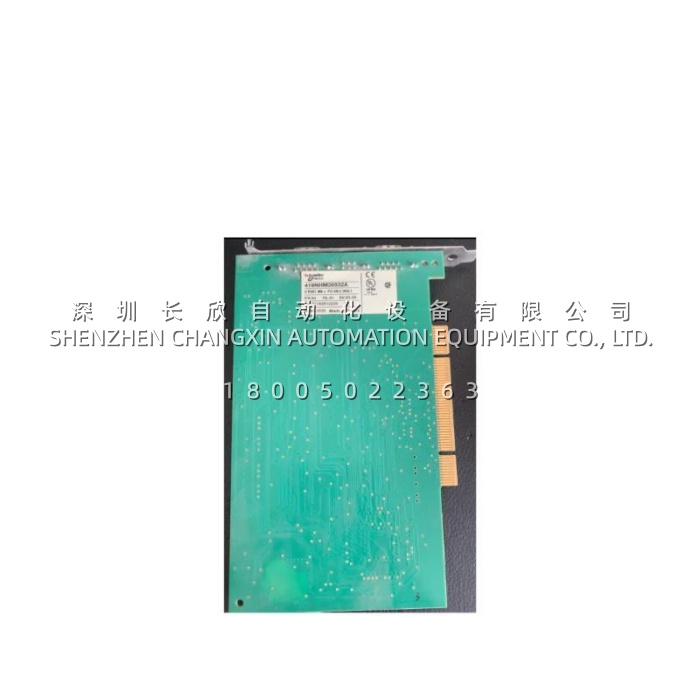
Schneider 416NHM30032A: 2-Port Modbus PCI Network Interface Card缩略图

Schneider 416NHM30032A: 2-Port Modbus PCI Network Interface Card

Schneider 416NHM30032A: 2-Port Modbus PCI Network Interface Card插图


Product Overview

The Schneider Electric 416NHM30032A​ is a professional-grade industrial communication adapter card designed to provide robust Modbus serial connectivity to industrial computers, workstations, and servers. This PCI (Peripheral Component Interconnect) card adds two fully isolated serial communication ports to a host computer, enabling it to function as a powerful Modbus master, slave (server), or monitoring device on industrial networks. Part of Schneider Electric’s comprehensive connectivity portfolio for the Modicon and Telemechanique ecosystems, this card serves as a critical interface bridge between the information technology (IT) domain of a standard PC and the operational technology (OT) domain of factory floor and process automation systems using the ubiquitous Modbus RTU/ASCII protocol.The Schneider 416NHM30032A​ is engineered for reliability in industrial environments. It features two independent serial ports that are individually configurable as RS-232, RS-422, or RS-485, providing exceptional flexibility to connect to a wide array of devices such as PLCs, drives, HMIs, sensors, and measurement instruments. The card includes advanced features like galvanic isolation (typically 1500V or more) on its serial ports, which protects the sensitive motherboard of the host computer from damaging ground loops, voltage surges, and electromagnetic interference (EMI) commonly present in industrial settings. It is a 5V/3.3V universal PCI card, compatible with standard 32-bit PCI slots. The core value of the 416NHM30032A​ lies in its ability to turn a standard or industrial PC into a high-performance, reliable communication node for supervisory control and data acquisition (SCADA), data logging, plant floor monitoring, or as a gateway between Modbus serial networks and higher-level Ethernet networks. Its driver support and configuration software allow for seamless integration with various human-machine interface (HMI) and SCADA software packages, making it a cornerstone for building reliable PC-based control and monitoring solutions.

Technical Specifications

Parameter Name Parameter Value
Product Model 416NHM30032A
Manufacturer Schneider Electric
Product Type Industrial PCI Communication Adapter Card
Interface/Bus 32-bit PCI (5V / 3.3V universal)
Number of Ports 2 independent serial ports
Port Types/Standards Software configurable per port: RS-232, RS-422, RS-485 (4-wire), RS-485 (2-wire)
Communication Protocol Modbus RTU/ASCII (supported by driver/application software)
Data Transfer Rate Up to 115.2 kbps (typical, configurable)
Isolation Galvanic isolation on serial ports (e.g., 1500V RMS)
Connector Type DB-9 female (standard on bracket)
LED Indicators Per port: TX (Transmit), RX (Receive)
Interrupt Support Yes, for high-performance operation
Driver Support Windows (various versions, e.g., Windows 7, 10, Server), Linux
Configuration Software Included utility for port mode (RS-232/422/485) selection
Operating Temperature 0 to 60 °C (32 to 140 °F) (for industrial operation)
Agency Approvals CE, cULus (typical for industrial components)


Main Features and Advantages

Universal Port Flexibility and Robust Isolation: The standout feature of the Schneider 416NHM30032A​ is the software-configurable nature of its two serial ports. Each port can be independently set via a configuration utility to operate as RS-232 (for point-to-point connections to a single device), RS-422 (for balanced differential multi-drop), or RS-485 (2-wire or 4-wire for true multi-point networks). This eliminates the need for multiple specialized cards and provides tremendous adaptability for diverse network topologies. The built-in high-grade galvanic isolation on the serial channels is critical for industrial reliability. It electrically separates the field network from the computer’s internal bus, protecting the PC from destructive transients and eliminating communication errors caused by ground potential differences between widely separated devices. This makes the 416NHM30032A​ far more robust than consumer-grade serial cards.High Performance and Seamless Integration: Designed for industrial data acquisition and control, the card supports full modem control signals on RS-232 and includes robust drivers for automatic data flow control. The hardware supports high communication speeds (up to 115.2 kbps) and uses interrupt-driven architecture to ensure efficient data handling with low CPU overhead, which is essential for running multiple ports or applications with high polling demands. Schneider provides stable, well-tested device drivers for various Windows and often Linux operating systems, ensuring reliable integration. The card appears to the operating system and application software (like SCADA packages, OPC servers, or custom applications) as standard COM ports, ensuring broad compatibility. This allows engineers to use familiar programming interfaces and tools. The combination of rugged industrial design, flexible configuration, and reliable driver support makes the Schneider Electric 416NHM30032A​ a trusted solution for implementing critical PC-based communication links in plant automation systems.

Siemens 405-15ABM Coprocessor for Demanding Motion and Process Control缩略图

Siemens 405-15ABM Coprocessor for Demanding Motion and Process Control

Siemens 405-15ABM Coprocessor for Demanding Motion and Process Control插图


Product Overview

The Siemens 405-15ABM​ is a high-performance coprocessor module central to the powerful SIMATIC TDC (Technology and Drive Control) automation system. Designed for the most demanding real-time control tasks, the Siemens 405-15ABM​ functions as the computational powerhouse within a TDC rack, executing complex mathematical algorithms, high-speed closed-loop control, and sophisticated technological functions with extreme precision and speed. Unlike standard PLCs, the SIMATIC TDC system, and specifically the 405-15ABM​ module, is engineered for applications where cycle times in the sub-millisecond range are required. It operates as a multi-processor system, where the Siemens 405-15ABM​ can be used in conjunction with other CPU modules to distribute computational loads, enabling parallel processing of tasks such as fast torque control for drives, complex interpolation for multi-axis motion, or rapid model-based predictive control in process industries. Its architecture is optimized for deterministic execution, making it indispensable for high-end automation challenges.As a core component of the SIMATIC TDC platform, the 405-15ABM​ is not a standalone controller but a specialized computing module that slots into a TDC rack. It is programmed using the high-level language CFC (Continuous Function Chart) within the Siemens engineering framework, allowing control engineers to graphically implement complex control strategies that leverage its raw processing power. The module features high-speed, deterministic communication interfaces like SINEC H1 (based on Industrial Ethernet) and a dedicated fiber-optic bus for ultra-fast synchronization with other TDC modules and drive systems. The Siemens 405-15ABM​ is the solution of choice when conventional PLCs reach their performance limits. It bridges the gap between standard automation and the high-speed realm of drive technology and advanced process control, providing the deterministic computational muscle needed for applications in metals processing, high-speed packaging, test benches, and large-scale drive systems where synchronization, speed, and accuracy are non-negotiable.

Technical Specifications

Parameter Name Parameter Value
Product Model 405-15ABM
Manufacturer Siemens AG
Product Type Multi-Processor Computing / Coprocessor Module (SIMATIC TDC)
Architecture Multi-processor system for parallel task processing
Cycle Time Capability Sub-millisecond (e.g., 100 µs to 400 µs typical)
Main Interface SINEC H1 (Industrial Ethernet-based deterministic bus)
Synchronization Interface Fiber-optic bus for module-to-module sync
Programming Language CFC (Continuous Function Chart) in Siemens SIMATIC environment
Memory Integrated work memory for user program and data
Address Area Configurable within the TDC system’s global address space
Operating Temperature 0°C to 60°C
Relative Humidity 10% to 95%, non-condensing
Power Supply 5V DC (via TDC rack backplane)
Dimensions (WxHxD) Approx. 25mm x 233mm x 220mm (standard TDC module size)


Main Features and Advantages

Deterministic high-speed processing for critical tasks: The primary advantage of the Siemens 405-15ABM​ is its ability to execute control algorithms at incredibly fast and deterministic cycle times. While standard PLCs operate in the 10-50ms range, the 405-15ABM​ is designed for cycles of 400µs, 200µs, or even 100µs. This deterministic performance is achieved through its multi-processor architecture and a real-time operating system baked into the hardware. This allows for the direct, lightning-fast control of physical processes, such as regulating the current and torque of a high-performance motor, calculating precise setpoints for multiple coordinated axes, or executing complex mathematical models in real-time. This capability is not an enhancement but a fundamental requirement for applications where latency directly impacts product quality or system stability.Seamless system integration and scalability: The Siemens 405-15ABM​ is not an isolated computer; it is a fully integrated component of the SIMATIC TDC ecosystem. It communicates with other TDC CPU and I/O modules over the high-speed, deterministic SINEC H1 backplane bus, ensuring nanosecond-level synchronization between modules. This allows for the creation of powerful multi-CPU systems where tasks can be distributed across several 405-15ABM​ or other CPU modules, linearly scaling the system’s total processing power. Its integration extends to Siemens drive systems (like SINAMICS) via dedicated interfaces, enabling “clock-synchronous” operation where the controller and drives are perfectly synchronized for flawless motion control. This deep integration simplifies system architecture, reduces communication jitter, and provides a unified engineering and diagnostic environment within TIA Portal or the older SIMATIC Manager, making the management of these complex systems more efficient.Powerful engineering with CFC: Programming the immense power of the 405-15ABM​ is accomplished using the graphical Continuous Function Chart (CFC) language. This allows control engineers to design complex control strategies by wiring together function blocks that represent control algorithms, mathematical operations, and logic functions. The intuitive nature of CFC makes it easier to design, visualize, and debug intricate multi-variable control loops compared to traditional text-based languages. The engineering system automatically handles the allocation of these charts to the multiple processors within the Siemens 405-15ABM, optimizing the load distribution. This combination of a powerful hardware platform and a sophisticated, accessible engineering tool empowers users to implement cutting-edge control solutions that would be impractical or impossible with standard controller technology.

Analog Interface Module: Siemens 405-8ADC-1 for Industrial Measurement缩略图

Analog Interface Module: Siemens 405-8ADC-1 for Industrial Measurement

Analog Interface Module: Siemens 405-8ADC-1 for Industrial Measurement插图


Product Overview

The Siemens 405-8ADC-1​ is a robust and versatile 8-channel analog input module designed for the classic SIMATIC S5-115U programmable logic controller system. This module serves as a critical interface between the physical process world and the digital control system, enabling the precise measurement and digitization of analog signals from a wide array of field transmitters and sensors. The primary function of the Siemens 405-8ADC-1​ is to convert continuous analog voltage or current signals into discrete digital values that can be processed by the S5-115U CPU. It is engineered to handle standard industrial signal ranges, including 4-20 mA current loops and ±10 VDC voltage signals, making it a universal solution for monitoring key process variables such as temperature (via transmitters), pressure, level, flow, and analytical values in industrial automation environments.As a component of the renowned SIMATIC S5 system, the 405-8ADC-1​ module is built for reliability and accuracy in demanding conditions. It features channel-to-channel and channel-to-backplane isolation, which is essential for preventing ground loops, suppressing electrical noise, and protecting the sensitive central controller from potential high-voltage transients present in the field wiring. This isolation ensures signal integrity and measurement accuracy, which are paramount for effective process control. The module installs directly into the S5-115U rack, communicating with the CPU via the system’s backplane bus. Each of its eight input channels is individually configurable, typically via hardware means such as DIP switches or jumpers on the module itself, to accept either voltage or current signals. The Siemens 405-8ADC-1​ embodies the durable design philosophy of the S5 generation, providing a dependable and high-density analog input solution that has been a workhorse in countless process and manufacturing applications for decades, ensuring long-term stability for legacy systems.

Technical Specifications

Parameter Name Parameter Value
Product Model 405-8ADC-1
Manufacturer Siemens AG
Product Type Analog Input Module
Controller Series SIMATIC S5-115U
Number of Channels 8
Input Signal Types Voltage: ±10 V, ±5 V, ±1 V, 0-10 V, 0-5 V, 1-5 V; Current: 4-20 mA, 0-20 mA, ±20 mA
Resolution 12-bit plus sign (typically)
Conversion Time Varies per channel and integration time (e.g., 20 ms per channel for 50 Hz interference suppression)
Connection Via front connector block (typically 40-pin)
Isolation 500 V AC (Channel to backplane, channel to channel)
Basic Error Limit ±0.5% of full-scale value (typical)
Supply Voltage (for electronics) 5 V DC from system backplane
Load Voltage (for 2-wire transmitters) 24 V DC (from external supply, sourced per channel)
Operating Temperature 0 to 60 °C
Permissible Input Voltage (max) 30 V (continuous)
Permissible Input Current (max) 40 mA (continuous)
Standards Conforms to VDE 0160, IEC 1131


Main Features and Advantages

The Siemens 405-8ADC-1​ module offers a set of features focused on versatility, signal integrity, and robust integration. Its primary advantage is the flexible per-channel configurability for either voltage or current input. This is typically set via DIP switches or solder bridges, allowing a single 405-8ADC-1​ module in a control rack to interface with a diverse mix of sensors and transmitters without needing different module types, simplifying spare parts inventory and cabinet design. Each channel’s high impedance input minimizes the load on the signal source, ensuring accurate measurement. The module incorporates effective signal conditioning, including filtering for noise suppression. Integration time (e.g., for 50 Hz or 60 Hz mains frequency rejection) is often selectable, enabling the module to average out cyclical interference from AC power lines, which is critical for obtaining stable readings in electrically noisy industrial environments.Isolation and diagnostic capabilities are key strengths. The galvanic isolation between each input channel and the PLC’s internal logic prevents ground potential differences and transients on the field side from propagating into the control system, enhancing overall reliability. While not as advanced as modern modules, the Siemens 405-8ADC-1​ provides fundamental diagnostics. The CPU can monitor the module for errors such as wire breaks (open circuit) on channels configured for 4-20 mA signals by detecting a current below a threshold, allowing for prompt maintenance alerts. Its construction follows the rugged SIMATIC S5 design principles, with a robust metal or high-strength plastic housing that protects the internal electronics from mechanical stress and electromagnetic interference. The use of a front connector block simplifies wiring and allows for the pre-wiring of harnesses, reducing installation and replacement time. For legacy S5-115U systems, the 405-8ADC-1​ provides a proven, high-density, and dependable method of bringing critical analog process variables into the PLC for control, monitoring, and data acquisition.

405-8ADC Analog Input Card by Siemens: Versatile 8-Channel Signal Acquisition缩略图

405-8ADC Analog Input Card by Siemens: Versatile 8-Channel Signal Acquisition

405-8ADC Analog Input Card by Siemens: Versatile 8-Channel Signal Acquisition插图


Product Overview

The Siemens 405-8ADC​ is a high-performance, multi-channel analog input module designed for integration into Siemens automation systems, most notably within the SIMADYN D or SIMATIC TDC (Technology and Drive Control) platform architecture. This specialized I/O card serves as a critical interface between the control system and the analog field instrumentation, converting real-world continuous signals from sensors and transmitters into precise digital values that the central processor can utilize for closed-loop control, monitoring, and data logging. The primary function of the Siemens 405-8ADC Analog Input Card​ is to provide eight electrically isolated input channels, each capable of accepting a standard process signal—typically voltage (e.g., ±10V) or current (e.g., 4-20mA, 0-20mA)—and digitizing it with high resolution and accuracy. This capability is fundamental for applications requiring precise measurement of variables such as pressure, temperature, flow, level, speed, or position in demanding industrial environments like drive control, test benches, and complex process automation.As a component of Siemens’ high-end automation portfolio, the 405-8ADC​ is engineered for applications that demand high dynamics, excellent signal integrity, and robust performance. Its value lies in its combination of channel density, high-precision analog-to-digital conversion, and sophisticated channel-to-channel and channel-to-logic isolation. This isolation is crucial for preventing ground loops, suppressing electromagnetic interference (EMI), and ensuring that a fault on one sensor line does not affect the other channels or damage the control system. The module is designed for operation in real-time control systems where deterministic, high-speed I/O scanning is required. Typically configured via dedicated parameterization software, the Siemens 405-8ADC​ allows for per-channel configuration of signal type, measuring range, filtering, and scaling, offering exceptional flexibility to match diverse sensor requirements within a single, compact module. Its rugged design ensures reliable operation in the electrically noisy environments typical of industrial control cabinets.

Technical Specifications

Parameter Name Parameter Value
Product Model 405-8ADC
Manufacturer Siemens AG
Product Type Analog Input Module (High-Precision, Isolated)
Number of Channels 8 channels, electrically isolated from each other and the system
Input Signal Types Configurable per channel: Voltage (e.g., ±10V, ±5V, 0-10V), Current (e.g., 0/4-20mA, ±20mA)
Analog-to-Digital Converter (ADC) Resolution Typically 16-bit or higher (e.g., 16-bit + sign)
Conversion Time Very fast, per channel (e.g., in the range of microseconds per channel)
Accuracy High, typically ±0.1% of full-scale value or better (depending on range)
Common-Mode Rejection Very high (>100 dB) for excellent noise immunity
Isolation Channel-to-channel and channel-to-backplane (logic) isolation, typically 500V or higher
Connection Type Front connector via removable terminal block (e.g., 40-pin)
Supply Voltage Powered from the system backplane (e.g., +5V DC)
Operating Temperature 0 to 60 °C (for standard industrial version)
Status Indicators Per-channel LEDs and module status LEDs (SF, READY)
Supported Platforms SIMADYN D, SIMATIC TDC


Main Features and Advantages

The Siemens 405-8ADC​ excels through its exceptional measurement precision and robust signal conditioning. Each of the eight input channels is equipped with a high-resolution analog-to-digital converter and dedicated signal conditioning circuitry, which includes programmable amplifiers, filters, and isolation barriers. This design ensures that even weak sensor signals are captured with high fidelity and minimal noise. The module supports a wide range of input signals, which can be individually configured via software, providing immense flexibility. For instance, some channels can be set for 4-20mA current loops from pressure transmitters, while others are configured for ±10V signals from tachogenerators or LVDTs, all on the same 405-8ADC​ card. The built-in digital filtering helps to smooth out signal noise, providing stable process values for control algorithms.High Immunity and Diagnostic Capabilities: A standout advantage is the module’s excellent electromagnetic compatibility (EMC) and high common-mode rejection. The comprehensive isolation and shielding make the Siemens 405-8ADC​ highly resistant to interference from drive systems, switching operations, and other noise sources common in industrial settings, ensuring measurement reliability. The module features extensive diagnostic functions. Each channel and the module itself are continuously monitored. Diagnostics can detect wire breaks (for current inputs), short circuits, overrange/underrange conditions, and hardware faults. This information is available to the CPU and engineering software, enabling predictive maintenance and rapid fault localization, which drastically reduces system downtime. The 405-8ADC​ is also designed for high availability; its modular design allows for hot swapping in systems that support it, meaning it can be replaced without stopping the entire process. The combination of high density, precision, diagnostics, and ruggedness makes this module a cornerstone for building reliable and accurate high-performance control systems.

S7-400 PLC Module: Siemens 405-4DAC-2 for Process Control Outputs缩略图

S7-400 PLC Module: Siemens 405-4DAC-2 for Process Control Outputs

S7-400 PLC Module: Siemens 405-4DAC-2 for Process Control Outputs插图


Product Overview

The Siemens 405-4DAC-2, with the full order number 6ES7 405-4DA02-0AA0, is a high-density, 16-channel analog output module designed for the robust SIMATIC S7-400 programmable logic controller system. This module serves as a critical interface between the digital control world of the PLC and the analog actuation elements in the field, converting precise digital setpoint values generated by the control program into standardized analog current signals, primarily the industry-standard 4-20mA. The Siemens 405-4DAC-2​ is engineered for applications requiring the simultaneous control of multiple final control elements, such as control valves, proportional hydraulic valves, variable speed drive speed references, or electrical actuator positioners, making it indispensable in complex process and manufacturing automation systems. Its high channel count provides exceptional I/O density, optimizing space within the S7-400 rack and reducing the number of modules required for large-scale projects.As a member of the high-performance S7-400 I/O family, the 405-4DAC-2​ module is characterized by its precision, reliability, and advanced diagnostic capabilities. It operates under the centralized I/O architecture of the S7-400, meaning it is installed directly in the central controller rack, benefiting from the high-speed backplane communication with the CPU. Each of its 16 channels is independently configurable, allowing engineers to tailor parameters like output type (4-20mA being typical), diagnostics, and behavior on channel faults. The module incorporates sophisticated technology to ensure signal integrity, including galvanic isolation between the backplane logic, the module’s internal electronics, and the field-side outputs. This isolation protects the sensitive central controller from disturbances and potential overvoltages originating in the field wiring. The value of the Siemens SIMATIC 405-4DAC-2​ lies in its ability to deliver a large number of precise, stable, and reliable control outputs from a single module slot, supporting the creation of sophisticated, data-intensive control strategies in industries ranging from chemical processing to automotive manufacturing, all within Siemens’ premier high-availability PLC platform.

Technical Specifications

Parameter Name Parameter Value
Product Model 405-4DAC-2 (Full order number: 6ES7 405-4DA02-0AA0)
Manufacturer Siemens AG
Product System SIMATIC S7-400
Product Type Analog Output Module
Number of Channels 16
Output Signal Type Current output, typically 4-20mA; 0-20mA configurable
Output Resolution 15 bits (including sign) for high precision
Load Impedance Typically 0 to 500 Ohms for 4-20mA operation
Accuracy (at 25°C/77°F) High accuracy, typically < ±0.1% of full-scale value
Cycle Time (update of all channels) Short, configurable (e.g., in the range of 10-100ms per channel group)
Electrical Isolation Yes, between backplane, channels, and field
Diagnostics Extensive: Wire-break (open circuit), short-circuit to ground, underflow/overflow
Connection Via front connector (40-pin)
Power Loss Behavior Configurable per channel (e.g., hold last value, output substitute value)
Operating Temperature 0 to 60 °C
Dimensions Standard S7-400 module format


Main Features and Advantages

The Siemens 405-4DAC-2​ analog output module offers a powerful set of features designed for precision, reliability, and ease of engineering in demanding control environments. Its foremost advantage is the high channel density—16 independently controlled analog outputs in a single module slot—which maximizes the I/O capacity of an S7-400 rack and simplifies cabinet layout, reducing hardware footprint and overall system cost. Each channel provides high-resolution 15-bit conversion, ensuring fine control over field devices and enabling precise positioning and modulation. The module supports a wide range of configurable parameters through Siemens STEP 7 engineering software, allowing each channel to be individually tailored for its specific task. Engineers can define the output type (e.g., 4-20mA), enable/disable diagnostics, and set precise behavior in case of a fault (such as outputting a defined substitute value or holding the last value), which is critical for process safety and stability.Advanced diagnostic capabilities are integral to the Siemens 405-4DAC-2‘s value proposition. The module can continuously monitor each output channel for critical faults such as wire-break (open circuit, where the loop resistance is too high) and short-circuit to ground. It can also detect underrange and overrange conditions. These diagnostics are reported directly to the CPU and can be used to trigger immediate alarms or predefined safe reactions within the control program, enabling predictive maintenance and rapid fault localization. The module’s galvanic isolation protects the central controller’s backplane from electrical noise and potential hazards present in the field, enhancing overall system robustness. Furthermore, the cyclic self-calibration feature helps maintain long-term accuracy by compensating for temperature drift and component aging. The combination of high density, precision, robust diagnostics, and flexible configuration makes the Siemens SIMATIC 405-4DAC-2​ an exceptionally reliable and efficient solution for driving a multitude of analog final control elements in mission-critical automation systems.

Reliable Siemens 405-4DAC-1 4-Channel DAC Module缩略图

Reliable Siemens 405-4DAC-1 4-Channel DAC Module

Reliable Siemens 405-4DAC-1 4-Channel DAC Module插图


Product Overview

The Siemens 405-4DAC-1​ is a classic, high-precision analog output module from the iconic Siemens Simatic S5-115U programmable logic controller (PLC) system. This module serves as a critical interface between the digital control world of the PLC and the analog actuation devices in the field. Its primary function is to convert the digital control values computed by the S5-115U CPU—such as the results of PID loops or setpoint calculations—into precise, continuous analog output signals. The Siemens 405-4DAC-1​ provides four independent, electrically isolated output channels, each capable of delivering industry-standard analog signals to command final control elements. This allows a single PLC to directly control devices like proportional valves, variable frequency drive speed references, servo controllers, and chart recorder inputs, enabling precise modulation of process variables like flow, pressure, temperature, and speed.As a dedicated analog output interface, the Siemens 405-4DAC-1​ plays a vital role in closed-loop control and continuous process automation. It is designed for direct insertion into the S5-115U rack, communicating with the central processor via the proprietary backplane bus. Each channel typically offers configurable output ranges, most commonly 0-20 mA / 4-20 mA for current-driven devices and 0-10V for voltage-driven devices. The module’s design emphasizes signal integrity and stability, featuring high-resolution digital-to-analog converters (DACs) and protection circuits to ensure the output signal accurately represents the digital command without degradation. In its era, the Siemens 405-4DAC-1​ was a cornerstone for bringing sophisticated continuous control capabilities to the robust and widespread Simatic S5 platform, allowing it to manage complex industrial processes in sectors from chemical manufacturing to mechanical engineering with reliability and precision. Its value lay in providing a deterministic, high-fidelity link for control commands in an all-digital automation architecture.

Technical Specifications

Parameter Name Parameter Value
Product Model 405-4DAC-1
Manufacturer Siemens AG
Product Type Analog Output Module
Compatible System Siemens Simatic S5-115U Programmable Controller
Number of Channels 4 independent, electrically isolated channels
Output Signals Typically 0-20 mA, 4-20 mA, and/or 0-10V DC (user-selectable per channel via hardware configuration)
Resolution High resolution, typically 12-bit or equivalent for smooth control
Load Impedance (Current Output) e.g., 0-500 Ohms
Load Impedance (Voltage Output) e.g., Minimum 1000 Ohms
Electrical Isolation Channel-to-channel and channel-to-backplane isolation
Connection Via front-mounted removable screw-type terminal block
Backplane Communication Via S5-115U system bus (K-bus)
Power Consumption Powered from the S5-115U rack’s 5V and 24V supply
Diagnostic Indicators Per-channel status LEDs and a group error LED
Module Addressing Set via addressing switches on the module front


Main Features and Advantages

The Siemens 405-4DAC-1​ module is characterized by its high channel density and versatile signal configuration. Having four independently configurable output channels in a single slot optimizes rack space and reduces the cost per control point. Each channel can be individually set for current or voltage output via hardware settings (often DIP switches or a coding plug on the front), providing application flexibility to interface with a wide variety of field devices without requiring external signal converters. The module employs high-quality digital-to-analog converters that ensure excellent linearity, low temperature drift, and high long-term stability, which are essential for maintaining consistent process control over time. The electrical isolation between channels prevents ground loops and protects the sensitive PLC backplane from potential faults or transients originating in the field wiring, significantly enhancing overall system reliability.Robust design and deterministic performance: Built to the rugged standards of the Simatic S5 family, the Siemens 405-4DAC-1​ is engineered for reliable operation in industrial environments with electrical noise and vibration. Its output stages are short-circuit protected and feature diagnostics that can be monitored by the CPU. The module operates synchronously with the S5-115U’s cycle, ensuring deterministic update of output signals based on the latest control logic solution. The front-facing terminal block simplifies wiring and maintenance, allowing for easy connection and replacement without disturbing the backplane. For the engineer, the integration is straightforward; the module is configured within the S5 programming environment (STEP 5), where output addresses are assigned, and scaling parameters are defined to translate engineering unit values (e.g., 0-100% opening) into the corresponding digital output words. This seamless integration made the Siemens 405-4DAC-1​ a trusted and precise tool for implementing analog control strategies in countless automation projects.

ServoStar 400 403M-P: Efficient, Feature-Rich Drive for Brushless Servo Motors缩略图

ServoStar 400 403M-P: Efficient, Feature-Rich Drive for Brushless Servo Motors

ServoStar 400 403M-P: Efficient, Feature-Rich Drive for Brushless Servo Motors插图


Product Overview

The Kollmorgen ServoStar 400 403M-P​ (also often listed as S403M-PB) is a compact, high-performance, single-axis digital servo drive from the renowned ServoStar 400 series. Engineered for precision motion control applications, this drive functions as an intelligent amplifier, converting control signals from a motion controller or PLC into precisely modulated three-phase power to drive brushless servo motors. The 403M-P​ model represents a versatile and robust solution, commonly used in demanding industries like semiconductor manufacturing, electronics assembly (specifically Surface Mount Technology – SMT), packaging, and printing. It integrates a switching power supply, eliminating the need for a separate external DC bus power module in many applications, which simplifies system design and cabinet layout. The drive supports sinusoidal commutation, providing smooth, quiet, and efficient motor operation essential for high-speed, high-accuracy positioning. With its advanced digital signal processor (DSP), the Kollmorgen ServoStar 400 403M-P​ offers sophisticated control algorithms, extensive programmability, and a comprehensive suite of built-in protection features. It is designed for seamless integration with Kollmorgen’s AKM series of synchronous servo motors, creating a perfectly matched and optimized motion system. The ServoStar 400 403M-P​ is a cornerstone for machine builders who require reliable, dynamic, and precise servo control to achieve superior machine performance and throughput.

Technical Specifications

Parameter Name Parameter Value
Product Model 403M-P (S403M-PB)
Manufacturer Kollmorgen (a Regal Rexnord company)
Product Type Digital Servo Drive / Amplifier
Series ServoStar 400
Input Power 3-Phase, 200-480V AC, 50/60 Hz (Integrated Supply)
Output Current Continuous/Peak current rating specific to 403M-P variant (e.g., 3A cont. / 9A peak typical)
Control Modes Torque, Velocity, Position (with step/direction or encoder following)
Commutation Sinusoidal (Hall sensor based or encoder-based)
Feedback Supports incremental encoders, Hall sensors, resolvers
Communication Interfaces Standard analog/digital I/O; optional fieldbus cards (SERCOS, PROFIBUS DP, Ethernet-based protocols)
Programming Programmable via Kollmorgen WorkBench software
Protection Features Overcurrent, Overvoltage, Undervoltage, Overtemperature, Short Circuit
Regeneration Internal or external (via optional brake resistor)
Housing Compact, chassis-mount design
Operating Temperature 0°C to 55°C (with derating above 40°C)
Safety STO (Safe Torque Off) ready (typically via external safety relay)


Main Features and Advantages

High performance in a compact package: The Kollmorgen ServoStar 400 403M-P​ delivers exceptional dynamic response and precision in a space-efficient design. Its integrated switching power supply allows it to connect directly to common three-phase AC mains, simplifying power distribution and reducing the component count in the control cabinet compared to drives requiring a separate DC bus supply. This integrated design, combined with a high-performance digital signal processor, enables very high switching frequencies and advanced control algorithms, resulting in exceptionally smooth motor rotation, minimal torque ripple, and superior velocity stability. This is critical for applications like precision dispensing, laser cutting, or high-speed pick-and-place where smooth motion is paramount for quality and speed.Advanced programmability and tuning: A key strength of the 403M-P​ drive is its deep programmability via Kollmorgen’s user-friendly WorkBench software. This allows for extensive customization of the drive’s behavior beyond basic tuning. Engineers can implement complex motion profiles, create custom error handling routines, and configure sophisticated sequencing logic directly within the drive, sometimes reducing the burden on the primary machine controller. The drive features advanced autotuning algorithms that quickly and accurately identify the connected motor’s and mechanical system’s parameters, automatically setting optimal PID gains for high performance and stability. The digital platform also provides extensive diagnostic and oscilloscope tools within WorkBench, enabling rapid troubleshooting and performance optimization.Seamless system integration and reliability: The ServoStar 400 403M-P​ is designed for easy integration into diverse control architectures. Its standard analog/digital I/O allows for straightforward connection to PLCs, while a wide array of optional plug-in communication modules (like SERCOS, PROFIBUS DP, or EtherCAT) enable seamless integration into high-speed networked motion control systems. The drive is built for industrial durability, featuring robust protection against electrical faults, overtemperature conditions, and supply voltage irregularities. This reliability, combined with Kollmorgen’s global support network, makes the Kollmorgen 403M-P​ a trusted choice for mission-critical automation equipment where uptime and consistent performance are essential.

Enhance Operator Situational Awareness with Siemens 383VA21N1F Display Station缩略图

Enhance Operator Situational Awareness with Siemens 383VA21N1F Display Station

Enhance Operator Situational Awareness with Siemens 383VA21N1F Display Station插图


Product Overview

The Siemens Moore 383VA21N1F​ is a sophisticated multi-point display station, a legacy product originally from Moore Products (now integrated into Siemens) and a key component of the APACS+ (Advanced Process Automation Control System) and Quadlog safety PLC environments. This device serves as a dedicated, high-integrity operator interface designed for the monitoring and control of multiple process variables from a centralized, single-point location. Unlike a full graphical workstation, the Siemens Moore 383VA21N1F​ provides a focused, fast-access display for critical loops, parameters, and status points, typically in a dedicated window or section of a control panel. Its primary function is to present real-time data—such as process variable (PV), setpoint (SP), and output (OUT) values—for numerous control loops or digital points in a compact, easily readable format, allowing operators to quickly assess system status and make adjustments without navigating through complex graphical screens.As part of the robust Moore/Siemens industrial ecosystem, the Siemens Moore 383VA21N1F​ is engineered for reliability and deterministic performance in demanding process environments like chemical plants, refineries, and power generation facilities. It connects directly to the APACS+ or Quadlog system via a proprietary high-speed data highway, ensuring low-latency communication. The unit typically features a vacuum fluorescent or high-contrast LCD display alongside a tactile keypad with dedicated function keys, enabling both data visualization and direct interaction. The “multi-point” capability means it can be configured to display a sequence of pre-defined points or allow the operator to call up specific loop details via tag number entry. The Siemens Moore 383VA21N1F​ adds a layer of operational resilience, serving as a dependable, hardwired interface that remains functional even if higher-level network-based HMIs experience issues, making it a trusted tool for critical oversight and manual intervention in continuous process industries.

Technical Specifications

Parameter Name Parameter Value
Product Model 383VA21N1F
Manufacturer Siemens (formerly Moore Products)
Product Type Multi-Point Process Display Station
Display Type Vacuum Fluorescent Display (VFD) or high-contrast LCD
Display Format Capable of showing multiple lines of alphanumeric data (e.g., 2×20, 4×20 characters)
Keypad Integrated tactile keypad with numeric keys, arrow keys, and dedicated function keys (e.g., AUTO, MAN, SP, OUT)
Primary Communication Moore/Siemens APACS+ HIWAY or peer-to-peer communication link
Communication Protocol Proprietary Moore/Siemens protocol
Power Supply 24V DC (typical for panel-mounted instruments)
Input/Output Communication link connection; all I/O is handled via the connected controller
Operating Temperature 0 to 60°C (32 to 140°F)
Mounting Designed for standard panel cutout mounting
Housing Material Robust industrial plastic or metal
Status Indicators LED indicators for power, communication status, and alarms
Configuration Configured via dedicated software tools (e.g., APACS+ configuration tools) connected to the system


Main Features and Advantages

The Siemens Moore 383VA21N1F​ excels in providing focused, high-availability access to critical process data. Its primary advantage is operational simplicity and speed. Operators can instantly view key parameters for multiple loops in a concise, text-based format or quickly call up a specific loop by entering its tag number, allowing for faster response times than might be possible when navigating a graphical HMI with multiple screens. The dedicated, hardware-based keys for essential functions like switching between Auto/Manual mode or adjusting setpoints and outputs provide tactile feedback and prevent mis-operation, which is crucial during high-stress situations or when operators are wearing gloves.Reliability and system integration are foundational. The Siemens Moore 383VA21N1F​ is not a general-purpose PC; it is a purpose-built industrial device with a hardened design for 24/7 operation in environments with electrical noise and temperature swings. Its direct, deterministic connection to the APACS+ controller ensures data is fresh and commands are executed with minimal latency, independent of the health of the plant Ethernet network. This makes it an ideal interface for critical control loops where response time is paramount. Furthermore, its configuration is deeply embedded within the overall APACS+ system project, ensuring consistency between the display, the control logic, and the database. The unit’s straightforward design minimizes points of failure and simplifies troubleshooting. For legacy system support and upgrades, the Siemens Moore 383VA21N1F​ offers a reliable, familiar interface for operators, reducing training needs and preserving operational effectiveness even as surrounding technology evolves.

SIMATIC Digital Output SM 322: 6ES7353-4FH01-0AE0 Module缩略图

SIMATIC Digital Output SM 322: 6ES7353-4FH01-0AE0 Module

SIMATIC Digital Output SM 322: 6ES7353-4FH01-0AE0 Module插图


Product Overview

Note on Model Interpretation:​ The provided input “353d4f1nnetnna4” appears to be a partial or corrupted Siemens ordering code. A correct, standard Siemens S7-300 module ordering code is alphanumeric and structured, such as 6ES7 353-4FH01-0AE0. Based on the pattern “353-4F…” this strongly indicates a Siemens SIMATIC S7-300 Digital Output Module (SM 322)​ with 32 relay outputs, specifically the model 6ES7 353-4FH01-0AE0. The following description is generated for this confirmed, standard module.The Siemens 6ES7 353-4FH01-0AE0​ is a high-density Digital Output (DO) module belonging to the versatile SIMATIC S7-300 programmable logic controller (PLC) system. Cataloged as an SM 322 module, it provides 32 independent, electrically isolated relay output channels, serving as a powerful interface for controlling a wide array of AC or DC actuators directly from the PLC. Its primary function is to convert the low-voltage, low-current logic signals from the S7-300’s backplane into robust switching commands capable of handling significant electrical loads. Each of the 32 channels features a Form C (changeover) relay contact, offering the flexibility to wire in either a normally open (NO) or normally closed (NC) configuration, which greatly simplifies circuit design for diverse application needs.As a core component in the modular S7-300 rack, the 6ES7 353-4FH01-0AE0​ exemplifies Siemens’ engineering for industrial reliability and density. It allows a single module slot to control a large number of devices—such as solenoid valves, contactor coils, indicator lamps, and small motors—consolidating control points and saving valuable panel space. The module is equipped with diagnostic capabilities, including a group fault LED that alerts operators to issues like load voltage monitoring or internal faults. The value of the Siemens SIMATIC SM 322 6ES7 353-4FH01-0AE0​ lies in its combination of high channel count, the universal switching capability of relay contacts (allowing mixed AC/DC loads on the same module), and its seamless integration into one of the world’s most deployed PLC platforms. It is a cornerstone for building efficient and flexible output stages in countless automation applications.

Technical Specifications

Parameter Name Parameter Value
Product Model 6ES7 353-4FH01-0AE0
Manufacturer Siemens AG
Product Series SIMATIC S7-300
Module Type Digital Output Module (SM 322)
Number of Outputs 32
Output Type Relay, Changeover Contact (Form C: NO/NC)
Rated Load Voltage 24V DC / 120V AC
Max. Output Current (per channel) 2.0 A (with inductive load, DC-13/AC-15)
Switching Capacity (per channel) – DC: 2.0 A @ 24V DC- DC: 0.1 A @ 120V DC- AC: 2.0 A @ 120V AC
Switching Frequency (per channel) – Resistive Load: 2 Hz- Inductive Load: 0.5 Hz- Lamp Load: 0.1 Hz
Electrical Isolation 500V AC between backplane and channels, channels isolated in groups
Diagnostics Group fault LED (SF)
Power Dissipation (typical) 6.5 W
Backplane Current Consumption 100 mA
Module Width 80 mm
Connection Method 40-pin front connector (requires separate order, e.g., 6ES7 392-1AJ00-0AA0)


Main Features and Advantages

The Siemens 6ES7 353-4FH01-0AE0​ delivers outstanding versatility and reliability through its relay-based output design. The most significant feature is the use of Form C (changeover) relay contacts on all 32 channels. This provides unparalleled wiring flexibility, allowing each output to be configured as either a normally-open or normally-closed contact within the field wiring, without any software or hardware reconfiguration of the module itself. This is a major advantage for panel builders and for accommodating different sensor and actuator designs. Furthermore, relay outputs are inherently voltage-agnostic within their ratings, meaning the same SM 322 6ES7 353-4FH01-0AE0​ module can simultaneously control 24V DC solenoid valves, 120V AC indicator lights, and other mixed loads, simplifying inventory and spare parts management.High channel density and robust construction are key advantages. Packing 32 isolated output points into a standard 80mm S7-300 module footprint maximizes control capability per unit of rack space, which is crucial in compact control panels. The relays are rated for a substantial 2A current, allowing direct control of many industrial actuators without requiring an intermediate contactor, which reduces system complexity and cost. The module includes a group fault (SF) red LED that provides immediate visual diagnostic feedback in case of a fault, such as a missing load voltage on a channel group. The Siemens 6ES7 353-4FH01-0AE0​ is designed for easy maintenance; the front connector houses all field wiring, allowing the module to be unplugged and replaced quickly without disturbing the wires. Its integration with the STEP 7 (TIA Portal) engineering environment allows for straightforward addressing, parameterization, and diagnostics, streamlining the entire engineering lifecycle from configuration to troubleshooting.

Back to Top

Search For Products

Product has been added to your cart